

Dollar Surges to Monthly High as Fed Rate Hike Bets Rise and Iran Tensions Persist
TLDR
- The dollar rose more than 1% this week, its biggest weekly gain since early March
- Markets now price a 65%+ chance of a Fed rate hike by December, up from under 20% a week ago
- Iran-U.S. tensions keep oil prices elevated, fueling inflation fears
- Sterling hit a five-week low as UK PM Keir Starmer faces a leadership challenge
- The Trump-Xi summit ended with little market reaction, though Iran’s Strait of Hormuz closure remained a key topic
The U.S. dollar posted its strongest weekly performance in over two months on Friday, rising more than 1% against a basket of currencies to hit a one-month high of 99.203 on the DXY index.
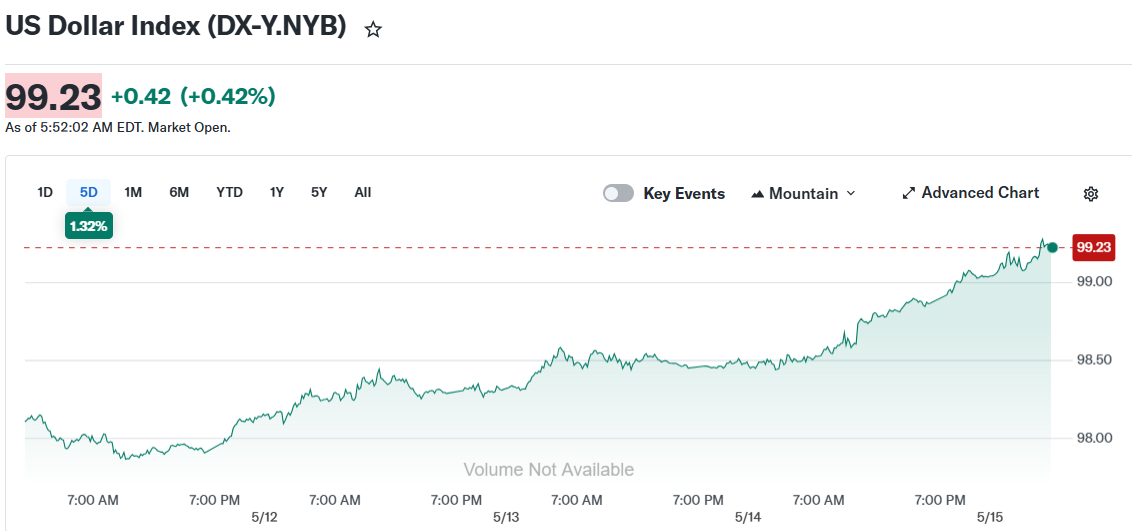 US Dollar Index (DX-Y.NYB)
The rally was driven by rising U.S. Treasury yields, which hit one-year peaks, and growing expectations that the Federal Reserve may need to raise interest rates before the end of the year.
Investors now price in a more than 65% chance of a Fed rate hike by December. Just one week ago, that figure was below 20%, according to the CME FedWatch tool. Markets are also fully pricing in a rate rise by March 2027.
The shift came after a string of stronger-than-expected U.S. economic data. Import prices and wholesale prices both came in above forecasts earlier in the week. Retail sales rose in April, and weekly jobless claims pointed to a stable labor market.
Ongoing tensions between the U.S. and Iran are adding to inflationary pressure. The Strait of Hormuz remains closed, keeping oil prices elevated. Higher energy costs are feeding through to broader price data, reinforcing the case for the Fed to act.
Sterling Hit by Political Uncertainty
The British pound fell to a five-week low against the dollar, touching $1.3332 at one point before recovering slightly to $1.3347. It is on course for its biggest weekly drop since November 2024.
Prime Minister Keir Starmer is facing a growing leadership challenge following poor local election results. Greater Manchester Mayor Andy Burnham indicated he would seek a parliamentary seat to mount a challenge. Economist Mohit Kumar at Jefferies noted that markets fear a more left-leaning leader could widen the UK’s fiscal deficit.
The euro also fell against the dollar, dropping to a one-month low of $1.1632 and set to lose 1.3% for the week.
Trump-Xi Summit Ends With Little Market Impact
Trump said his patience with Iran was running out and that both he and Xi want the Strait of Hormuz reopened and oppose Iran having nuclear weapons.
The onshore yuan slipped from a three-year high against the dollar to 6.8038, pressured by broad dollar strength.
Elsewhere in Asia, the yen weakened to 158.47 per dollar despite strong domestic wholesale inflation data. The Singapore dollar, Korean won, and Philippine peso also edged lower.
The dollar rose 0.3% against the Malaysian ringgit to 3.945, with analysts at Kenanga expecting it to consolidate between 3.93 and 3.96 next week.
The post Dollar Surges to Monthly High as Fed Rate Hike Bets Rise and Iran Tensions Persist appeared first on CoinCentral.


You May Also Like

XRP Whales Hold Steady as 68.5% of Supply Concentrated in Large Wallets

Trump Stock Moves Draw Attention After Iran War Market Dip




