Polygon Cuts Block Time to 1.75 Seconds as Stablecoin Payments Push Grows
TLDR
- Polygon reduced average block time from 2 seconds to 1.75 seconds.
- The upgrade raises theoretical throughput to about 3,260 TPS.
- PIP-86 plans a later block-time cut to 1.5 seconds.
- Polygon added a private stablecoin payment feature using ZK proofs.
- Visa expanded its stablecoin pilot to include Polygon.
Polygon has reduced its average block time to 1.75 seconds, marking the network’s first block-time reduction since launch as it works to support faster payments, stablecoin transfers and settlement activity.
The upgrade reduced block time by 250 milliseconds and is now visible on Polygonscan, where recent blocks show production times of 1.75 seconds. Polygon software engineer Lucca Martins said the change gives the network about 14% more payment capacity per second.
The update raises Polygon’s maximum theoretical throughput to about 3,260 transactions per second. Shorter block times can help clear transaction backlogs more quickly and reduce the duration of fee spikes during periods of congestion.
The change arrives as Polygon increases its focus on high-frequency use cases, including stablecoin payments, decentralized finance trading and institutional settlement. Faster block production may support applications that require quick confirmation and lower delay between transactions.
Polygon Targets Faster Stablecoin Payments
Polygon’s block-time reduction is part of Polygon Improvement Proposal PIP-86. The proposal includes a two-step plan that would reduce block time further to 1.5 seconds.
PIP-86 also includes changes to checkpoint rewards. Those adjustments are intended to keep Polygon’s POL token emissions near the network’s 1% target after the block-time reduction.
The network has been positioning itself as infrastructure for payments and stablecoins. Faster transaction processing can be important for wallets, merchants, payment processors and financial applications that need to settle large volumes of smaller transfers.
The upgrade may also support private stablecoin transfers. Polygon recently introduced a wallet feature that lets users route stablecoin payments through a shielded pool verified by zero-knowledge proofs.
That feature is designed to hide sender, receiver and transfer amount data on-chain while preserving compliance tools such as Know Your Transaction screening and auditable records. Polygon community lead Smokey said the system is aimed at giving businesses more privacy when using stablecoins.
Visa Adds Polygon to Stablecoin Pilot
Polygon’s stablecoin push also comes after Visa expanded its stablecoin settlement pilot to include Polygon. The program, launched by Visa in 2023, allows selected partners to test settlement using stablecoins instead of traditional bank rails.
Visa’s April 29 expansion also added Base, the Canton Network, Arc and Tempo. The pilot is designed to test whether stablecoins can provide faster settlement for payment companies and financial institutions.
Polygon has also been used by companies testing USDC-based payments, including digital creator payouts. These integrations show how stablecoins are becoming a core area of competition for blockchain networks seeking payment and settlement use cases.
The network’s technical roadmap also includes the Gigagas plan, which targets far higher throughput over time. Earlier upgrades, including Bhilai, Rio and Madhugiri, have been part of Polygon’s effort to improve performance and prepare for larger transaction volumes.
The latest block-time cut does not guarantee higher demand by itself. Network usage will still depend on wallet adoption, stablecoin flows, developer activity, institutional participation and competition from other blockchains.
POL Token Remains Under Pressure
Polygon’s POL token did not show a strong immediate price reaction after the upgrade. The token traded near $0.09 to $0.102 in recent market data and remains down about 54% over the past year.
Technical data cited by traders shows POL attempting to recover from April lows near $0.084 to $0.085. The token has been trying to hold the $0.10 region, which traders view as a short-term psychological level.
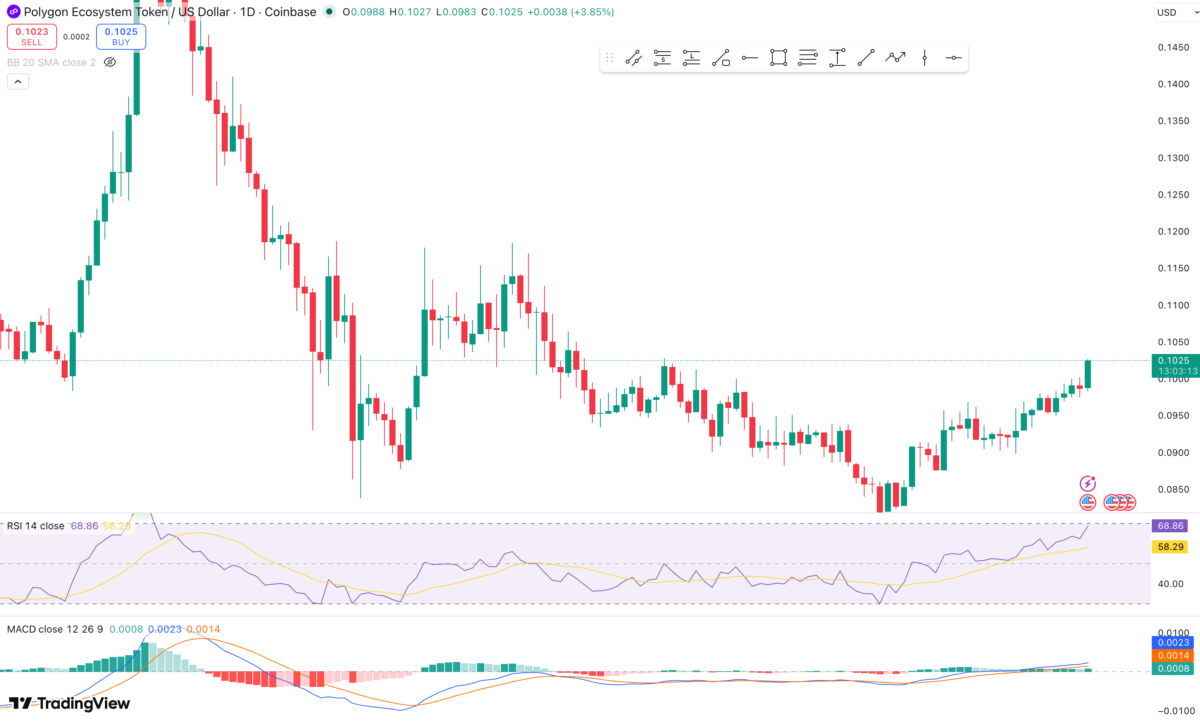 POL/USD 1-day price chart (Source: TradingView)
Immediate resistance is being watched near $0.102 to $0.105. A confirmed break above that area could bring the $0.110 to $0.115 range into focus. Short-term support is seen around $0.097 to $0.098, with lower support near $0.090 and $0.084.
Momentum indicators have shown improving short-term conditions. The relative strength index has moved near 68, close to overbought territory, while the MACD has turned positive. Those indicators suggest stronger buying activity, though a short pullback remains possible if buyers fail to hold current levels.
The post Polygon Cuts Block Time to 1.75 Seconds as Stablecoin Payments Push Grows appeared first on CoinCentral.


You May Also Like

Ruby red state Republicans fear new White House map would accidentally help Dems

Top 6 Crypto PR Agencies With a Track Record in Tier-1 Business Media in 2026