US and UK Create Joint Crypto Task Force to Shape Future Regulations

The two countries will create the “Transatlantic Taskforce for Markets of the Future” to develop shared policies for digital assets.
UK Chancellor Rachel Reeves and US Treasury Secretary Scott Bessent agreed to form this group during President Donald Trump’s recent state visit to Britain. The task force has 180 days to create recommendations for both governments.
This marks the first time these two financial powerhouses have joined forces specifically to tackle crypto regulation. The move comes as both countries race to create clear rules for the fast-growing digital asset industry.
What the Task Force Will Do
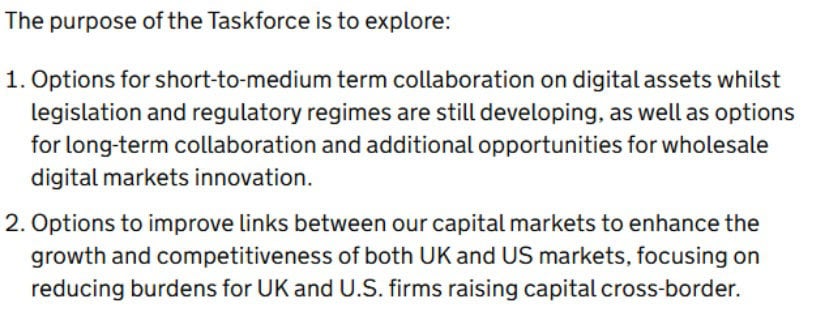
The new task force has two main jobs. First, it will find ways for the US and UK to work together on digital asset rules while both countries are still writing their laws. Second, it will look for ways to make it easier for companies to raise money across both markets.
The group will be led by officials from both the US Treasury and UK Treasury departments. It will also include regulators from both countries who handle financial markets and digital assets.
“These recommendations are to be developed in close collaboration with industry partners ensuring we unlock opportunities for investors, businesses, and market participants on both sides of the Atlantic,” the US Treasury Department said in its announcement.
Industry Leaders Show Support
Major financial and crypto companies played a key role in shaping this partnership. Bank of America, Barclays, Circle, Citi, Coinbase, and Ripple all sent representatives to meetings between the two governments.
Dante Disparte from Circle called the task force a “pivotal step forward.” He said the partnership would help create “safer, more resilient markets” while making sure these technologies benefit people globally.
Coinbase also backed the plan. The company wants the partnership to focus on turning traditional assets into digital tokens and creating a “stablecoin corridor” between the two countries.
Why This Matters Now
The timing of this announcement is important. The Trump administration has taken a friendly approach to cryptocurrency, supporting the industry’s growth. This is different from previous US policies that were more cautious about digital assets.
Source: gov.uk
Meanwhile, the UK has struggled to keep up with the US in financial markets. Many companies have moved their stock listings from London to New York in recent years. George Osborne, a former UK finance minister who now advises Coinbase, recently wrote that Britain was “falling far behind the US” on cryptocurrency policy.
The UK also faces stricter rules under European regulations, even after Brexit. The country wants to change this to stay competitive in the global financial system.
Current Crypto Rules in Both Countries
Both countries are still building their crypto frameworks. In the US, the Securities and Exchange Commission recently created its own crypto task force under new leadership. This group aims to provide clearer rules for the industry instead of relying mainly on enforcement actions.
The UK published draft legislation in April 2025 that would bring crypto companies under the same rules as traditional financial firms. This includes requirements for capital, conduct, market abuse prevention, and senior manager accountability.
The UK plans to start accepting applications from crypto companies in late 2025, with full rules taking effect in 2026. Companies that don’t get approved will need to stop serving UK customers or shut down.
Challenges Ahead
The task force faces several obstacles. One major issue is stablecoins – digital currencies tied to regular money like the US dollar. These have been controversial in the UK, where regulators once proposed limiting how much individuals could hold.
The UK also needs to develop its own pound-backed stablecoin to compete with dollar-based options. Without this, the country might not fully benefit from the partnership with the US.
Both countries also need to balance innovation with consumer protection. Previous crypto collapses have made regulators more careful about allowing new digital assets.
The task force must also coordinate with other global efforts to regulate crypto. The European Union, Japan, and other major economies are all working on their own rules.
Market Impact
Financial markets reacted to the news on Monday. Coinbase stock fell about 3.5%, matching broader crypto market declines. Bitcoin traded around $112,700, down 2.4% in 24 hours.
However, industry experts believe better regulatory clarity could help crypto markets in the long run. Clear rules make it easier for large institutions to invest in digital assets and for companies to build new products.
The partnership could also help both countries compete with other financial centers like Singapore and Hong Kong, which have been more welcoming to crypto companies.
The Path Forward
The task force will need to move quickly to meet its 180-day deadline. This timeline suggests both governments want to show concrete progress on crypto policy before other major economies finalize their own rules.
Success could position the US-UK partnership as the global standard for crypto regulation. Other countries often follow the lead of these two major financial centers when creating their own policies.
The group will also need input from industry experts to make sure new rules work in practice. The involvement of major banks and crypto companies in the initial discussions suggests this will continue.
Bottom Line: A New Era
This partnership represents the biggest step yet toward coordinated international crypto regulation. If successful, it could reshape how digital assets are regulated worldwide while helping both countries maintain their positions as leading financial centers. The real test will be whether the task force can deliver practical solutions that work for both innovative crypto companies and cautious regulators.
You May Also Like

VFX Token vs Chainlink: When Real Trading Data Beats Oracle Promises

The Role of Blockchain in Building Safer Web3 Gaming Ecosystems
- Immutable Ownership of Assets Blockchain records can be manipulated by anyone. If a player owns a sword, skin, or plot of land as an NFT, it is verifiably in their ownership, and it cannot be altered or deleted by the developer or even hacked. This has created a proven track record of ownership, providing control back to the players, unlike any centralised gaming platform where assets can be revoked.
- Decentralized Infrastructure Blockchain networks also have a distributed architecture where game data is stored in a worldwide network of nodes, making them much less susceptible to centralised points of failure and attacks. This decentralised approach makes it exponentially more difficult to hijack systems or even shut off the game’s economy.
- Secure Transactions with Cryptography Whether a player buys an NFT or trades their in-game tokens for other items or tokens, the transactions are enforced by cryptographic algorithms, ensuring secure, verifiable, and irreversible transactions and eliminating the risks of double-spending or fraudulent trades.
- Smart Contract Automation Smart contracts automate the enforcement of game rules and players’ economic exchanges for the developer, eliminating the need for intermediaries or middlemen, and trust for the developer. For example, if a player completes a quest that promises a reward, the smart contract will execute and distribute what was promised.
- Anti-Cheating and Fair Gameplay The naturally transparent nature of blockchain makes it extremely simple for anyone to examine a specific instance of gameplay and verify the economic outcomes from that play. Furthermore, multi-player games that enforce smart contracts on things like loot sharing or win sharing can automate and measure trustlessness and avoid cheating, manipulations, and fraud by developers.
- Cross-Platform Security Many Web3 games feature asset interoperability across platforms. This interoperability is made viable by blockchain, which guarantees ownership is maintained whenever assets transition from one game or marketplace to another, thereby offering protection to players who rely on transfers for security against fraud. Key Security Dangers in Web3 Gaming Although blockchain provides sound first principles of security, the Web3 gaming ecosystem is susceptible to threats. Some of the most serious threats include: