

The oil crisis, broken roads, and a resettled Aeta community’s future
- Part 1: ‘Bago pumutok ang Pinatubo, walang Aeta na nanglilimos’
- Part 2: A resettled Aeta community empowered by a volunteer-run learning center
This is the last of a three-part series examining how the Aeta resettlement community in Kalangitan in Capas, Tarlac fares 35 years after the eruption of Mount Pinatubo.
CAPAS, Tarlac – In the stifling heat of Tarlac, Nelson de Guzman held up an empty plastic liter bottle. The scent of gasoline tainted the air; the few dredges left pooled at the bottom. He shook his head.
“Hindi mo maiwasan hindi mamroblema kasi sa mahal ng presyo [ng gasolina], dumodoble na ang gastusin,” he said.
(You can’t avoid worrying because with how expensive [gasoline] is now, our expenses are doubling.)
As the village elder of Gayaman, the 200 or so Aeta residents here look to him with respect. He provides a guiding voice to this resettled Aeta community on issues ranging from health issues to new developments in and around the area. As a healer, Nelson has warded off afflictions, be they gayuma (love spell) or other ailments, healing with nature and the guidance of his anito (ancestral spirit).
But this time, the scourge that threatens the community is harder to deal with. It’s unfamiliar, distant, and economic. It’s contending with market forces.
The price of oil has soared since the war on Iran by the United States and Israel disrupted the supply of oil from the Middle East. As hostilities flared, oil tankers have been hindered or barred from crossing the Strait of Hormuz and reaching global markets. The Philippines, which imports roughly 98% of its crude oil requirements from the Middle East, has been left extremely exposed to global supply and price shocks. (READ: Surging oil prices could push 1.34 million Filipinos into poverty – PIDS)
When I visited Kalanigtan in May, the crisis was still in full swing. The April inflation rate had just been announced to have hit 7.2% – a three-year high. Fuel was a main driver as gasoline prices were 59.6% higher than last year, while diesel prices climbed even higher at 122.7%. At the pump, gasoline was selling between P80 to P94. In the community, the price was even higher, closer to P100 a liter.
Though Kalangitan is thousands of kilometers away from the conflict, the village elder is keenly aware of the root cause of their recent hardship.
“Apektado talaga yung kabuhayan ng tao sa nangyarihing itong gulo sa ibang bansa. Dahil lang doon sa kanila ‘yung mina ng gas, mina ng langis, hindi nila iniisip ay maraming taong apektado,” Nelson said. “Wala man tayo sa kanilang alitan, pati tayo naaagrabyado.”
(The livelihood of people are really affected by this mess happening in a different country. Just because they have the source of gas and oil, they’re not thinking about all the people affected. Even if we’re not parties to their fight, we suffer from it.)
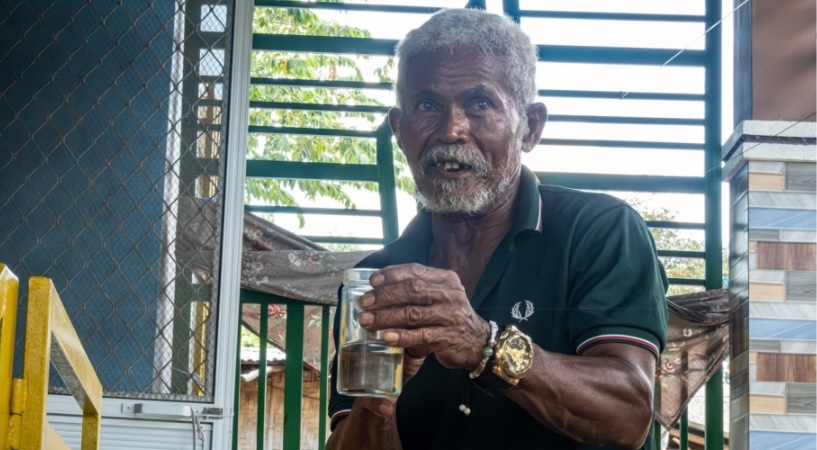 ELDER. Nelson holds up a glass to demonstrate how he would communicate with his anito. Photo by Lance Spencer Yu.
Before this, Nelson used to sell gas in bottles — like the one that now stood empty — around the community. He used to sell one big bottle, about a liter in size, at about P60. Now, the same bottle goes for at least P100.
“Ibig sabihin, kung uutangin naman, ‘yan ang mahirap kasi umaangal na sila, nagrereklamong masyadong mahal,” he said. “Para wala akong kagalit na tao, huminto ako.”
(The problem is, if they buy it on credit, it becomes difficult because they complain that it’s too expensive. So to avoid getting on anyone’s bad side, I just stopped.)
Nowadays, everyone in the village buys their gasoline and diesel from the nearby Caltex gas station. And for those with existing debts to Nelson?
“Saka na lang ko. Kung gusto niyo bayaran o hindi. Ganun na lang. Kaysa naman pilitin mo siya, e kinakapos na sila sa sahod.”
(They can pay it back next time, if they want to pay me back or not. I left it at that, rather than forcing them to pay me back when they’re already struggling to make ends meet.)
Fuel prices empty the classroom
As oil prices rose, so did the cost of moving goods. For a remote community like Kalangitan, that cuts further into what’s left to take home at the end of each selling day.
For Aiza, bringing goods out of the community already meant spending before earning. She would rent a kolong-kolong (motorized tricycle) to carry produce and handicrafts from the resettlement area to town, where a day’s sales might bring in around P1,000. Before the fuel hikes, the trip cost about P500, already half of what she hoped to earn. After prices climbed, the rental rose to P700, leaving only a few hundred pesos.
“Noong tumaas ang presyo ng langis, tumaas sa P700 ‘yung presyo ng renta sa kolong-kolong, kaya halos wala na din po talaga silang maiuwi,” said Angel Manalo, community advocacy lead at Liwanag at Dunong. “Ang daing nila wala na talagang natitira para doon na sumasahod. Para naman sa mga nagtitinda, ‘yung kita nila, halos nauuwi na lang talaga sa pagbayad ng gasolina.”
(When the price of gas went up, the rental of a kolong-kolong also rose to P700, so there really was hardly anything left for them to take home. Their complaint is that there’s nothing left from their salaries. For vendors, their income mostly just goes to paying for gasoline.)
The strain has also reached the Aeta Learning Center. The weekend classes held by volunteer organization Liwanag at Dunong continue, but fewer adults are able to attend. The same crisis that has made earning harder has also made studying harder to justify. Sundays can no longer be spared.
“Decreasing po talaga tayo, lalong lalo na ‘yung adult learners natin,” Manalo said, referring to the attendance rate. “Noong nagka-oil crisis din po talaga, kailangan na mag-doble kayod nang mga katutubo. Kaya kung before, kaya pa nilang yung Sunday, ilaan talaga sa pagpasok sa learning center, ngayon, meron talagang ilan sa kanila na hindi na maipagpaliban yung Linggo para magtrabaho or magbenta.”
(It really has been decreasing, especially among our adult learners. When the oil crisis hit, the indigenous community really had to work twice as hard. Whereas before they could still set aside Sundays to attend classes at the learning center, now, some of them can no longer give up their Sundays because they need to work or sell.)
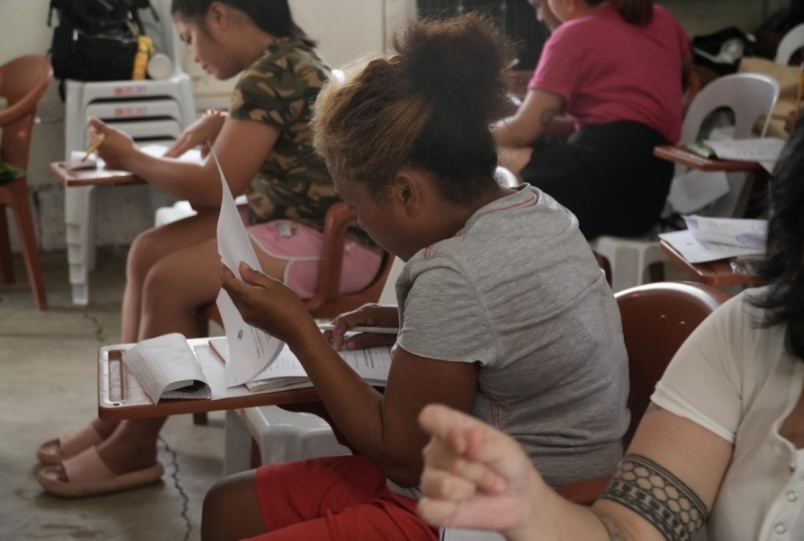 STUDY. Adult learners in the Aeta Learning Center review their lessons on a Sunday. Photo by Lance Spencer Yu.
The Aeta Learning Center had once expanded beyond weekend classes, with weekday lessons led by four katutubong guro (indigenous peoples’ teachers) from the community itself. But much of that has been put on hold. The teachers, too, have had to focus on earning enough to get by.
Neslyn Pelacio, who graduated from the Alternative Learning Program in 2023, was one of those community teachers. She and her husband Jessie have felt that pressure acutely. When I visited the community, Neslyn had only a few minutes to spend with the volunteers. Even on this Sunday morning — the morning of her birthday too — she was preparing to go to the mountains where she had ginger planted. The journey alone could take up to half a day.
“Bago ‘yung krisis sa langis, meron talaga silang naitatabi mula sa sweldo ni Tatay Jessie. Pero noong tumaas nga itong presyo ng gasolina, wala na din po talaga silang maitabi mula sa sinusuweldo kaya nawalan din po talaga sila ng ipon,” Manalo said.
(Before the oil crisis, they were able to set aside some savings from the salary of Jessie. But now that the price of gasoline has gone up, they really aren’t able to set anything aside, and that’s why their savings are running out.)
Even the elders have had to pull back. Belen David, the village elder of Sitio Bagingan, used to attend Sunday classes regularly. But recently, that has changed.
“Hindi na din talaga siya makapasok kasi hanggang Sunday ng umaga nagtitinda sila. Tapos pagdating ng hapon, sobrang pagod na ng katawan niya,” Manalo said.
(She really can’t attend because even on Sunday mornings they have to sell their goods. By afternoon, she’s exhausted.)
The goods Belen sells comes far away from the resettlement area, where the soil is too poor and space too limited for families to grow anything at scale. Reaching the farmlands can take up to 12 hours on foot, or about five hours by kolong-kolong — a distance that only seems to grow farther as the cost of travel increases.
The road to self-determination
Displacement runs through many stories in Kalangitan. Minda de la Cruz knows it well. Originally displaced by the eruption of Pinatubo, she, like many other Aetas, was moved from one place to another before eventually settling in Sitio Bagingan. Here, livelihood remains difficult, and the price of oil is another burden she cannot escape.
“Kahit anong gawin namin, tumaas ang gas. Wala din kami magagawa,” she said. “Basta nagsisikap lang kami. Sariling kami lahat.”
(No matter what we do, gas prices have gone up. There’s nothing we can do. So we just keep on working. We rely on ourselves.)
Having lost their fertile farmland around Pinatubo, many Aetas now have to travel far to harvest from their gasak — upland plots that can be half a day away. For Minda, that means spending the week collecting sweet potatoes and then selling them when she can on the weekends. But higher fuel and transport costs keep eating into what little profit she makes.
What frustrates her most is the feeling that the government only remembers them when it needs something. In ordinary times, their help is absent. But during elections, officials and candidates descend into the community to offer their support, and more importantly, court their votes.
“Kung minsan sinasabi ko hindi tayo napapansin ng gobyerno, bakit kung botohan? Kulang na nga lang ‘yung aso kikilalanin nila, sa totoo talaga. ‘Ay, i-boto niyo kami!’ Pero pagdating sa tulong ng gobyerno, bakit wala kami?” Minda said.
(Sometimes, it’s like the government doesn’t notice us, but why do things change during elections? The only thing left is for them to chat up the dog, and tell them ‘Oh, vote for us!’ But when it comes to actual help, why do we never get any?)
In Bagingan, residents have been asking for years for the repair of a road that they use to reach work, transport goods, and bring children and elders to the Aeta Learning Center.
Year after year, the promises have begun to blur. Officials tell them not to worry. Help will come. The dilapidated road? It’ll be fixed, they say — just vote us into office! But she’s heard those assurances one too many times.
“Sabi nila, ‘Huwag kayong mag-alala.’ Puro na lang huwag mag-alala. Anong gagawin? Mag-rebelde para mapansin?”
(They always tell us, ‘Don’t worry.’ It’s always don’t worry. What are we supposed to do? Become rebels just to be noticed?)
Nelson has similarly grown tired of hearing the same recycled promises: “Sabi nila, ‘yung kalsada ninyo, kami bahala. Basta kaming naupo. Palaging ganun. Ilang taon na.”
(They always say, we’ll take care of your road once we get into office. It’s always the same. It’s been years.)
The road in its current state is an unpaved stretch of dirt that turns soft and muddy in the rain, then hardens and cracks again under the sun. Residents say motorcycles and carts can flip along the worst parts.
“‘Yung daan po talaga doon sa Bagingan area, sira na po talaga siya,” Manalo said. “May isang part doon na halos kalahati ng kalsada, halos naging bangin na siya. Hindi po siya nasesemento kaya pagdating ng mga bagyo, talagang gumuguho na ang daanan.”
(That road in Bagingan is really broken. There’s a part there where nearly half the road has turned into a ravine. It’s not cemented, so when a storm comes, the road gets washed away.)
The Liwanag at Dunong community advocacy lead said that officials in the area have known about this problem for years, but little has changed. Now, the oil crisis has only compounded the issue.
“Dahil hanggang ngayon, hindi pa rin binibigyan pansin ‘yung kalsada sa lugar nila, noong nagkaroon din ng oil crisis, mas matindi ‘yung effect sa kanila dahil hindi sila makadaan sa shorter route. Kailangan nila dumaan sa mas mahabang ikot. Mas mahal po talaga sa gasolina,” she said.
(Because no one has been paying any attention to the road in their area, when the oil crisis hit, the effect was even harsher on the community now that they can’t pass this shorter route. They need to circle around a longer way. They need to spend more on gasoline too.)
And with the rainy season looming, conditions will only become worse. Several people in the community recounted memories of walking through mud that reached their knees.
In a video taken by a meter reader in late 2025, the same stretch appears still badly damaged. Schoolchildren hobble along the fractures, their backpacks jostling. Belen, Bagingan’s village elder, had a simple plea: fix the road.
“Sana po matulungan niyo po kami dito sa aming daan. Nahihirapan po kami. ‘Yung mga anak ko, hirap na hirap po. ‘Yung pangangalakal, nahihirapan dito sa daan namin,” she said.
(We hope that you can help us with our road. We’re struggling. My children are having such a difficult time. This road makes selling our goods hard.)
It is a modest request from a community that has already done much of the work of rebuilding on its own. The Aetas of Kalangitan have survived displacement, poor livelihood, and years of insufficient government support. They have built a learning center, pushing for education as a way to claim more control over their future.
Now, they want the government to meet them on that road to self-determination by fixing the actual road.
“Sana ang daan namin ayusin naman para hindi kami mahirapan. Para hindi naman kami mahirapan na tulad ng pagtitinda namin ng kalakal. Para hindi kami tulak ng tulak ng mga motor namin. Ayon lang nama. Sana mapansin kami ng gobyerno na magawa ‘yung daan namin sa Kalangitan,” Minda said.
(I hope they can fix the road so we don’t have such a hard time. So that we don’t struggle so much to sell our goods. So that we don’t have to keep pushing our motorcycles. All we’re asking is for them to fix it. I hope the government notices us and fixes our road in Kalangitan.) – Rappler.com
Lance Spencer Yu is a former business journalist for Rappler. He previously covered how government policies and economic shocks affected vulnerable sectors, including onion farmers and jeepney drivers. He later worked as a private capital analyst at MSCI, and as an investment and strategy analyst at Dedale Intelligence, producing research for private equity funds and institutional investors.
Trisha Concepcion holds a Bachelor of Arts in Literature, major in Literary and Cultural Studies, from De La Salle University. Her experience spans education, cultural work, and research, including work in museum programming and indigenous heritage-related government projects. She has also taught under the Arts and Design Track at De La Salle University Senior High School, handling subjects in research, arts, culture, and literature. She is currently pursuing graduate studies in Anthropology.


추천 콘텐츠
SUI Price Prediction: Analyst Says a 10X Rally Is Still Possible

Best Music AI Websites For Songs And Soundtracks

British Pound Slides as Warsh’s Hawkish Fed Stance Boosts US Dollar


인기 뉴스
더보기
