Gold dropped 8% this week, its worst performance since 2020, as central banks signal no rate cuts. Silver fell nearly 10% amid dollar strength. The post Why GoldGold dropped 8% this week, its worst performance since 2020, as central banks signal no rate cuts. Silver fell nearly 10% amid dollar strength. The post Why Gold

Why Gold Plunged More Than 8% This Week Despite Middle East Conflict

2026/03/20 18:47
4 min read
For feedback or concerns regarding this content, please contact us at crypto.news@mexc.com

Key Takeaways

  • Gold experienced an 8% weekly decline, marking its steepest drop since the beginning of 2020
  • The late February U.S.-Israel military action against Iran sparked inflation concerns, pressuring precious metals
  • Leading central banks worldwide, including the Federal Reserve and European Central Bank, maintained current rates and indicated limited future reductions
  • Silver experienced a steeper decline of nearly 10% during the week, with market observers noting its greater vulnerability to currency fluctuations
  • Gold prices fell below the $4,800–$5,200 trading corridor established since conflict erupted

Precious metals showed modest gains on Friday, though gold remains poised to close its third consecutive week in negative territory. Spot gold advanced approximately 1.4% to reach $4,715 per ounce, while futures contracts gained roughly 2.4%.
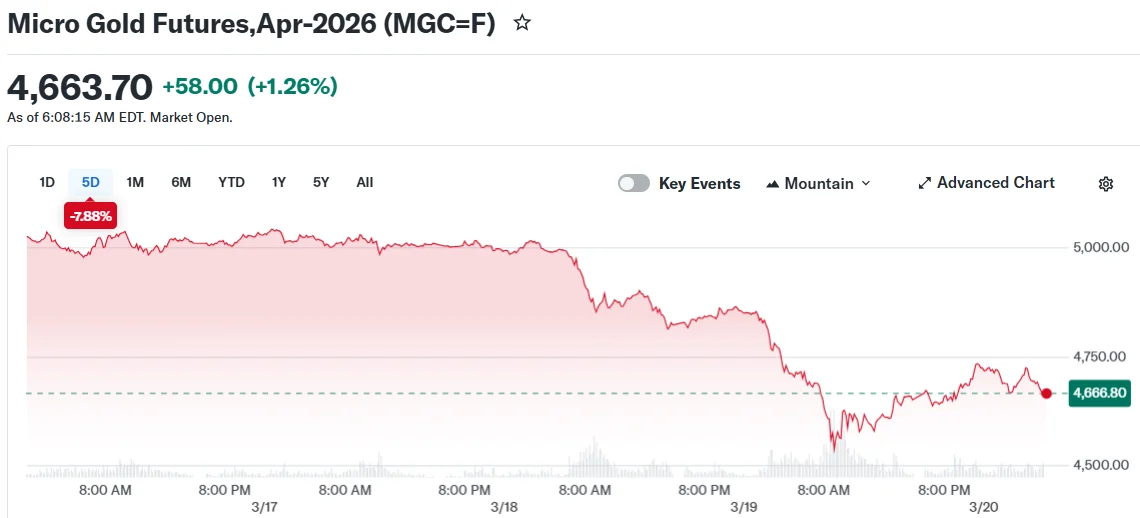
Micro Gold Futures,Apr-2026 (MGC=F)Micro Gold Futures,Apr-2026 (MGC=F)

Friday’s modest rebound couldn’t offset the substantial damage from earlier in the week. Gold has shed more than 8% over the past five trading sessions, representing its poorest weekly showing since the early months of 2020.

Prior to this week’s selloff, gold had maintained a relatively stable trading band between $5,000 and $5,200 following the commencement of U.S.-Israel military operations against Iran in late February. This week’s sharp decline sent prices tumbling well beneath that established range.

The ongoing military conflict has heightened worries about escalating energy costs and broader inflationary pressures. Crude oil prices surged to nearly four-year peaks this week following attacks on critical energy infrastructure across the Middle East region.

Global monetary authorities have reacted to these inflationary warning signs with a notably hawkish stance. Australia’s central bank implemented a rate increase, while the Federal Reserve, European Central Bank, Swiss National Bank, and Bank of Japan all maintained their existing policy rates.

These institutions uniformly communicated that monetary easing remains off the table for the foreseeable future. This messaging proved particularly damaging for gold, as reduced borrowing costs typically provide tailwinds for the non-yielding precious metal.

The Federal Reserve maintained its policy stance on Wednesday while cautioning that inflationary pressures may intensify. Although gold traditionally serves as an inflation protection mechanism, elevated interest rates enhance the relative appeal of yield-generating investments.

Dollar strength created additional headwinds for gold. An appreciating greenback increases the cost of gold for international buyers using alternative currencies, potentially dampening global demand.

The dollar weakened on Friday, providing temporary relief for precious metals. Multiple central banks signaled potential rate increases, which strengthened their respective currencies relative to the U.S. dollar.

Silver Experiences Sharper Decline

Silver sustained steeper losses than gold’s, falling nearly 10% throughout the week. Spot silver climbed 0.5% on Friday to $73.14 per ounce, though this gain only marginally offset the week’s substantial losses.

Market analysts at OCBC noted that silver demonstrates heightened sensitivity to both dollar movements and overall market risk appetite compared to gold. The firm indicated it may adjust its silver price forecasts “modestly lower” in response to current market dynamics.

Silver also confronts challenges from potential global economic deceleration, which could diminish industrial consumption. The metal plays a crucial role in solar energy systems and various electrical applications.

Platinum declined 2.9% for the week, though it recovered 2.1% on Friday to trade around $2,016 per ounce.

Market Expert Perspectives

Nicholas Frappell, who leads institutional markets globally at ABC Refinery, informed Reuters that gold successfully maintained critical technical support thresholds on a weekly timeframe.

He suggested gold could potentially rally back toward the $4,800 level where the breakdown occurred. Frappell also observed that market participants had positioned themselves for further selling rather than accumulation following gold’s disappointing performance throughout the conflict period.

Spot gold has now retreated more than 10% since the February 28 U.S.-Israel strike on Iran commenced.

The post Why Gold Plunged More Than 8% This Week Despite Middle East Conflict appeared first on Blockonomi.

Disclaimer: The articles reposted on this site are sourced from public platforms and are provided for informational purposes only. They do not necessarily reflect the views of MEXC. All rights remain with the original authors. If you believe any content infringes on third-party rights, please contact crypto.news@mexc.com for removal. MEXC makes no guarantees regarding the accuracy, completeness, or timeliness of the content and is not responsible for any actions taken based on the information provided. The content does not constitute financial, legal, or other professional advice, nor should it be considered a recommendation or endorsement by MEXC.

You May Also Like

PayPal USD Goes Live on Stellar, Expanding Access to Stablecoin Payments

PayPal USD Goes Live on Stellar, Expanding Access to Stablecoin Payments

PayPal USD (PYUSD), the fully regulated U.S. dollar-backed stablecoin, is now live on the Stellar network, announced on Thursday. The launch marks a milestone for both PayPal and Stellar, extending PYUSD’s reach into new wallets, platforms, and business use cases across global payments. The announcement was made at the Stellar Meridian event in Copacabana, Rio de Janeiro, on September 18, a flagship annual gathering of blockchain leaders, investors, and policymakers. Expanding Access Through Stellar’s Ecosystem By deploying on Stellar, PYUSD integrates with wallets and platforms including Bitcoin.com, Chipper Cash, Decaf, Arculus, Meru, CiNKO, COCA, Lobstr, and others. This expansion alllows millions of users to access a stablecoin option designed for low-cost payments. “Expanding PYUSD to the Stellar network is an exciting step toward making stable, trusted digital dollars more accessible and useful worldwide,” said Corbin Fraser, CEO of Bitcoin.com. “By supporting PYUSD on Stellar, we’re enabling our millions of users to enjoy fast, low-cost transfers while strengthening the role of stablecoins in real-world payments.” Empowering Businesses and SMEs Beyond consumer payments, PYUSD on Stellar offers small and medium-sized businesses access to near-instant settlement and real-time working capital. Companies can use PYUSD to pay suppliers, manage inventory, or cover operational costs without the delays typically associated with traditional finance. According to Paypal liquidity providers can participate by backing these financing opportunities and earning potential returns linked to real-world commerce. This creates a virtuous cycle of faster payments, improved liquidity, and enhanced financial inclusion, explains PayPal. PYUSD’s fully backed reserves—held in U.S. dollar deposits, U.S. Treasuries, and similar cash equivalents—add trust and transparency. Oversight from the New York State Department of Financial Services (NYDFS) ensures a high regulatory standard. PayPal Deepens Onchain Presence “PayPal continues to be at the forefront of payments, meeting our customers where they are — online, offline, and now onchain,” said May Zabaneh, Vice President of Crypto at PayPal. “Expanding PYUSD to Stellar broadens access to PYUSD and opens up new use cases and opportunities for seamless transactions for customers.” With this move, PayPal strengthens its role in the stablecoin ecosystem, offering consumers and enterprises a digital currency that bridges traditional finance with blockchain-powered efficiency. Stellar’s Growing Role in Digital Payments Stellar, which has processed over 20 billion operations across nearly 10 million accounts, provides a proven network for innovation in payments. Developers can integrate PYUSD into programmable payment solutions and enterprise-grade platforms using Stellar’s open-source SDKs and Soroban smart contracts. “Having a global leader like PayPal bring PYUSD to the Stellar network is a major step forward in how stablecoins can power real-world payments,” said Denelle Dixon, CEO of the Stellar Development Foundation. “This milestone sets the stage for broader adoption and innovation.”
Share
CryptoNews2025/09/19 01:00
bluesky funding disclosed: $100M Series B led

bluesky funding disclosed: $100M Series B led

The post bluesky funding disclosed: $100M Series B led appeared on BitcoinEthereumNews.com. In a move that underscores growing investor confidence in decentralized
Share
BitcoinEthereumNews2026/03/20 20:09
Market Strategist Says the USA Just Nuked XRP. Here’s What Happened

Market Strategist Says the USA Just Nuked XRP. Here’s What Happened

Financial markets do not wait for clarity—they react instantly to tension. When global uncertainty rises, capital moves fast, and risk assets often take the first
Share
Timestabloid2026/03/20 20:05