The Warsaw Stock Exchange just rolled out Poland’s first Bitcoin ETF, marking a milestone moment for Eastern Europe’s crypto adoption.The Warsaw Stock Exchange just rolled out Poland’s first Bitcoin ETF, marking a milestone moment for Eastern Europe’s crypto adoption.

Poland Debuts First Bitcoin ETF in Eastern Europe – Can Bitcoin Hyper Follow With 10x Gains?

5 min read
Poland Debuts First Bitcoin ETF in Eastern Europe – Can Bitcoin Hyper Follow With 10x Gains?

For the first time, Polish investors can tap into $BTC exposure through their brokerage accounts instead of navigating wallets, exchanges, or private keys.

The debut puts Poland on the same trajectory as Canada in 2021 and the US in 2024, where ETFs triggered billions in institutional inflows and signaled Bitcoin’s shift into mainstream finance.

With a population of 38M and a growing fintech sector, Poland’s move could ripple across the region. But if ETFs cement Bitcoin’s role as a regulated asset, what about scaling its utility? That’s where projects like Bitcoin Hyper ($HYPER) come in.

Poland Enters The ETF Arena

Poland’s debut product, the Bitcoin BETA ETF, began trading this week on the Warsaw Stock Exchange (GPW).
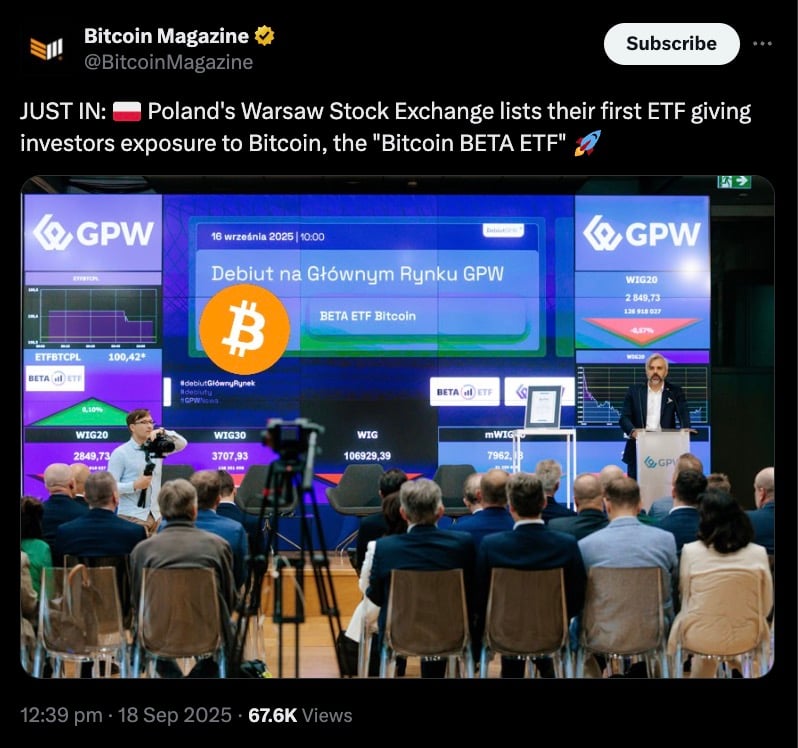
Announcement of the Bitcoin BETA ETF in Poland.

Source: X/@BitcoinMagazine

Managed by AgioFunds and greenlit by the Polish Financial Supervision Authority back in June, the fund gives traditional investors regulated access to $BTC without requiring direct custody.

Instead of holding Bitcoin itself, the ETF tracks futures contracts listed on the Chicago Mercantile Exchange (CME). Brokerage firm DM BOŚ serves as market maker, ensuring liquidity on the exchange.

The structure includes a management fee of up to 1% and hedges currency risk through forward contracts, softening the impact of USD/PLN swings on returns. The launch is framed as a response to investor demand.

With 400+ companies worth over $600B listed, GPW remains the heavyweight exchange in Central and Eastern Europe.

Why It Matters for Eastern Europe

Poland has positioned itself as a regional leader in digital finance. The timing of its first Bitcoin ETF is significant: it lands just as the EU rolls out its MiCA framework, giving investors regulatory clarity that has often been missing in Central and Eastern Europe.

That clarity matters. And it could encourage neighboring markets like Czechia, Hungary, and the Baltics to pursue similar products, sparking a domino effect across the region.

The move also mirrors global flows. In North America, Bitcoin ETFs routinely absorb thousands of $BTC in daily inflows, underscoring how traditional capital prefers regulated channels.
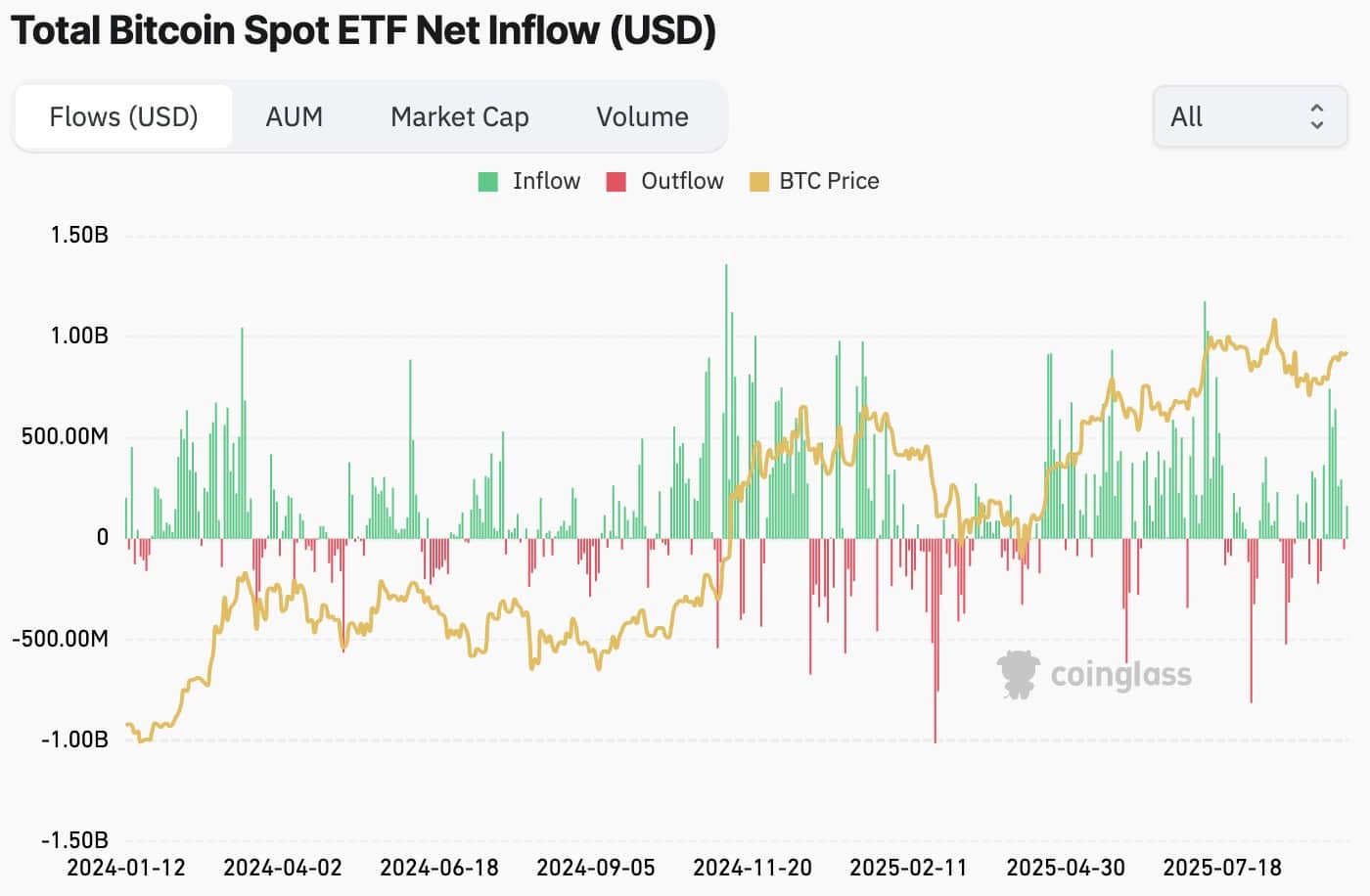
Total Bitcoin Spot ETF net inflow in USD.

Source: Coinglass

If that pattern repeats in Warsaw, Bitcoin could see stronger mainstream traction in Eastern Europe than ever before.

From Store of Value to Execution Layer

The arrival of Poland’s first Bitcoin ETF reinforces Bitcoin’s reputation as a store of value; a digital equivalent of gold that institutions can now access through regulated channels.

Yet Bitcoin’s core limitations remain unchanged – slow transaction speeds, high fees, and almost no programmability compared to chains like Ethereum ($ETH) or Solana ($SOL).

That gap is why Layer-2 solutions are emerging as the next frontier. These networks build on top of Bitcoin to bring speed, scalability, and functionality without compromising its base-layer security.

One of the first serious attempts to do this is Bitcoin Hyper ($HYPER), a project that aims to give Bitcoin the same flexibility developers enjoy on Solana and Ethereum. And for investors looking beyond ETFs, Bitcoin Hyper represents a chance to capture growth in Bitcoin’s utility layer, not just its store-of-value status.

Bitcoin Hyper ($HYPER) – A Layer-2 Set To Unleash Bitcoin’s Potential 

Bitcoin Hyper ($HYPER) positions itself as a true Layer-2 for Bitcoin, one that’s built on Ethereum infrastructure and integrates the Solana Virtual Machine (SVM).

The design lets users bridge their $BTC onto the network, where it is minted on-chain and instantly usable for sub-second, low-fee transactions. Zero-knowledge proofs continuously settle activity back to Bitcoin’s base layer, keeping the system trustless and secure.

The benefits go beyond speed. Because Bitcoin Hyper integrates the SVM, it integrates seamlessly with existing Solana apps from day one, unlocking a wide range of Bitcoin-native dApps, DeFi platforms, and even meme coin launches that Bitcoin’s main chain could never handle. Everything runs on the $HYPER token, which fuels transactions, staking, and governance.
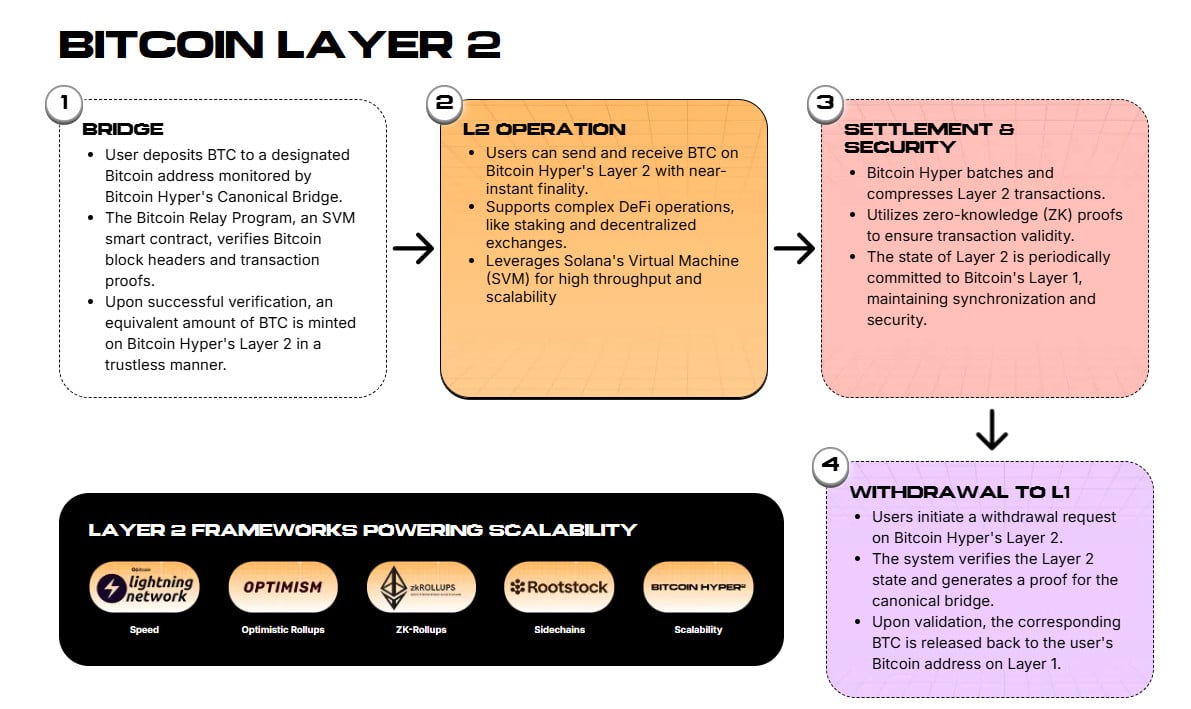
Bitcoin Hyper ($HYPER) Layer-2 framework for powering scalability.

Thanks to Bitcoin Hyper, investors effectively gain exposure to Bitcoin’s execution layer, while Bitcoin itself remains the monetary base. So, unsurprisingly, the Bitcoin Hyper presale is proving to be a phenomenal success. Just moments ago, it breached the $16.9M milestone. That figure has been helped along by a good few whale buys, including this one for $161.3K. 

Right now, $HYPER is priced at $0.012945 and you can stake your tokens for 68% APY. Want to find out more? Take a look at our guide to buying $HYPER.

Poland’s ETF listing helps normalize Bitcoin exposure for institutions, but Bitcoin Hyper stands out as the parallel play that expands $BTC’s use cases and drives real demand.

While ETFs pave the way for regulated inflows, projects like Bitcoin Hyper offer the kind of utility layer that carries 10x potential compared to passive ETF exposure.

Where ETFs make Bitcoin safe to hold, $HYPER makes it powerful to use. So much so, that our Bitcoin Hyper price prediction reckons this new meme coin has the potential to close the year at $0.2. That would mean a 1,445% return on your investment.

Ready to jump in? Join the $HYPER presale before the next price increase.

Market Opportunity
Hyperlane Logo
Hyperlane Price(HYPER)
$0.10593
$0.10593$0.10593
+0.72%
USD
Hyperlane (HYPER) Live Price Chart
Disclaimer: The articles reposted on this site are sourced from public platforms and are provided for informational purposes only. They do not necessarily reflect the views of MEXC. All rights remain with the original authors. If you believe any content infringes on third-party rights, please contact service@support.mexc.com for removal. MEXC makes no guarantees regarding the accuracy, completeness, or timeliness of the content and is not responsible for any actions taken based on the information provided. The content does not constitute financial, legal, or other professional advice, nor should it be considered a recommendation or endorsement by MEXC.

You May Also Like

MoneyGram Taps Stablecoins To Shield Colombians From Peso Weakness

MoneyGram Taps Stablecoins To Shield Colombians From Peso Weakness

According to multiple reports, MoneyGram is rolling out a new mobile app in Colombia that lets users receive, hold and move money using USD-backed stablecoins, specifically USDC. Related Reading: Ethereum Giant The Ether Machine Aims For US Public Debut The service is being positioned as a hybrid: a stored-value USD balance that can be funded, […]
Share
Bitcoinist2025/09/18 20:30
BDACS Launches KRW1 Stablecoin Backed by the Won

BDACS Launches KRW1 Stablecoin Backed by the Won

The post BDACS Launches KRW1 Stablecoin Backed by the Won appeared on BitcoinEthereumNews.com. BDACS Launches KRW1 Stablecoin Backed by South Korean Won Custody service provider BDACS has launched KRW1, a new stablecoin pegged 1:1 to the South Korean won (KRW). The regulated custodian focuses on institutional clients and offers services including crypto asset custody and transaction infrastructure supporting multiple blockchains. The KRW1 project recently completed its proof-of-concept (PoC) phase, with the stablecoin launching on the Avalanche blockchain. Each KRW1 token is fully backed by fiat currency, with reserves held at Woori Bank, one of South Korea’s largest financial institutions. Transparency and Platform Features BDACS emphasizes full transparency: holders can monitor reserves in real time via banking API integration, although no dedicated portal is currently available. According to the press release, “The KRW1 launch goes far beyond token issuance. BDACS has developed a comprehensive platform, including issuance and governance systems, as well as a user application supporting peer-to-peer transfers and transaction verification.” The stablecoin is positioned for global use, with potential expansion through new network integrations and collaborations with dollar-pegged stablecoins like USDC and USDT. BDACS also plans to integrate KRW1 into government initiatives, though negotiations or official involvement have not been confirmed. Current Status and Market Outlook KRW1 remains in the concept stage and is not yet publicly traded or available to retail consumers, as South Korea currently lacks a stablecoin framework. However, the launch is reportedly supported by the country’s new president, Lee Je-moon. In related news, Kakao is also reportedly considering a won-pegged stablecoin, highlighting growing interest in this emerging asset class. Source: https://coinpaper.com/11089/bdacs-launches-krw-1-stablecoin-backed-by-the-won
Share
BitcoinEthereumNews2025/09/18 21:28
Exclusive interview with Smokey The Bera, co-founder of Berachain: How the innovative PoL public chain solves the liquidity problem and may be launched in a few months

Exclusive interview with Smokey The Bera, co-founder of Berachain: How the innovative PoL public chain solves the liquidity problem and may be launched in a few months

Recently, PANews interviewed Smokey The Bera, co-founder of Berachain, to unravel the background of the establishment of this anonymous project, Berachain's PoL mechanism, the latest developments, and answered widely concerned topics such as airdrop expectations and new opportunities in the DeFi field.
Share
PANews2024/07/03 13:00