Bitcoin Enters Bull Regime As Taker Flow Surge Drives $3,400 Premium
Bitcoin has reclaimed the $70,000 level and is now testing resistance near $74,000, signaling renewed strength after several weeks of volatile price action. The recent move higher suggests that buyers are regaining control as market sentiment begins to improve, with traders closely watching whether BTC can sustain momentum above this critical resistance zone.
Beyond the price chart, derivatives market data is beginning to reflect a notable structural shift. According to top analyst Axel Adler, Bitcoin’s Integrated Market Index, a model designed to measure aggregate pressure from the derivatives market, has recently flipped back into a bullish regime.
The indicator operates on a 0–100 scale and combines normalized metrics of price behavior and futures market flows. Readings above 55 typically indicate a bullish regime, while values below 45 suggest bearish conditions.

From February 15 onward, the model remained firmly in a bear regime. During that period, both price dynamics and futures market flows deteriorated simultaneously as sustained negative net taker volume and compression in open interest pushed the Flow Index below the bearish threshold. As Bitcoin’s price dropped toward $63,000, the Integrated Index reached its lowest levels.
However, the structure shifted on March 10, when taker flow reversed, and open interest began expanding again. Since that moment, the model has remained firmly bullish, with the index currently standing at 96, its highest level in weeks.
Price Index and Fair Value Confirm Bitcoin’s Regime Shift
Adler further explains that Bitcoin’s Price Index (0–100) and 30-day Fair Value model provide additional insight into how the market is behaving relative to its statistical equilibrium. The Price Index represents the normalized z-score of price, measuring how far Bitcoin deviates from its recent average, while Fair Value acts as an adjusted benchmark that reflects the prevailing market regime.
During the previous bear regime, Bitcoin consistently traded below Fair Value, signaling persistent market weakness. At the peak of selling pressure on February 24, the discount widened significantly. At that moment, Bitcoin was trading more than $3,300 below Fair Value, while the Price Index dropped to 1.85, indicating that price had deviated sharply below the statistical norm for that market environment.
Today, the situation has reversed. According to Adler’s data, the Price Index currently stands at 95.35, with Bitcoin trading around $73,886, while the model estimates Fair Value at approximately $70,433. This places the market at a premium of about $3,453 above Fair Value.
Adler notes that premiums exceeding $3,000 with a Price Index above 90 represent zones of heightened attention. However, this does not automatically imply an imminent reversal. As long as the Integrated Index remains strong—currently around 0.94—the premium is considered structurally justified, supporting the view that the current breakout reflects a genuine regime shift rather than a temporary price anomaly.
Bitcoin Tests Major Resistance After Recovery From February Selloff
The weekly chart shows Bitcoin attempting to extend its recovery after the sharp decline that unfolded earlier in 2026. Following a prolonged uptrend that pushed BTC above the $110,000 region in late 2025, the market entered a corrective phase characterized by strong selling pressure and a sequence of lower highs.
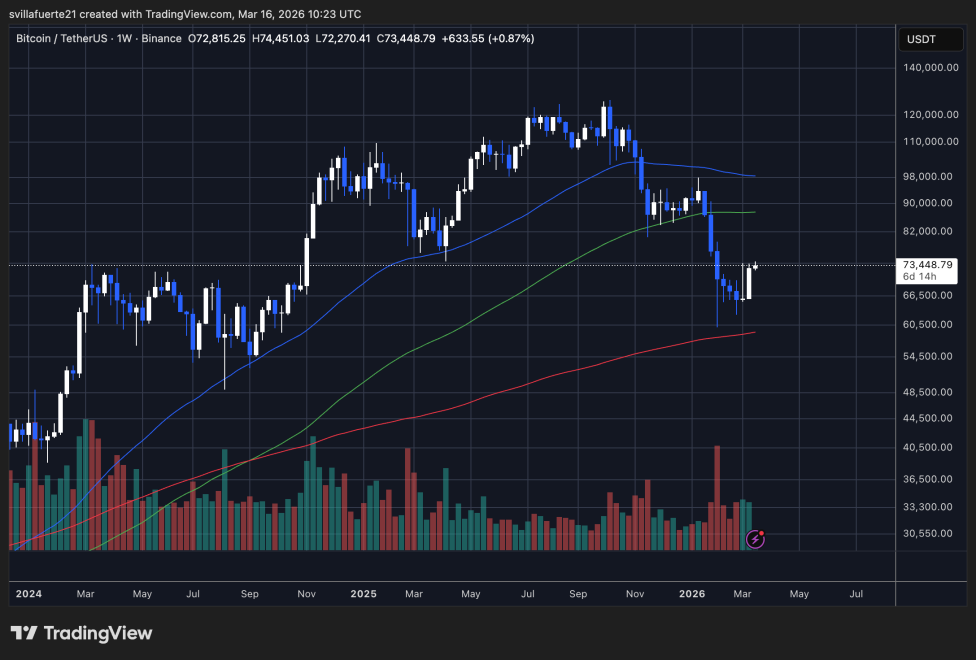
That correction accelerated in February, when Bitcoin dropped toward the $60,000–$65,000 zone, triggering a surge in trading volume that likely reflected forced liquidations and broader market capitulation. However, buyers stepped in quickly after the decline, allowing BTC to stabilize and begin a gradual rebound.
In recent weeks, Bitcoin has reclaimed the $70,000 level and is now trading near $73,400, approaching an important resistance zone around $74,000–$75,000. This region previously acted as a key support level before the February breakdown and is now functioning as overhead resistance.
From a technical perspective, Bitcoin remains above its 200-week moving average, which continues to slope upward and serves as a critical long-term support indicator. Meanwhile, the 100-week moving average sits above the current price, suggesting that BTC must reclaim higher levels to fully confirm a bullish continuation.
If Bitcoin manages to break above the $74K resistance zone, the next upside targets could emerge around the $82K–$90K range. However, failure to sustain momentum may lead to renewed consolidation as the market absorbs recent volatility.
Featured image from ChatGPT, chart from TradingView.com
You May Also Like

XRPL Validator Reveals Why He Just Vetoed New Amendment

XRP vs Pepeto: XRP Ledger Expands But Pepeto Presale is the Clear Winner for 2026