Spot Bitcoin ETFs recorded strong inflows on March 13, adding fresh momentum to institutional demand. Meanwhile, market analysts pointed to key resistance and supportSpot Bitcoin ETFs recorded strong inflows on March 13, adding fresh momentum to institutional demand. Meanwhile, market analysts pointed to key resistance and support

Spot Bitcoin ETFs amass $180M inflows, will BTC price see a boost?

2026/03/14 19:09
3 min read
For feedback or concerns regarding this content, please contact us at crypto.news@mexc.com
Summary
  • Spot Bitcoin ETFs recorded $180.4M inflows on March 13, led by BlackRock’s IBIT with $143.6M and Fidelity’s FBTC with $23.2M.
  • Analyst Ali Martinez said Bitcoin has entered a low-resistance zone, with little resistance until $82,045 and key support at $66,898.
  • A chart shared by Michaël van de Poppe shows BTC forming higher lows near $65,117, with a potential resistance zone between $76,604 and $79,127.

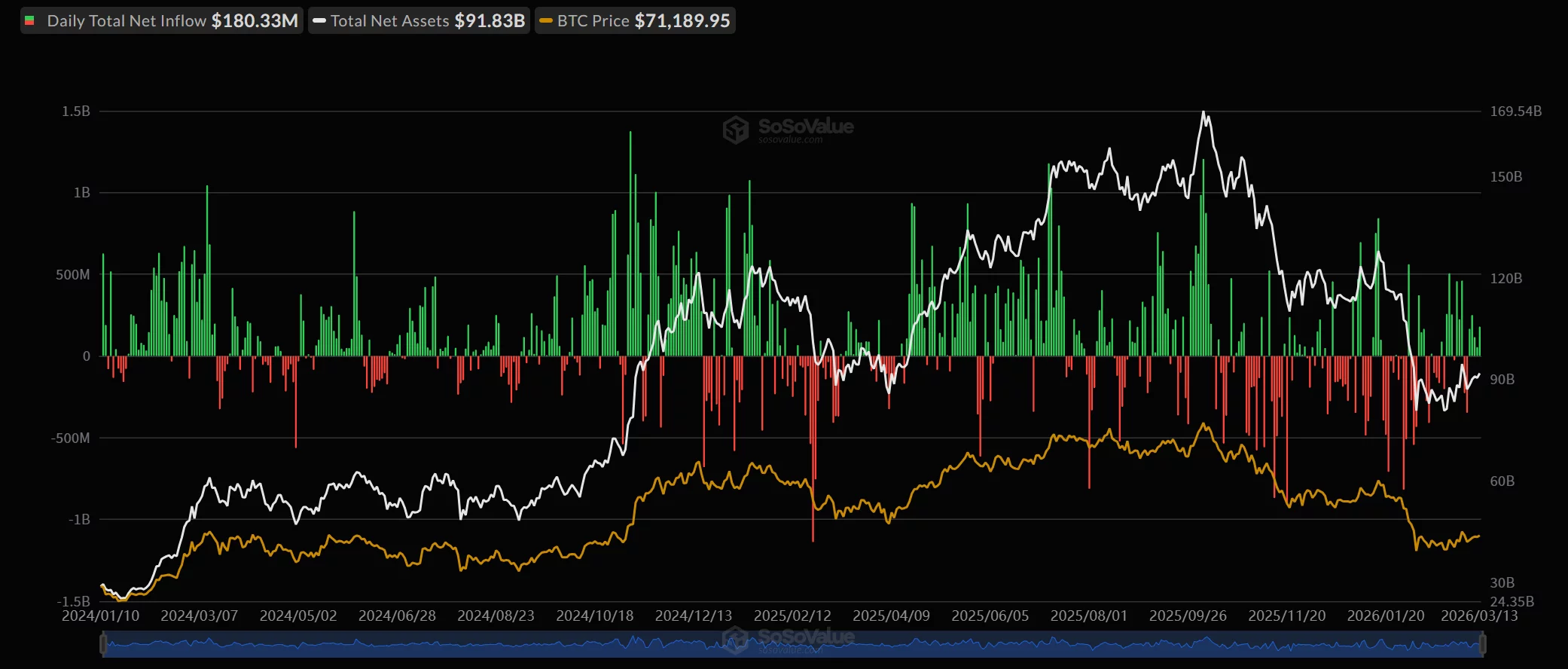
Spot Bitcoin ETFs recorded strong inflows on March 13, adding fresh momentum to institutional demand. Meanwhile, market analysts pointed to key resistance and support levels for Bitcoin (BTC) price with $82,000 in sight. Data shared by Farside Investors shows that U.S. spot Bitcoin ETFs attracted $180.4 million in net inflows on March 13, 2026.

Spot Bitcoin ETFs continue inflow streak
Spot Bitcoin ETFs amass $180M inflows, will BTC price see a boost? - 1

The funds extended a streak of positive flows after several volatile sessions earlier in the month.The largest share of inflows came from BlackRock’s IBIT, which added $143.6 million. Fidelity’s FBTC followed with $23.2 million, while Bitwise’s BITB recorded $3.1 million. ARK Invest’s ARKB posted $2.4 million, and VanEck’s HODL brought in $8.1 million.

Other Bitcoin ETFs reported no daily inflows, including Grayscale’s GBTC, Invesco’s BTCO, and Franklin Templeton’s EZBC. The latest figures from Farside UK reflect a rebound in ETF demand after significant outflows earlier in March. On March 6, spot Bitcoin ETFs collectively recorded $348.9 million in outflows.

The flows later turned positive, with $167.1 million in inflows on March 9 and $246.9 million on March 10, before moderating to $53.8 million on March 12. Since launch, cumulative inflows remain heavily concentrated in a few products. BlackRock’s IBIT has attracted more than $63 billion, while Fidelity’s FBTC has gathered nearly $11 billion, according to the totals displayed in the dataset.

Analysts remain optimistic on BTC price

At the same time, analysts are closely watching Bitcoin’s technical structure. Crypto analyst Ali Martinez said Bitcoin has entered a “low-resistance zone,” suggesting the asset could move higher with relatively limited selling pressure.

“Bitcoin $BTC has entered a low-resistance zone, with little standing in the way until $82,045,” Martinez wrote. He added, “Meanwhile, the key support floor sits at $66,898.”

A chart shared by crypto analyst Michaël van de Poppe shows Bitcoin trading around $71,720 on the 4-hour timeframe after rebounding from earlier March lows. The chart highlights a higher-low structure forming near $65,117, which Poppe described as a support level the market continues to hold.

Above the current price range, the chart marks a potential resistance band between $76,604 and $79,127, while a broader upside target zone sits near $80,646. The technical setup also shows Bitcoin reclaiming a short-term moving average after a series of consolidations.

Poppe described the recent price move as typical end-of-week volatility.“Classic price action on a Friday afternoon on #Bitcoin,” Poppe wrote on X. He noted, “Runs all the way towards the recent high, takes liquidity and inverses.”

Poppe added that he would be watching the next few sessions closely as he expects fresh highs soon. “Would be interested to see how this develops coming days, but would suggest that we’re going to attack the highs again in next two weeks.”

Market Opportunity
Bitcoin Logo
Bitcoin Price(BTC)
$72,900.44
$72,900.44$72,900.44
+1.98%
USD
Bitcoin (BTC) Live Price Chart
Disclaimer: The articles reposted on this site are sourced from public platforms and are provided for informational purposes only. They do not necessarily reflect the views of MEXC. All rights remain with the original authors. If you believe any content infringes on third-party rights, please contact crypto.news@mexc.com for removal. MEXC makes no guarantees regarding the accuracy, completeness, or timeliness of the content and is not responsible for any actions taken based on the information provided. The content does not constitute financial, legal, or other professional advice, nor should it be considered a recommendation or endorsement by MEXC.

You May Also Like

The Channel Factories We’ve Been Waiting For

The Channel Factories We’ve Been Waiting For

The post The Channel Factories We’ve Been Waiting For appeared on BitcoinEthereumNews.com. Visions of future technology are often prescient about the broad strokes while flubbing the details. The tablets in “2001: A Space Odyssey” do indeed look like iPads, but you never see the astronauts paying for subscriptions or wasting hours on Candy Crush.  Channel factories are one vision that arose early in the history of the Lightning Network to address some challenges that Lightning has faced from the beginning. Despite having grown to become Bitcoin’s most successful layer-2 scaling solution, with instant and low-fee payments, Lightning’s scale is limited by its reliance on payment channels. Although Lightning shifts most transactions off-chain, each payment channel still requires an on-chain transaction to open and (usually) another to close. As adoption grows, pressure on the blockchain grows with it. The need for a more scalable approach to managing channels is clear. Channel factories were supposed to meet this need, but where are they? In 2025, subnetworks are emerging that revive the impetus of channel factories with some new details that vastly increase their potential. They are natively interoperable with Lightning and achieve greater scale by allowing a group of participants to open a shared multisig UTXO and create multiple bilateral channels, which reduces the number of on-chain transactions and improves capital efficiency. Achieving greater scale by reducing complexity, Ark and Spark perform the same function as traditional channel factories with new designs and additional capabilities based on shared UTXOs.  Channel Factories 101 Channel factories have been around since the inception of Lightning. A factory is a multiparty contract where multiple users (not just two, as in a Dryja-Poon channel) cooperatively lock funds in a single multisig UTXO. They can open, close and update channels off-chain without updating the blockchain for each operation. Only when participants leave or the factory dissolves is an on-chain transaction…
Share
BitcoinEthereumNews2025/09/18 00:09
New Crypto Investors Are Backing Layer Brett Over Dogecoin After Topping The Meme Coin Charts This Month

New Crypto Investors Are Backing Layer Brett Over Dogecoin After Topping The Meme Coin Charts This Month

Climbing to the top of the meme coin charts takes more than a viral mascot or celebrity tweets. Hype may spark attention, but only momentum, utility, and adaptability keep it alive. That’s why the latest debate among crypto enthusiasts is catching attention. While Dogecoin remains a household name, a new player has entered the arena […] The post New Crypto Investors Are Backing Layer Brett Over Dogecoin After Topping The Meme Coin Charts This Month appeared first on Live Bitcoin News.
Share
LiveBitcoinNews2025/09/18 00:30
XRP Price Prediction 2026: Pepeto’s Presale Math Overshadows XRP and Solana as Wall Street Pushes $540 Million Into SOL ETFs

XRP Price Prediction 2026: Pepeto’s Presale Math Overshadows XRP and Solana as Wall Street Pushes $540 Million Into SOL ETFs

Goldman Sachs, Morgan Stanley, and Citadel collectively poured over $540 million into U.S. spot Solana ETFs in a single quarter. When the most conservative names
Share
Techbullion2026/03/16 05:37