The Ethereum Foundation has unveiled ERC-8004, a proposal to build decentralized AI systems that can rebuild trust in artificial intelligence. It says that someThe Ethereum Foundation has unveiled ERC-8004, a proposal to build decentralized AI systems that can rebuild trust in artificial intelligence. It says that some

Ethereum Prepares Mainnet Launch of ERC-8004 for AI-to-AI Interaction

  • The Ethereum Foundation has unveiled ERC-8004, a proposal to build decentralized AI systems that can rebuild trust in artificial intelligence.
  • It says that some of the world’s leading AI developers, including from Google, have come onboard to help realize on-chain AI-to-AI interactions.

The Ethereum Foundation’s proposal to host decentralized AI infrastructure on the Ethereum network is edging cloer to reality. Under ERC-8004, the network is creating trustless AI agents, with the support of industry leaders like Google and Coinbase.

The Foundation first proposed ERC-8004 in August last year with the formation of a new AI team, as we reported. Since then, it has been working with leading developers to finetune the future of decentralized AI. It announced on Tuesday that the proposal is going live on the mainnet soon, stating:

Under the new protocol, AI agents can discover, select and interact with other agents without the need for pre-existing trust, ushering in an era of open-ended agent economies, the Foundation says.

In an accompanying video, Davide Crapis revealed that the Foundation’s ambition go beyond the blockchain community. It’s targeting tech firms and AI developers globally, and it believes once the proposal is live, they will see the value of decentralized platforms and turn to Ethereum for their AI infrastructure needs. Crapis is the leader of the AI team at the Foundation.

He stated:

Ethereum Lays Groundwork for Decentralized AI

The Ethereum Foundation’s ambition to attract players beyond blockchain is off to a great start. According to Crapis, in the five months since ERC-8004 was announced, nearly 2,000 developers have started building on top of the new standard.

Crapis developed the standard alongside Marco De Rossi, the AI lead at MetaMask. Since then, other notable names have joined the movement, including Jordan Ellis, a core AI developer at Google. He stated:

Essentially, ERC-8004 is building on top of the existing agent communications protocols, like Agent-to-Agent (A2A) from Google. It then assigns three new registries: identity, reputation and validaiton. This gives an agent verifiable onchain identity, shows the feedback from others who have worked with it, and enables third parties to verify its work. This provides the three most important factors for trust while keeping it lightweight and inexpensive to run.
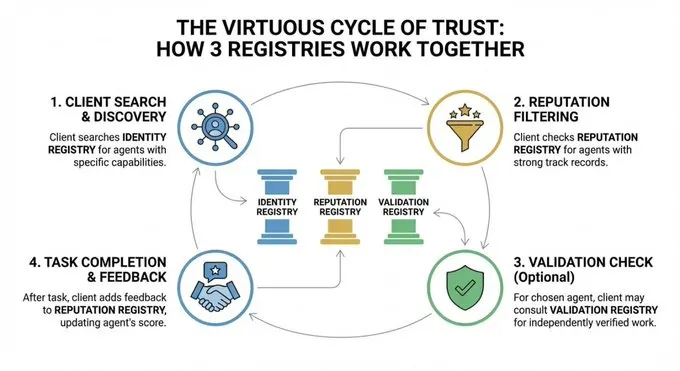
ERC-8004Image courtesy of The Data Science Collective.

AI continues to be one of the primary technologies impacting the crypto sector, and most top networks have extensive initiatives that seek to integrate the technology. Trust, privacy and security are the main themes that blockchain developers are working on. A week ago, Cardano’s privacy network Midnight announced a new partnership with AlphaTON to introduce confidential AI to Telegram, as we reported.

Ethereum trades at $3,030 at press time, gaining 2.6% in the past day as the broader market recovers.

]]>
Disclaimer: The articles reposted on this site are sourced from public platforms and are provided for informational purposes only. They do not necessarily reflect the views of MEXC. All rights remain with the original authors. If you believe any content infringes on third-party rights, please contact service@support.mexc.com for removal. MEXC makes no guarantees regarding the accuracy, completeness, or timeliness of the content and is not responsible for any actions taken based on the information provided. The content does not constitute financial, legal, or other professional advice, nor should it be considered a recommendation or endorsement by MEXC.

You May Also Like

Vitalik Buterin Withdraws 16,384 ETH to Fund Open-Source Technology and Privacy Projects

Vitalik Buterin Withdraws 16,384 ETH to Fund Open-Source Technology and Privacy Projects

TLDR: Buterin withdrew 16,384 ETH to personally fund open-source projects as Ethereum Foundation reduces spending.  The initiative supports secure hardware, privacy
Share
Blockonomi2026/01/30 16:39
What is the most promising crypto right now? A practical checklist

What is the most promising crypto right now? A practical checklist

Crypto interest often spikes after headlines. This guide helps everyday readers turn curiosity into repeatable checks that limit obvious execution risks. We focus
Share
Coinstats2026/01/30 15:52
Inside Upexi’s SOL play: staking yield and locked token deals

Inside Upexi’s SOL play: staking yield and locked token deals

The post Inside Upexi’s SOL play: staking yield and locked token deals appeared on BitcoinEthereumNews.com. Upexi is the largest public company holding Solana tokens and uses a SOL strategy to build its holdings and generate additional revenue through staking. In an interview with crypto.news, Upexi CEO Allan Marshall explains why the company executed a large equity private placement to build a crypto treasury, citing MicroStrategy’s playbook and a more accommodating U.S. policy backdrop. Summary Upexi is the largest public holder of Solana, using equity raises to build a SOL treasury and earn staking yield. Upexi CEO Allan Marshall spoke with crypto.news in an interview. Corporate strategy focuses on accretive issuances, staking, and discounted locked SOL purchases, not venture investing. Upexi markets itself as a “new institutional gateway to Solana’s (SOL) speed, scale, and rapidly growing ecosystem.” But it isn’t alone, as it joins a handful of rival companies also building Solana treasuries, while dozens of other public entities are focusing on other coins. Speaking to crypto.news, Marshall discusses strategy and market perception. He notes that Upexi is focused on accretive capital raises, staking, and discounted, locked SOL purchases rather than venture investing. He also discusses how the company measures progress through an “adjusted SOL per share” metric designed to remove timing and leverage effects. We also discuss the company’s risk management strategies, which include a buy-and-hold approach, no hedging, disciplined use of leverage, and custody with qualified providers. The entire interview transcript is below: crypto.news: Upexi is now the largest corporate holder of Solana with over 2 million SOL in treasury. Why did you make such a dramatic shift now? Was there something specific that happened in the past few months that gave you the confidence to commit so heavily to a crypto treasury at this time? Allan Marshall: Upexi did the first large-scale equity private placement to create an altcoin treasury, and there were…
Share
BitcoinEthereumNews2025/09/20 02:51