Uniswap dominates DeFi with over a billion in yearly fees, while Labs adds tens of millions more.Uniswap dominates DeFi with over a billion in yearly fees, while Labs adds tens of millions more.

UNI Crypto: With a $5.7B Market Cap, Investors Question Token Utility Amid Soaring Protocol Revenues

Uniswap Price Consolidates Near $9.57 as Buyers Test Recovery Momentum

Yet none of this revenue reaches token holders, leaving the token’s $5.7B market cap driven mostly by governance weight rather than real value capture.

Price Struggles to Reflect Protocol Strength

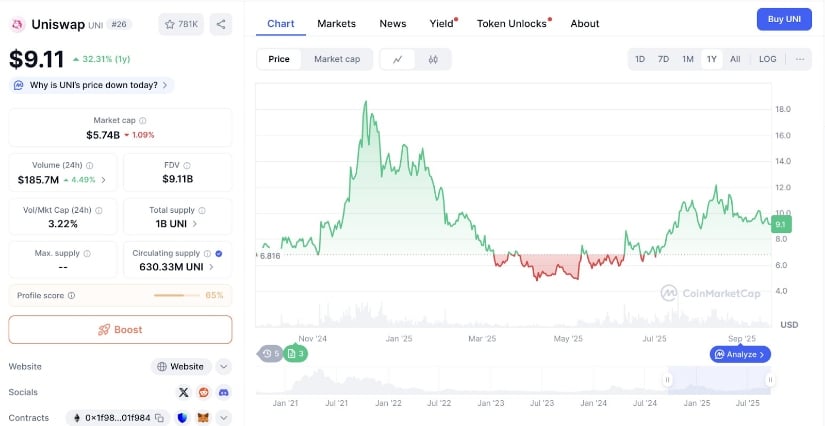
In a recent X post, market analyst Clemente highlighted the growing disconnect between Uniswap’s massive protocol revenue and the token’s stagnant value. While the asset Labs reportedly brings in $50 million per year and the protocol itself generates an eye-popping $1.65 billion in fees annually, none of this revenue directly accrues to the token holders.

With the token trading at $9.11 and carrying a $5.7 billion market cap, the lack of value capture has sparked heated discussions across the community.
Price Struggles to Reflect Protocol Strength

Source: X

The core issue stems from the asset’s design as a governance token, rather than a direct claim on the protocol’s cash flows.

This structure allows holders to vote on proposals but does little to reward them financially, leaving many to question whether governance utility alone justifies the asset’s multi-billion-dollar valuation. Without a clear buyback, burn, or dividend mechanism, the token risks being overshadowed by other DeFi tokens that tie revenues more directly to holders.

Price Action Highlights the Disconnect

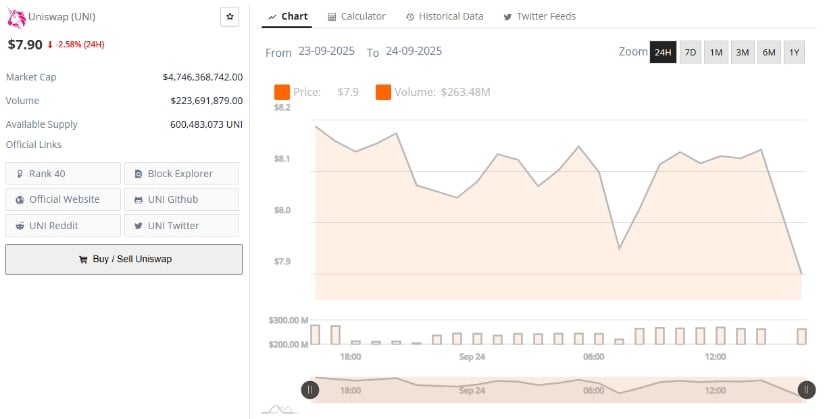
Supporting analyst view, BraveNewCoin data show Uniswap trading at $7.90, down -2.58% in the last 24 hours. The token carries a $4.74 billion market cap, with daily trading volume at $223.6 million and a circulating supply of just over 600 million.
Price Action Highlights the Disconnect

Source: BraveNewCoin

Despite the protocol’s enormous fee generation, price action suggests investors remain cautious, as the asset continues to lag behind the platform’s financial strength.

This steady underperformance underscores the ongoing debate about its role in the ecosystem. While the underlying protocol thrives, the lack of direct value capture weighs on sentiment.

Bearish Momentum Persists Despite Signs of Stabilization

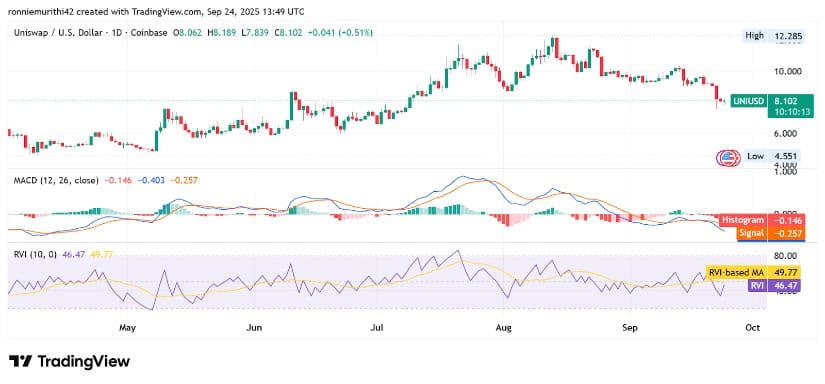
At the time of writing, UNI is trading at $8.12, a modest 0.72% uptick on the day after weeks of volatility that pushed the asset from highs of $12.29 down to lows of $4.55.

Despite this slight recovery, the broader short-term outlook remains bearish, as the token is still retracing heavily from its August peak. The pullback highlights sellers’ dominance, though the latest price action suggests the market may be attempting to stabilize.
Bearish Momentum Persists Despite Signs of Stabilization

Source: TradingView

Momentum indicators reinforce this cautious picture. The MACD remains negative, with both the line and signal below zero, pointing to persistent bearish control, while the histogram indicates fading strength in selling pressure as the gap narrows.

Meanwhile, the RVI sits at 46.42, below its moving average of 49.77, signaling that sentiment leans bearish but not in oversold territory. This leaves room for either further downside if pressure continues or a potential shift toward consolidation if buyers step in to defend current levels.

Market Opportunity
Moonveil Logo
Moonveil Price(MORE)
$0.001414
$0.001414$0.001414
-6.85%
USD
Moonveil (MORE) Live Price Chart
Disclaimer: The articles reposted on this site are sourced from public platforms and are provided for informational purposes only. They do not necessarily reflect the views of MEXC. All rights remain with the original authors. If you believe any content infringes on third-party rights, please contact service@support.mexc.com for removal. MEXC makes no guarantees regarding the accuracy, completeness, or timeliness of the content and is not responsible for any actions taken based on the information provided. The content does not constitute financial, legal, or other professional advice, nor should it be considered a recommendation or endorsement by MEXC.

You May Also Like

Vitalik Buterin Withdraws 16,384 ETH to Fund Open-Source Technology and Privacy Projects

Vitalik Buterin Withdraws 16,384 ETH to Fund Open-Source Technology and Privacy Projects

TLDR: Buterin withdrew 16,384 ETH to personally fund open-source projects as Ethereum Foundation reduces spending.  The initiative supports secure hardware, privacy
Share
Blockonomi2026/01/30 16:39
What is the most promising crypto right now? A practical checklist

What is the most promising crypto right now? A practical checklist

Crypto interest often spikes after headlines. This guide helps everyday readers turn curiosity into repeatable checks that limit obvious execution risks. We focus
Share
Coinstats2026/01/30 15:52
Inside Upexi’s SOL play: staking yield and locked token deals

Inside Upexi’s SOL play: staking yield and locked token deals

The post Inside Upexi’s SOL play: staking yield and locked token deals appeared on BitcoinEthereumNews.com. Upexi is the largest public company holding Solana tokens and uses a SOL strategy to build its holdings and generate additional revenue through staking. In an interview with crypto.news, Upexi CEO Allan Marshall explains why the company executed a large equity private placement to build a crypto treasury, citing MicroStrategy’s playbook and a more accommodating U.S. policy backdrop. Summary Upexi is the largest public holder of Solana, using equity raises to build a SOL treasury and earn staking yield. Upexi CEO Allan Marshall spoke with crypto.news in an interview. Corporate strategy focuses on accretive issuances, staking, and discounted locked SOL purchases, not venture investing. Upexi markets itself as a “new institutional gateway to Solana’s (SOL) speed, scale, and rapidly growing ecosystem.” But it isn’t alone, as it joins a handful of rival companies also building Solana treasuries, while dozens of other public entities are focusing on other coins. Speaking to crypto.news, Marshall discusses strategy and market perception. He notes that Upexi is focused on accretive capital raises, staking, and discounted, locked SOL purchases rather than venture investing. He also discusses how the company measures progress through an “adjusted SOL per share” metric designed to remove timing and leverage effects. We also discuss the company’s risk management strategies, which include a buy-and-hold approach, no hedging, disciplined use of leverage, and custody with qualified providers. The entire interview transcript is below: crypto.news: Upexi is now the largest corporate holder of Solana with over 2 million SOL in treasury. Why did you make such a dramatic shift now? Was there something specific that happened in the past few months that gave you the confidence to commit so heavily to a crypto treasury at this time? Allan Marshall: Upexi did the first large-scale equity private placement to create an altcoin treasury, and there were…
Share
BitcoinEthereumNews2025/09/20 02:51