

77 Billion XRP is Exposed to Quantum Computing Threats: Report
- New research has revealed that 76.82 billion XRP from 5.6 million accounts would be at risk of access by quantum computers.
- The quantum threat is lower for XRP than for Bitcoin, where genesis coins belonging to Satoshi Nakamoto and early adopters would be at risk.
Over 76 billion XRP is held in exposed accounts and would be under threat once quantum computing arrives, a new report has revealed.
The report was published by an XRP Ledger default Unique Node List (dUNL) validator known as Vet, who scanned all the existing 7.8 million XRP accounts. He found that 5.6 million accounts are quantum exposed. In this case, quantum exposed refers to any account that has signed at least one transaction, which has exposed its public key. Quantum safe accounts have never submitted a signed transaction to the public ledger.
The researcher found that of the 76.82 billion XRP that’s exposed, 96% is held by active accounts, meaning they have signed a transaction in the past year or so. These accounts are expected to migrate to quantum-secure wallet addresses once the technology launches to the masses.
However, 3.83% of the exposed XRP, or 2.94% of the total XRP supply, remains dormant and has not been used for at least five years. A smaller share (0.03% of exposed accounts) was used once back when XRP launched in 2013 and has yet to make any transaction since.
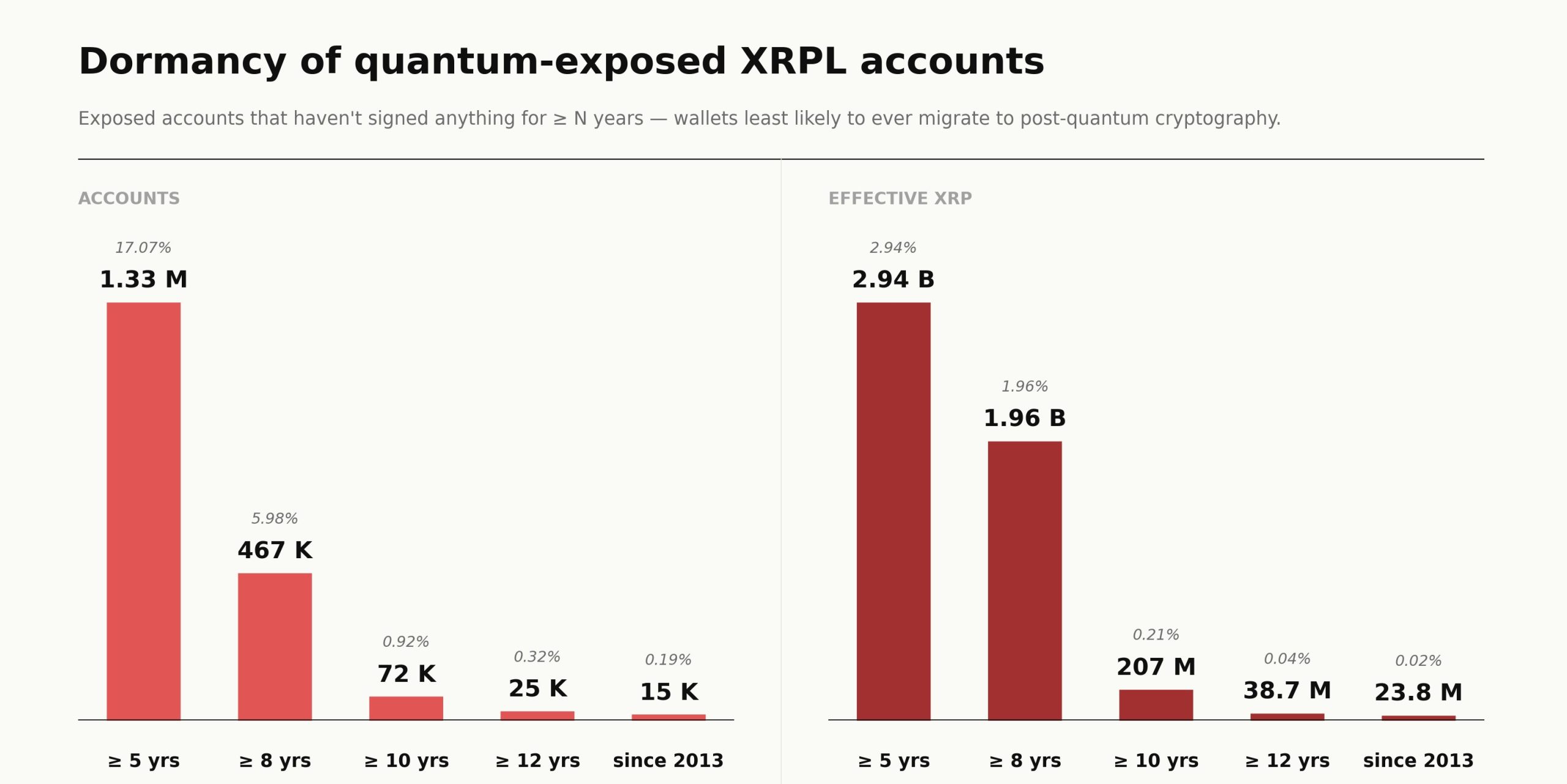 Data courtesy of VET.
This group faces an imminent risk once quantum computers become mainstream. Unlike their active counterparts, these accounts are not expected to migrate their tokens to quantum-secure addresses. As the researcher notes, the ultimate dilemma for the crypto industry is whether to find a way of protecting this group, threatening the decentralization principle of crypto, or leave them at risk of theft from criminals using quantum computers.
XRP Prepares for the Quantum Future
A month ago, Google’s Quantum AI team published a paper claiming that quantum attacks would hijack Bitcoin transactions in nine minutes, stealing the BTC before the network confirms it in a block 41% of the time.
The latest research doubles down on this threat. While a sizable number of XRP may be at risk, the quantum threat to Bitcoin is much more significant. Vet noted that the BTC that has not moved in over five years is much higher than XRP, making it more vulnerable to attack. Satoshi Nakamoto alone has not touched his 1.1 million BTC since July 2010. This stash accounts for 5.24% of all Bitcoin.
For XRP, about 27% of all accounts on the XRPL, holding 23 billion tokens, are considered quantum safe. This is mainly because they never broadcast a signed transaction publicly, but there’s a small share that disabled its master key or is actively rotating authority.
Even Ripple’s tokens are not safe. The researcher says while the company’s wallets are multi-sig, a quorum of the signers’ public keys have been recorded on XRPL. He notes:
With quantum computers being imminent (some like Bill Gates say within the next 3-5 years), Ripple says it’s leading the industry in transitioning to quantum-secure infrastructure.
In a blog post two weeks ago, the company said XRPL has some building blocks that gives it an advantage. One is key rotation at the account level, which allows users to move on from vulnerable keys without changing their accounts. In most mainstream networks, users would need to move their assets to entirely new accounts.
XRPL also offers seed-based key generation which offers ‘deterministic derivation of new keys,’ the company added. This allows users to generate new keys and manage them easily, making upgrade and transitions easier and more secure.
XRP trades at $1.38 after dipping 3.6% in the past week. However, it has recovered from a weekly low of $1.349, recorded on Wednesday, despite a 30% drop in trading volume to $1.61 billion.
The post 77 Billion XRP is Exposed to Quantum Computing Threats: Report appeared first on ETHNews.


You May Also Like

One Of Frank Sinatra’s Most Famous Albums Is Back In The Spotlight
Twilio (TWLO) Stock Jumps 18% as Q1 Growth Hits a Three-Year High
