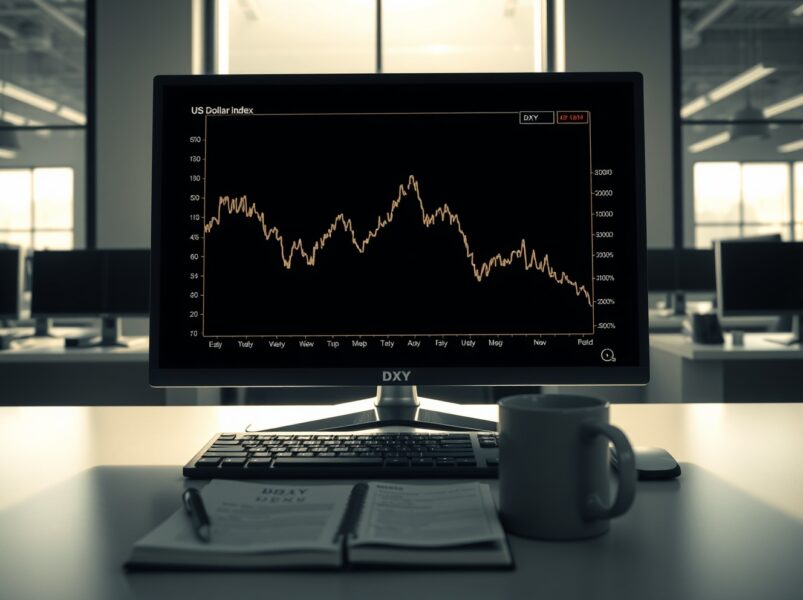
US Dollar: The Precarious Haven – TD Securities Warns of Limited Durability in Global Shifts
BitcoinWorld
US Dollar: The Precarious Haven – TD Securities Warns of Limited Durability in Global Shifts
Global financial markets face renewed uncertainty as TD Securities delivers a sobering assessment of the US dollar’s role as a conditional safe haven with questionable long-term durability. The analysis arrives amid significant monetary policy divergences and geopolitical realignments that challenge traditional currency dynamics. Market participants worldwide now scrutinize the dollar’s resilience against emerging economic headwinds.
Understanding the Conditional Haven Status
Historically, investors flock to the US dollar during periods of global stress. This flight-to-quality phenomenon stems from several structural advantages. The United States maintains the world’s deepest capital markets and most liquid government debt instruments. Furthermore, the dollar serves as the primary reserve currency for central banks globally. However, TD Securities analysts note these advantages face mounting pressures.
Recent market behavior illustrates this conditional nature. During the 2023 regional banking crisis, dollar strength proved pronounced but temporary. Conversely, during certain geopolitical tensions in 2024, dollar gains remained muted. The analysis identifies specific conditions that must align for haven demand to materialize effectively. These conditions include:
- Global risk aversion spikes that overwhelm regional concerns
- Federal Reserve policy positioning relative to other central banks
- US economic outperformance compared to major trading partners
- Absence of domestic US political or fiscal shocks
Structural Challenges to Dollar Durability
Multiple structural factors now threaten the dollar’s long-term strength according to the report. Persistent US fiscal deficits have pushed federal debt to historically high levels relative to GDP. Meanwhile, dedollarization efforts by several nations, though gradual, create incremental headwinds. The growth of alternative payment systems and digital currencies also introduces new variables.
Monetary policy divergence presents another critical challenge. The Federal Reserve’s current stance contrasts sharply with other major central banks. This divergence affects interest rate differentials that traditionally support dollar strength. The following table illustrates recent policy rate comparisons:
| Central Bank | Current Policy Rate | 2025 Projected Direction |
|---|---|---|
| Federal Reserve (US) | 4.50-4.75% | Holding steady |
| European Central Bank | 3.75% | Potential easing |
| Bank of England | 5.00% | Gradual cuts |
| Bank of Japan | 0.10% | Slow normalization |
Expert Analysis from TD Securities
TD Securities currency strategists emphasize that haven status depends heavily on relative rather than absolute strength. “The dollar doesn’t need to be fundamentally strong,” explains one senior analyst cited in the report. “It merely needs to appear stronger than alternatives during stress periods.” This relativity creates vulnerability as other economies stabilize their financial systems.
The analysis references historical precedents including the 2013 taper tantrum and 2020 pandemic panic. In both episodes, initial dollar strength eventually gave way to sustained weakness as conditions normalized. Current market pricing suggests investors anticipate a similar pattern. Futures positioning data shows reduced net-long dollar positions among institutional investors.
Global Economic Realignments and Impacts
Broader economic shifts further complicate the dollar outlook. Supply chain reconfiguration continues to alter global trade patterns. Regionalization efforts in both Asia and Europe reduce dollar-denominated transaction volumes over time. Additionally, commodity exporters increasingly accept alternative currencies in bilateral agreements.
Geopolitical fragmentation presents another durability challenge. The report notes that during multi-polar crises, haven flows often fragment along political lines. Some investors may seek Swiss francs or gold instead of dollars depending on crisis origins. This behavioral shift reduces the dollar’s capture rate during stress events.
Technological innovation also plays a role. The development of central bank digital currencies (CBDCs) could eventually facilitate direct currency swaps between nations. Such developments might bypass dollar clearing systems in certain transactions. While these changes remain incremental, they establish alternative infrastructure.
Market Implications and Investor Considerations
For portfolio managers, the analysis suggests several strategic adjustments. Currency hedging costs require more frequent reassessment given volatility expectations. Diversification across reserve currencies becomes increasingly important for risk management. Additionally, gold and other traditional havens may regain prominence in balanced portfolios.
The report specifically examines correlation patterns between dollar strength and various asset classes. These relationships have shown notable instability in recent quarters. For instance, the traditional inverse correlation between the dollar and emerging market assets has weakened considerably. This decoupling reflects changing global capital flows.
Conclusion
TD Securities presents compelling evidence that the US dollar’s haven status remains conditional and potentially less durable than historical patterns suggest. Structural economic shifts, policy divergences, and technological changes collectively challenge traditional assumptions. While the dollar maintains significant advantages, investors must recognize its evolving role in global finance. Prudent risk management now requires acknowledging these limitations within broader portfolio construction.
FAQs
Q1: What does “conditional haven status” mean for the US dollar?
Conditional haven status means the dollar attracts safe-haven flows only under specific circumstances rather than universally during all market stresses. The conditions include particular types of crises, favorable US policy positioning, and absence of domestic US vulnerabilities.
Q2: How does Federal Reserve policy affect dollar durability?
Federal Reserve policy crucially influences dollar strength through interest rate differentials. When the Fed maintains higher rates than other central banks, it typically supports dollar strength. However, if rate differentials narrow or if the Fed’s policy creates domestic instability, dollar durability suffers.
Q3: What are the main threats to the dollar’s reserve currency status?
Primary threats include persistent US fiscal deficits, dedollarization initiatives by other nations, development of alternative payment systems, geopolitical fragmentation reducing dollar usage in certain regions, and potential technological disruption from digital currencies.
Q4: How should investors adjust portfolios given this analysis?
Investors should consider diversifying currency exposure beyond dollar-denominated assets, reassess hedging strategies more frequently, increase allocations to alternative havens like gold or Swiss francs, and monitor correlation changes between dollar strength and other asset classes.
Q5: Is the dollar likely to lose its haven status completely in the near future?
Most analysts, including those at TD Securities, do not expect complete loss of haven status in the immediate future. The more likely scenario involves gradual erosion and increased conditionality, with the dollar remaining important but facing more competition during stress periods.
This post US Dollar: The Precarious Haven – TD Securities Warns of Limited Durability in Global Shifts first appeared on BitcoinWorld.
You May Also Like

CEO Sandeep Nailwal Shared Highlights About RWA on Polygon

USD/CAD Consolidation Holds with Firm Support – Scotiabank’s Crucial Analysis