

Second Bitcoin ETF issuer predicts BTC hitting $1M – but cuts timeline to within the next US Presidential term
Matthew Sigel of VanEck said Bitcoin could reach $1 million by the next US Presidential term.
That puts a 1,150% increase as a 2031 target inside a market that is still trying to prove it can hold the $80,000 area.
CryptoSlate's Bitcoin page shows BTC near $80,200 on May 9, with a market capitalization near $1.61 trillion and an all-time high of $126,198 set on Oct. 6, 2025.
A move to $200,000, another price target being batted around lately, would require Bitcoin to rise roughly 2.5 times from that level. A move to $1 million would require roughly 12.5 times.
Bitcoin has produced larger percentage moves before, but the current forecast cycle now rests on a market question: whether the latest institutional demand is strong enough to absorb coins being sold into the rebound.
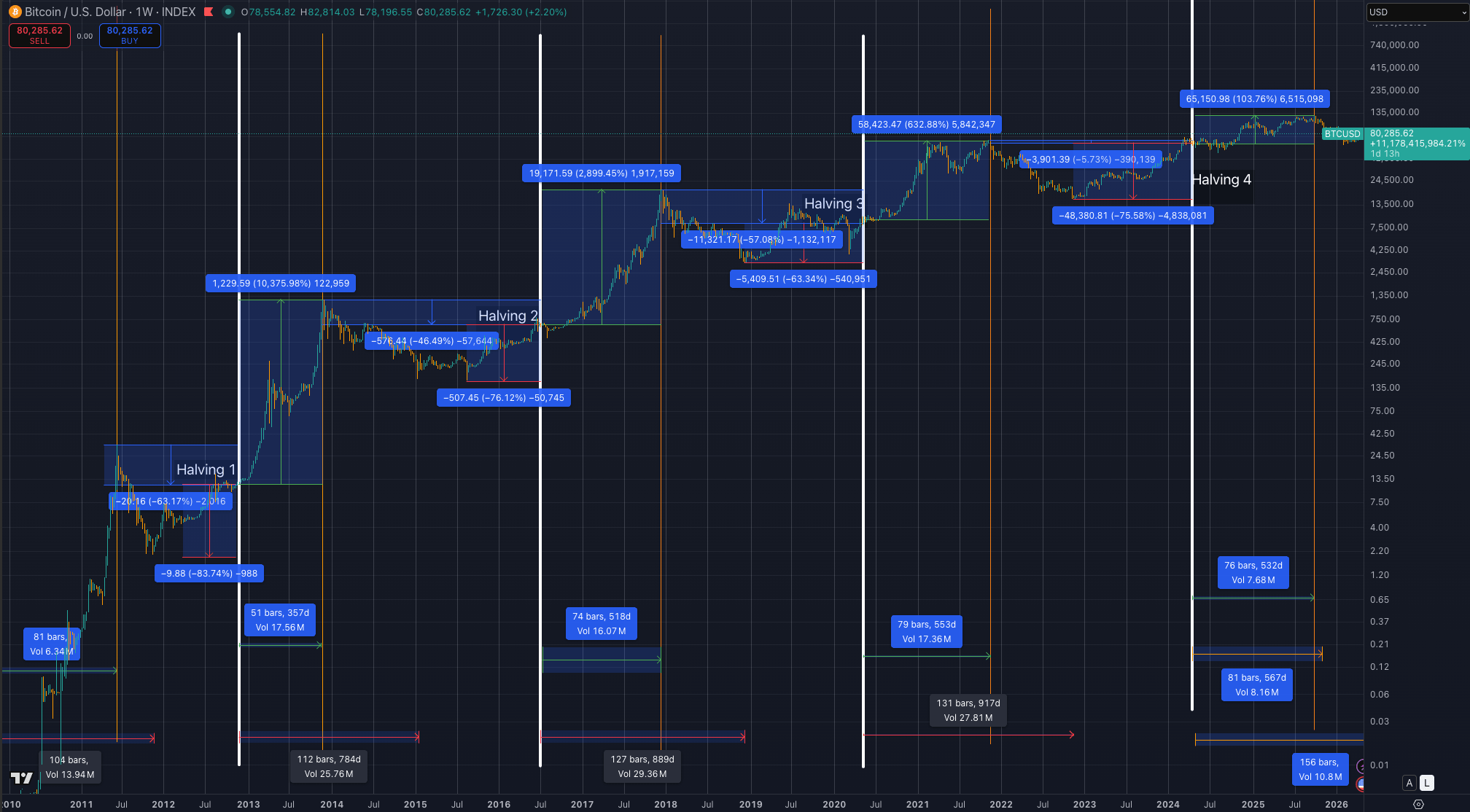 Bitcoin price chart showing projected Bitcoin cycle highs and pullbacks across multiple halving periods.
Why seven-figure math is back
The VanEck call lands alongside other seven-figure frameworks. Bitwise CIO Matt Hougan laid out a formal $1 million model in March, arguing that Bitcoin can reach seven figures by gaining share as the store-of-value market expands.
In his model, the market grows to about $121 trillion over 10 years, and Bitcoin reaches $1 million if it captures about 17% of the total.
That is a different time horizon from Sigel's reported five-year view, but the logic overlaps. Both depend less on a single trading catalyst and more on Bitcoin becoming a larger part of how institutions, advisers, sovereign entities, and younger investors think about long-term savings outside the fiat banking system.
VanEck's own research desk had already published a longer-range version of that argument. In a 2024 Bitcoin 2050 scenario, the firm modeled a possible $2.9 million Bitcoin price by 2050 if BTC becomes a meaningful medium of exchange and reserve asset.
That report used assumptions around trade settlement, reserve holdings, and Bitcoin scaling infrastructure. The newly reported call is more immediate, but it comes from the same broad research posture: Bitcoin as a macro asset whose valuation depends on adoption beyond crypto-native buyers.
If the thesis is only a trading call, the next resistance level carries most of the weight. If the thesis is that adoption math, ETF flows, portfolio allocation, sovereign reserve behavior, and the size of the global store-of-value market carry more weight than a single weekly candle.
The near-term price frame is less clean. Fundstrat's Tom Lee's $200,000 to $250,000 Bitcoin range for 2026 should also be part of the conversation.
Prior CryptoSlate coverage had already placed Lee's $200,000 forecast among a wide 2026 target set that also included more conservative and more aggressive institutional calls.
Arthur Hayes, the Maelstrom CIO and BitMEX co-founder, is cited as aiming for a shorter-term $125,000 target tied to liquidity and war-driven spending.
Together, those calls make Bitcoin look like it is re-entering a target-heavy phase. Hayes' framework is macro-liquidity and event-driven. Lee's is a 2026 market-cycle view.
Bitwise's model is a store-of-value share calculation. VanEck's reported call compresses a seven-figure outcome into roughly half a decade.
That difference should keep us grounded. A cluster of bullish forecasts can shift sentiment, but the market structure still has to carry the price there. The Fear and & Greed Index still sits firmly in the ‘fear' category.
The low-$80,000 test carries the forecast
Recent CryptoSlate coverage framed Bitcoin's rebound above $80,000 as a live test between seller supply and ETF demand. Long-term holders have been taking profits into strength, while spot Bitcoin ETF buyers have helped absorb supply.
That standoff is why the $90,000 area keeps appearing as the next upside test.
The bullish version is straightforward. If ETF demand continues to absorb coins from older holders, the low-$80,000 range could become a base rather than a ceiling. From there, a move toward $90,000 would provide the market with evidence that institutional access is doing real price-discovery work, rather than merely softening a rebound.
That would still leave $200,000 as a stretch target. It would, however, make six-figure 2026 targets easier to discuss without treating them as detached from traded demand.
A market that can hold $80,000, push through $90,000, and do it on broad spot demand would look more compatible with the Fundstrat-style bull case than a market that keeps rejecting the same supply zone.
The failure case is just as important. If ETF demand fades while long-term holders continue selling into rallies, the $1 million conversation becomes a long-horizon adoption argument rather than an explanation for the current price.
In that case, the five-year and 10-year targets can remain intellectually coherent while the 2026 market still struggles to escape its range.
That tension separates price targets from the evidence that would make them relevant now. Bitcoin can leave the $1 million debate unresolved for now. It needs to show whether the buyers who arrived through ETFs and institutional channels are still willing to absorb supply near levels that recently acted as resistance.
The practical threshold is therefore smaller than the largest target on the board. A clean $90,000 push would not validate seven-figure math, but it would show that the market can handle seller pressure while fresh capital still reaches spot Bitcoin products.
What would change the market signal next
Bitcoin needs to hold the low-$80,000 area and then attack $90,000 with enough spot demand to make the move look durable.
ETF flow data, long-term holder distribution, and any fresh confirmation of the VanEck comments will carry more weight than another round number from an executive or strategist.
The seven-figure targets are moving the debate away from whether Bitcoin can regain its 2025 high and toward whether the asset can claim a larger share of global savings. That is a much larger argument than a technical breakout, but it still needs the current market to cooperate.
For now, the credible takeaway is that institutional researchers are again willing to publish or defend seven-figure math while the market tests whether ETF-era demand can turn $80,000 from a stress point into a launch point.
The post Second Bitcoin ETF issuer predicts BTC hitting $1M – but cuts timeline to within the next US Presidential term appeared first on CryptoSlate.


You May Also Like

Positive Sentiment Prevails in XRP ETFs: Here Are the Latest Data

SHIB Price Prediction: Critical $0.0000085 Target Emerges as Bears Challenge Bulls




