

AI News: Solana’s Anatoly Warns AI Could Break Post-Quantum Security
Key Insights:
- AI News: Anatoly Yakovenko warns AI could crack post-quantum cryptography.
- Hidden risks in PQC math and real-world deployment remain unclear.
- Ethereum L2s may face future quantum threats and “harvest now, decrypt later” risks.
As the crypto industry is largely concentrating on potential quantum computing threats, fresh AI news is garnering attention. In the latest update, Solana co-founder Anatoly Yakovenko has warned that AI could pose a serious threat to post-quantum cryptography.
Notably, Yakovenko noted that artificial intelligence could expose the weaknesses that the crypto industry couldn’t understand yet. His remarks highlight not just theoretical risks, but also the practical challenges of safely deploying these next-generation security systems.
AI News: Anatoly Yakovenko Flags Risks in PQC Security
Solana Co-Founder Anatoly Yakovenko recently took to X to share his thoughts on quantum computing and the potential risks AI could pose.
In his X post, the Solana co-founder noted that the biggest risk facing post-quantum cryptography today is the possibility that AI could eventually break its signature schemes.
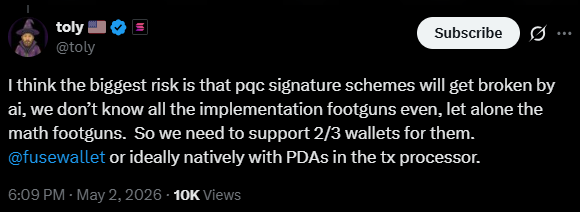 Quantum Computing AI News | Source: Anatoly Yakovenko, X
As per the AI news, Yakovenko further added that the crypto industry still lacks a clear understanding of the potential weaknesses in these systems. The industry not only lacks knowledge in terms of complex mathematics, but also in how they are implemented in real-world applications.
Considering this aspect, Anatoly Yakovenko shared this quantum computing-related AI news. He warned that hidden risks or “footguns” could emerge during deployment, making these solutions less secure than expected.
To address this issue, he suggested adding extra safeguards, such as 2/3 multi-signature wallet support. He added that even integrating native protection through Program Derived Addresses (PDAs) at the transaction processing level could do.
Overall, his message in this AI news is clear. He means that even next-generation cryptographic solutions are not foolproof. Thus, the industry needs to prepare for unexpected risks, especially as artificial intelligence continues to evolve.
Ethereum L2s May Not Be Ready for Quantum Threats, Says Yakovenko
In addition to the latest AI news, Anatoly Yakovenko has also shared another major quantum computing update.
On May 2, the Solana co-founder stated, “Ethereum L2s are not quantum safe, abandon all hope.” It is worth noting that Yakovenko’s remarks came in response to a developer update highlighting Solana’s progress in post-quantum cryptography.
The update showed ongoing work on integrating Falcon-512, a quantum-resistant signature scheme designed to withstand attacks from future quantum computers.
Efforts by Solana clients like Anza and Firedancer suggest the network is actively moving toward bringing these protections into real-world use.
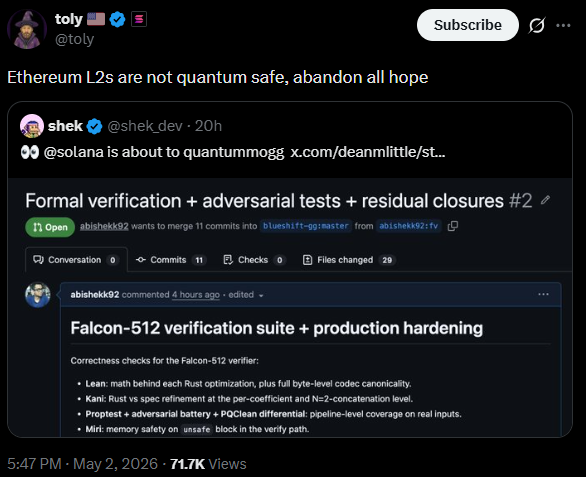 AI News: Solana Co-Founder About Quantum Threats | Source: X
Meanwhile, he criticizes Ethereum Layer 2 networks. He says that those chains still rely heavily on traditional cryptographic systems. He added that most L2 wallets today use the Elliptic Curve Digital Signature Algorithm (ECDSA), particularly the widely used secp256k1 curve.
Even though it is currently safe from attack, it can be rendered unsafe by developments in quantum computing. Furthermore, the AI news showed that the Solana founder raised a crucial problem.
The problem pointed out was the fact that once transactions are posted to the network, the related public keys will be exposed. What follows is the risk of using “harvest now, decrypt later” attacks on these transactions.
To put it simply, the malicious parties can harvest the information today and decrypt it once quantum computing technology is developed enough to break the encryption. Algorithms like Shor’s algorithm can be used for the decryption process.
The post AI News: Solana’s Anatoly Warns AI Could Break Post-Quantum Security appeared first on The Coin Republic.


You May Also Like
Altcoin Season Index Stalls at 43: Critical Shift in Crypto Market Trends

Google selects Nigerian Startups for Elite Africa Accelerator




