

DeepSeek AI Predicts the Price of Solana, Cardano and Dogecoin by The End of 2026
The first few months of 2026 have delivered a mixed bag for cryptocurrency holders, with major assets trading well below their all-time peaks while showing signs that a rotation back into altcoins could be building.
DeepSeek AI has analyzed current market structure, on-chain metrics, and historical patterns to generate price projections for Solana, Cardano, and Dogecoin through the end of this year.
These scenarios consider everything from macroeconomic conditions to network-specific developments that could shape each project’s trajectory.
Solana Price Performance During Early 2026 Shows Deep Correction From Peak Levels
Solana entered 2026 after a remarkably strong previous cycle, but the last few months have told a different story. Trading around $94.60 in mid-March, SOL sits approximately 67.85% below its all-time high near $294.33. The numbers reveal a market in transition.
| Metric (mid Mar 2026) | Solana (SOL) | Why it matters |
|---|---|---|
| Approx current price | ~$94.60 | Backed out from ATH and drawdown |
| Market cap | $54.08 B | Large liquid L1, institutionally watchable |
| 24h volume | ~$6.00 B | Deep liquidity, supports large flows |
| 7d change | +8.44% | Short term momentum has turned positive |
| 30d change | +5.03% | Modest recovery from early 2026 lows |
| 1y change | −26.53% | Still down over last year |
| YTD 2026 change | −25.35% | 2026 has been a net drawdown so far |
| Drawdown from ATH (~$294.33) | ~67.85% below peak | Still far from prior cycle high |
The broader market context helps explain Solana’s position. Total crypto market cap sits at roughly $2.54 trillion, down about 7.7% from a year ago. Altcoin market cap hovers near $1.05 trillion, only slightly below last year’s levels but approximately 40% off its late-2025 peak.
The Altcoin Season Index reads near neutral at about 49, though this represents a sharp rise from last month and suggests capital might finally rotate from Bitcoin into higher beta alternatives.
What Could Drive Solana Price Action Through The Rest Of 2026
Solana faces a defining year in terms of whether it transforms from a fast layer-1 narrative into genuinely exchange-grade infrastructure. Network reliability sits at the top of the watch list.
Consistent uptime and predictable finality would allow institutions to treat Solana as core infrastructure, potentially driving more order flow and on-chain liquidity. Another year of congestion or downtime would seriously limit that institutional shift.
Throughput improvements also matter enormously. The roadmap targets latency reductions and block-production redesign through proposal-builder separation and multiple concurrent proposers.
Success here strengthens the thesis of Solana as an order-book chain and could attract high-frequency trading activity, options venues, and decentralized exchanges built around order books.
Validator and client diversity represents another crucial factor. More independent clients reduce censorship risk and single-implementation vulnerabilities, which sophisticated capital monitors closely. Any critical bug or exploit would damage the institutional narrative significantly.
Ecosystem development beyond speculative memes will determine whether Solana becomes a base layer for consumer applications like payments, gaming, and NFTs, plus serious DeFi and real-world asset rails. Regulatory treatment of high-performance layer-1s adds another variable, with compliant structures potentially greenlighting more institutional products.
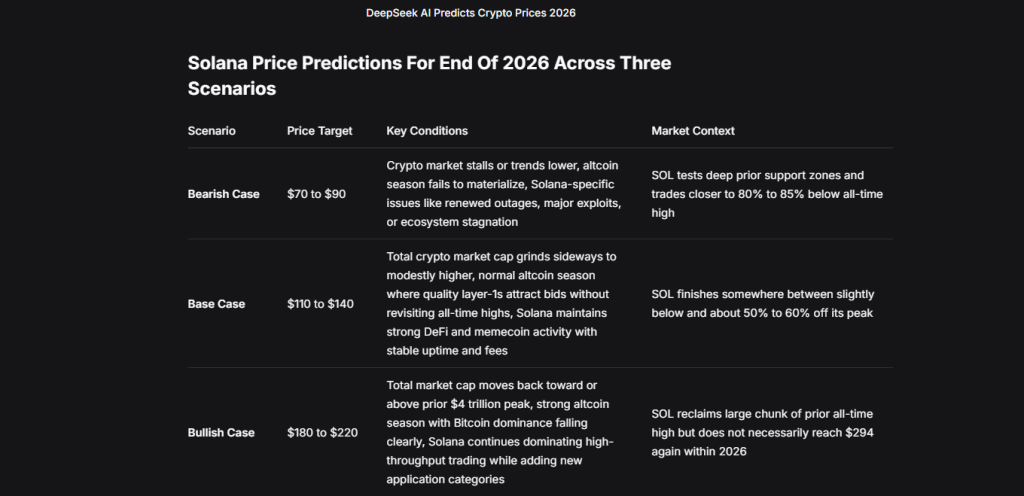
Solana Price Predictions For End Of 2026 Across Three Scenarios
Starting from the current zone near $95, DeepSeek AI generated three distinct paths for SOL through year-end.
The bearish case lands roughly between $70 and $90. This scenario would likely accompany a crypto market that stalls or trends lower, an altcoin season that fails to materialize, or Solana-specific issues such as renewed outages, major exploits, or ecosystem stagnation. SOL could test deep prior support zones and trade closer to 80% to 85% below its all-time high.
 Source: DeepSeek AI
The base case ranges from approximately $110 to $140. Conditions supporting this outcome include total crypto market cap grinding sideways to modestly higher, a normal altcoin season where quality layer-1s attract bids without revisiting all-time highs, and Solana maintaining strong DeFi and memecoin activity with stable uptime and fees. SOL would finish 2026 somewhere between slightly below and about 50% to 60% off its peak.
The bullish case projects $180 to $220. This would need total market cap moving back toward or above its prior $4 trillion peak, a strong altcoin season with Bitcoin dominance falling clearly, and Solana continuing to dominate high-throughput trading while adding new application categories. SOL might reclaim a large chunk of its prior all-time high but still not necessarily reach $294 again within 2026.
Cardano Performance Through Early 2026 Reveals Deeper Drawdown Than Solana
Cardano presents a different profile entirely, sitting much deeper in its drawdown and showing slower conversion of its long roadmap into dominant application usage. Trading near $0.29 in mid-March, ADA sits approximately 90.75% below its all-time high near $3.10.
| Metric (mid Mar 2026) | Cardano (ADA) | Why it matters |
|---|---|---|
| Approx current price | ~$0.29 | Backed out from ATH and drawdown |
| Market cap | $10.35 B | Large cap but well below top L1s |
| 24h volume | ~$0.84 B | Liquidity solid but smaller than SOL |
| 7d change | +7.32% | Short term bounce |
| 30d change | −3.13% | No clear uptrend over the month |
| 1y change | −60.46% | Heavy underperformance over the last year |
| YTD 2026 change | −19.52% | 2026 is negative so far |
| Drawdown from ATH (~$3.10) | ~90.75% below peak | Deep in prior cycle drawdown |
The context matters significantly here. While total crypto market cap dropped only about 7% to 8% over the last year, ADA fell more than 60%.
This suggests either valuation reset, narrative fatigue, or loss of relative positioning among layer-1 platforms. Year-to-date numbers show continued pressure, though the last seven days produced a modest bounce.
Key Factors That Could Influence Cardano Price During 2026
Cardano’s 2026 story revolves less around raw throughput and more around whether governance mechanisms and roadmap execution translate into real enterprise and institutional usage. On-chain governance effectiveness stands as perhaps the most critical variable.
The platform pushes institutional-grade governance with decentralized stakeholder voting, a Constitutional Committee, and active treasury participation. Efficient governance without gridlock strengthens ADA’s positioning as a serious long-term platform, while slow politics or capture becomes a narrative drag.
Delivery of major upgrades including the van Rossem hard fork and Hydra matters enormously. These upgrades target 1,000 to 10,000 transactions per second while preserving security. Timely implementation with working applications builds confidence, while delays or broken releases reinforce perceptions that Cardano moves slowly.
Critical integrations from the 2026 roadmap deserve attention as well. Governance-funded projects including tier-1 stablecoins, enterprise-grade oracles, Bitcoin DeFi access, institutional privacy tools, custody solutions, and secure cross-chain bridges will determine whether Cardano becomes a credible real-world asset and DeFi hub or remains mostly a staking chain.
Treasury and funding dynamics also play a role. A self-sustaining ecosystem requires the treasury to fund infrastructure and key applications rather than vanity projects. Predictable funding keeps serious teams around, while misallocation pushes builders to other chains.
Cardano Price Projections For End Of 2026 Across Multiple Scenarios
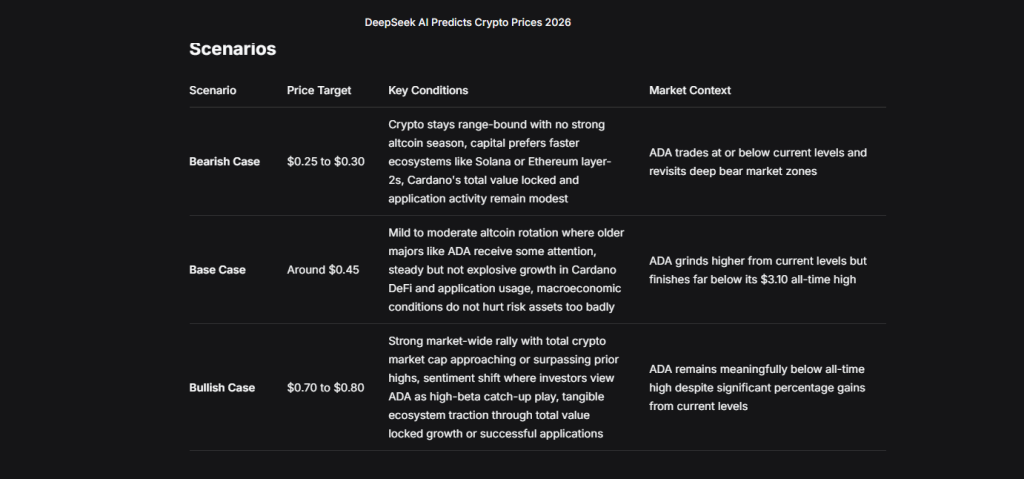
Starting from the current zone near $0.29, DeepSeek AI generated three scenarios based on ADA’s history of large cycle swings.
The bearish case falls around $0.25 to $0.3. This could occur if crypto stays range-bound with no strong altcoin season, capital keeps preferring faster ecosystems like Solana or Ethereum layer-2s, and Cardano’s total value locked and application activity stay modest. ADA could trade at or below current levels and revisit deep bear market zones.
 Source: DeepSeek AI
The base case ranges around $0.45. This assumes a mild to moderate altcoin rotation where older majors like ADA receive some attention, steady but not explosive growth in Cardano DeFi and application usage, and macroeconomic conditions that do not hurt risk assets too badly. ADA might grind higher from current levels but finish far below its $3.10 all-time high.
The bullish case projects $0.7 to $0.80. This would need a strong market-wide rally with total crypto market cap approaching or surpassing prior highs, a sentiment shift where investors view ADA as a high-beta catch-up play, and tangible signs of ecosystem traction through total value locked growth or successful applications. Even here ADA would remain meaningfully below its all-time high.
Dogecoin Price Performance During Early 2026 Shows Continued Cooling Period
Dogecoin trades near $0.10 in mid-March, sitting approximately 86% below its all-time high of $0.73757. The numbers reveal a market in post-bubble territory.
| Metric | Dogecoin (DOGE) | Interpretation |
|---|---|---|
| Current price | $0.10 | Around ten cents per coin |
| 24h change | −0.50% | Flat to slightly negative daily move |
| 7d change | +6.00% | Small positive weekly bounce |
| 30d change | −11.99% | Down low double digits over roughly one month |
| 1y change | −42.03% | Large drawdown over last year |
| Market cap | $17.05 B | Large cap meme coin |
| 24h volume | $2.02 B | Very liquid, heavily traded |
| All time high price | $0.73757 | Peak during prior mania |
| Drawdown from ATH | ~86% below ATH | Price is ~7.3x lower than the peak |
The 30-day and one-year changes show DOGE grinding in a downtrend or sideways range through early 2026 without any fresh breakout. Despite this, market cap and volume confirm that liquidity remains extremely deep, meaning large moves can be absorbed without Dogecoin disappearing. The speculative crowd remains willing to trade short-term swings.
What Really Drives Dogecoin Price In 2026
Dogecoin responds much less to protocol innovation and much more to culture, payments adoption, and regulatory framing of meme assets. Development momentum remains minimal compared to modern layer-1s, with limited significant upgrades and no smart contract functionality. Any credible move toward technical upgrades would create a narrative shock.
Security through merged mining with Litecoin provides a quiet but important fundamental. As long as Litecoin mining remains economically viable, Dogecoin benefits from higher hashrate that makes attacks expensive. If Litecoin mining shrinks, Dogecoin’s security assumptions could face questions.
Real-world payments and integrations will shape the medium-term outlook. Sustained merchant and platform adoption would improve relevance, while lack of such moves keeps DOGE in pure-meme territory. The community provides genuine stamina and resilience, but this does not automatically compound into long-term infrastructure without parallel technical and ecosystem growth.
Regulatory treatment of meme coins adds uncertainty. Future actions pressuring exchanges to delist highly speculative tokens could hurt DOGE’s liquidity and accessibility, while a hands-off approach that leaves established memes unbothered would prove supportive.
Read Also: Kaspa vs. Ethereum: Could KAS Really Overtake ETH?
Macro conditions and crypto-wide liquidity drive DOGE more than any internal metric. The coin performs best when total market cap rises and Bitcoin volatility runs high. In risk-off environments, DOGE usually underperforms relative to Bitcoin and larger utility majors because it offers no cash flow or fundamental yield argument.
Dogecoin Price Scenarios For End Of 2026 From Current Levels
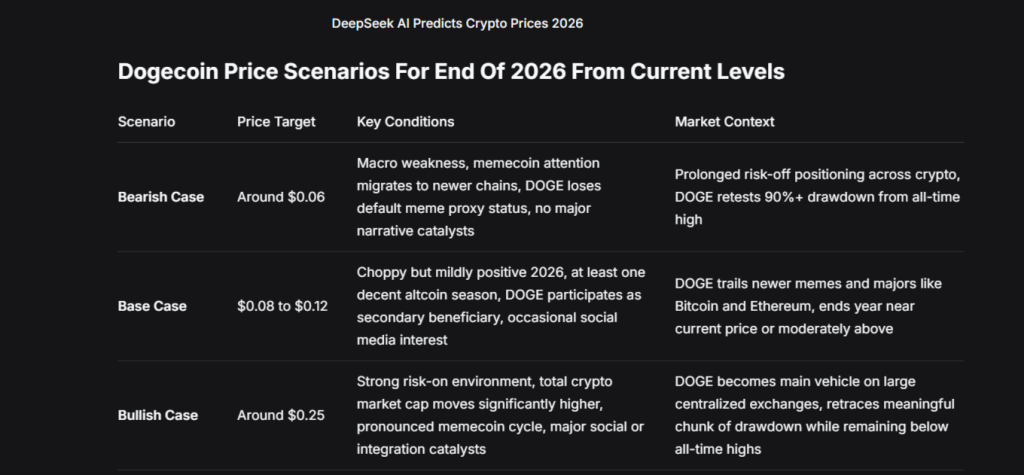
Starting from approximately $0.10, with roughly 12% losses over 30 days, about 42% losses over one year, and an 86% drawdown from all-time highs, DeepSeek AI generated three scenarios.
The bearish case lands around $0.06. This could happen if macro conditions weaken and crypto sees prolonged risk-off positioning, memecoin attention migrates mostly to newer chains while DOGE loses status as default meme proxy, and no major narrative catalyst emerges. DOGE might retest deep prior bear-market ranges, perhaps 90% or more below its all-time high.
 Source: DeepSeek AI
The base case ranges from $0.1 $0.12. This assumes crypto has a choppy but mildly positive 2026 with at least one decent altcoin season. DOGE participates but as a secondary beneficiary behind newer memes and majors like Bitcoin and Ethereum. Social media interest spikes occasionally but not to 2021 levels. DOGE could end the year around current price or moderately above it.
The bullish case projects around $0.25. This would need a strong risk-on environment where total crypto market cap moves significantly higher, a pronounced memecoin cycle where DOGE again becomes a main vehicle on large centralized exchanges, and one or more major social or integration catalysts bringing DOGE back into mainstream attention. DOGE might retrace a meaningful chunk of its drawdown.
Read Also: The Brutal Reason Most XRP Holders Will Never Become Millionaires
Markets now wait to see whether geopolitical tensions, macroeconomic shifts, and crypto-specific developments push these assets toward the upper or lower bounds of their projected ranges. The next few months will reveal whether the rotation into altcoins continues building or fades once again.
Subscribe to our YouTube channel for daily crypto updates, market insights, and expert analysis.
The post DeepSeek AI Predicts the Price of Solana, Cardano and Dogecoin by The End of 2026 appeared first on CaptainAltcoin.
You May Also Like

Top 9 decentralised exchanges to trade on in March 2026

Whale Dumps Almost 15 Billion SHIB After Two-Year Hold At 83% Loss, But There Is A Catch ⋆ ZyCrypto

