

AI-Driven Growth Revives Inflation Concerns, Clouding Fed Rate Plan
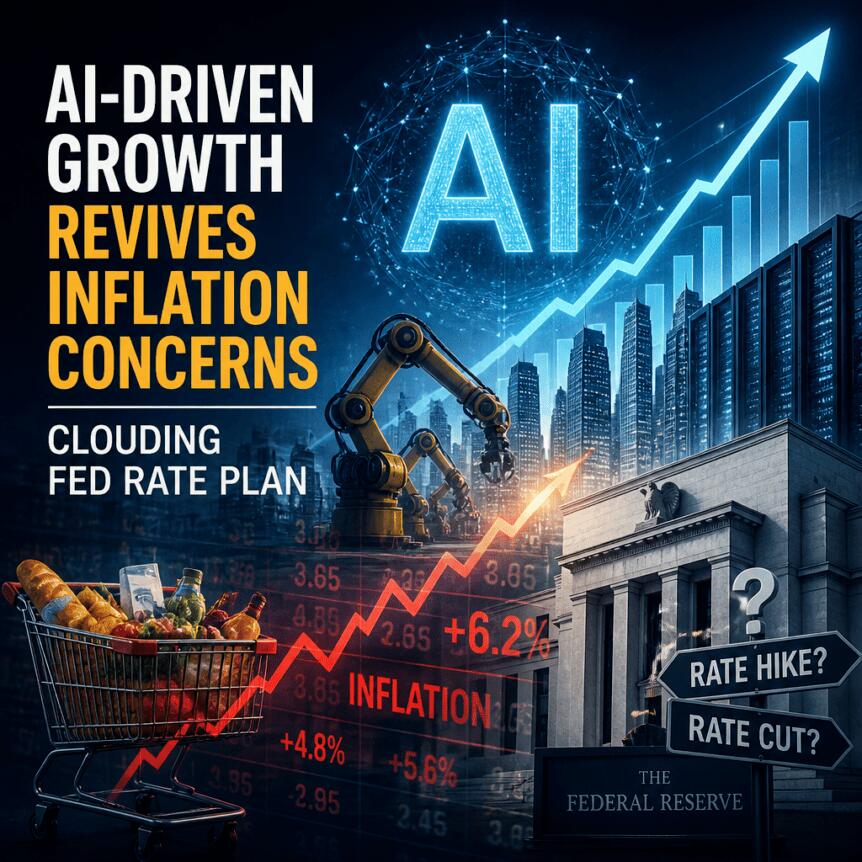
Federal Reserve officials were divided last month on whether to raise interest rates or keep them steady, as meeting minutes released Wednesday pointed to accelerating demand for artificial intelligence infrastructure as a factor sustaining inflation.
The minutes cover the first Federal Open Market Committee (FOMC) meeting under Chair Kevin Warsh and highlight how strong AI-driven spending may keep prices elevated for certain technology inputs—especially chips—and for electricity used to power data centers.
Key takeaways
- FOMC meeting minutes cited “ongoing strong demand for AI infrastructure” as likely to sustain upward pressure on prices for technology products and electricity.
- Officials expected inflation to stay “elevated in the near term,” with risks still “tilted to the upside.”
- Projections implied a hawkish path: the “dot plot” showed hikes, not cuts, with many members expecting at least one increase before the end of 2026.
- The Fed’s year-end PCE inflation projection rose, reinforcing the view that policy may remain restrictive for longer.
AI demand enters the Fed’s inflation discussion
According to the minutes, many participants argued that demand for AI infrastructure is acting as an inflation support rather than a one-time impulse. They specifically noted that continued demand for technology products and electricity could keep price pressures from fading quickly.
In practice, the minutes’ logic points to the economics of AI buildouts: higher demand for semiconductors used by data centers, combined with competition for energy, can lift consumer prices across a wide range of electronic goods, devices, and power-related costs. This process is often described in policy and financial circles as “chipflation.”
For crypto and other risk-sensitive assets, the implication is straightforward: higher inflation tends to reduce liquidity and spending power while supporting higher interest rates—conditions that can weigh on speculative exposure.
Near-term inflation expected to remain sticky
Fed participants anticipated inflation would remain “elevated in the near term.” They also discussed the possibility that disinflation could improve if the Middle East conflict eases, but they judged that the overall balance of risks to inflation was still skewed upward.
AI played a dual role in these deliberations. The minutes state that strong AI-related investment can lift growth above potential output, which can in turn contribute to more persistent inflationary pressure—essentially keeping demand strong while costs remain elevated for critical inputs.
Dot plot and projections reinforce “higher for longer”
While the minutes reflect a split among officials, the broader policy signal leaned hawkish. The Fed’s dot plot, as cited in the report, suggested rate increases rather than cuts. Nine of 18 voting members projected at least one rate hike before the end of 2026, while six expected two 25-basis-point increases.
Inflation expectations also moved in the minutes’ framing: the central bank’s PCE inflation projection for year-end increased from 2.7% to 3.6%. Together, those changes point to an outlook where the Fed may need to tolerate a longer period of restrictive policy to bring inflation back toward target.
At the Fed’s June meeting, rates were held steady at 3.5% to 3.75%. In parallel, CME futures markets indicated a roughly 70% probability that rates would remain unchanged at the next meeting scheduled for July 29, according to the CME FedWatch tool.
Why AI infrastructure may complicate monetary policy
One notable theme in the discussion was how AI infrastructure buildout can produce near-term inflation pressure even while promising longer-term productivity improvements. Nick Ruck, director of LVRG Research, told Cointelegraph that the Fed’s recent meeting underscores this tension: massive AI infrastructure expansion can lift inflation through surging demand for semiconductors, energy, and data centers, even as it sets the stage for productivity gains over time.
That mix matters because it challenges a common policy assumption that technological investment uniformly improves efficiency quickly enough to ease inflation. If the cost of deploying AI systems remains concentrated in specific supply chains and energy systems, the benefit to productivity may arrive later than the price pressure created by demand for the underlying infrastructure.
Ruck’s comments also framed the issue as one that may require solutions beyond traditional monetary tools—particularly approaches that improve how resources are allocated and reduce bottlenecks in the digital economy. While the minutes focused on conventional price dynamics, the investor takeaway is that AI-driven inflation can interact with monetary policy in ways that are harder to neutralize quickly.
What it could mean for crypto market conditions
In general, elevated inflation and restrictive rate expectations tend to tighten financial conditions, which can reduce risk appetite and liquidity. The minutes’ emphasis on technology and electricity price pressures strengthens the case that inflation may not fall as quickly as some investors might hope, especially if AI-related capex continues expanding.
At the same time, investors are also watching for how the Fed’s approach could evolve if inflation pressures prove to be structural rather than transitory. That question is likely to remain central for markets, including crypto, where broader liquidity conditions often play an outsized role in determining price behavior.
Readers should watch the next phase of Fed communication for signs that officials see AI-related inflation as temporary supply bottlenecks or as a more persistent feature of the pricing environment—because that distinction could shape how long “higher for longer” expectations last and, by extension, how supportive macro conditions remain for risk assets.
This article was originally published as AI-Driven Growth Revives Inflation Concerns, Clouding Fed Rate Plan on Crypto Breaking News – your trusted source for crypto news, Bitcoin news, and blockchain updates.


You May Also Like

Russia's largest private bank Alfa-Bank tests crypto trading

Zapper DeFi Dashboard Shuts Down After $15M Backing

Solana FUD Hits 2026 High As SOL Volume Falls To Yearly Low



