

European Equities Surge to Record Peaks Amid Shifting Central Bank Outlook
Key Takeaways
- Both the STOXX 600 and DAX indices achieved unprecedented all-time peaks during Friday’s trading session, with the STOXX 600 posting its strongest weekly performance in more than four weeks
- Weaker-than-anticipated U.S. employment figures diminished market expectations for an imminent Federal Reserve interest rate increase
- Christine Lagarde, President of the European Central Bank, indicated that inflation and economic expansion risks are achieving greater equilibrium, reducing urgency for additional rate hikes
- Siemens shares surged following a rating upgrade from Kepler Cheuvreux, moving from “reduce” to “hold” status
- L’Oreal shares declined after J.P. Morgan issued concerns regarding the company’s second-half performance outlook
European equity markets climbed to unprecedented territory on Friday, concluding a robust trading week as subdued U.S. employment statistics and more measured central bank communication bolstered market sentiment.
The pan-European STOXX 600 index momentarily reached a historic peak during trading hours, advancing approximately 0.2% to 649.86 points. Germany’s benchmark DAX index similarly achieved a record level, climbing 0.5% for the session. Over the weekly period, the STOXX 50 surged 2.3% while the STOXX 600 advanced 1.9% — marking its most impressive weekly gain in approximately four weeks.
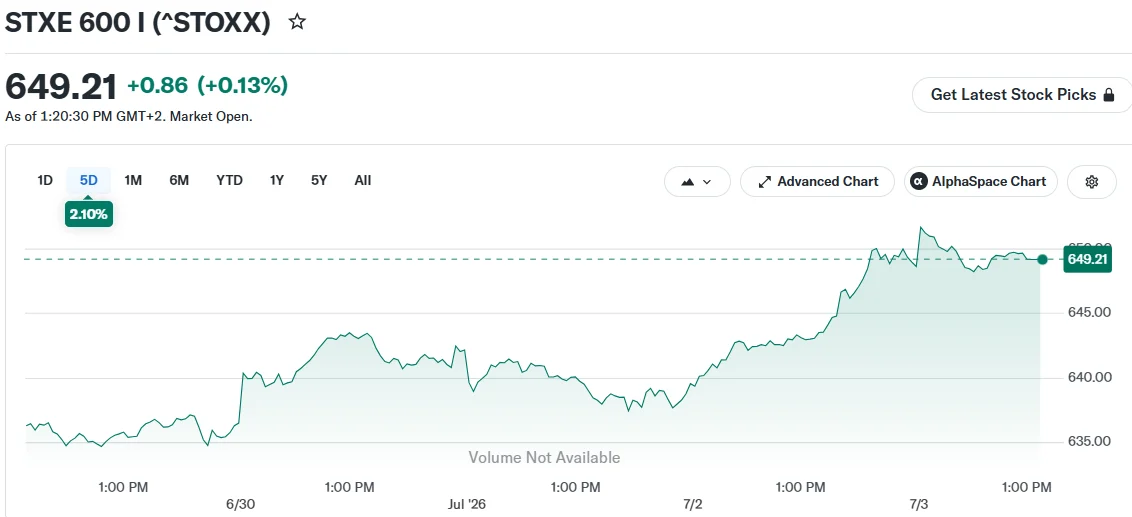 STXE 600 I (^STOXX)
The upward momentum extended across multiple sectors, with technology, industrials, banking, automotive, and utility stocks all recording positive movements.
U.S. Employment Report Shifts Market Sentiment
The primary driver behind this market advance was Thursday’s U.S. non-farm payrolls data, which fell short of analyst projections. This employment report prompted investors to reduce their expectations for a Federal Reserve rate increase at the upcoming September policy meeting.
Prior to the employment data release, financial markets had priced in over 60% probability of a Fed rate hike in September, influenced partially by initial statements from recently appointed Fed Chair Kevin Warsh. Following the data publication, market expectations pivoted toward maintaining current rates until at least October.
A more dovish Federal Reserve stance holds significant implications for European financial markets. It alleviates upward pressure on international financing costs and diminishes capital outflows from the eurozone toward elevated U.S. Treasury yields.
ECB Commentary Reinforces Market Optimism
European Central Bank President Christine Lagarde contributed to the constructive market atmosphere during the ECB’s annual symposium in Sintra, Portugal. She stated that threats to eurozone inflation and economic expansion are achieving better balance — a subtle linguistic adjustment that investors interpreted as reduced urgency for continued monetary tightening.
Earlier during the week, eurozone inflation statistics for June registered below market forecasts. Market participants currently anticipate merely 23 basis points of total ECB rate increases throughout the remainder of the calendar year.
Advancements in U.S.-Iran diplomatic negotiations also provided support, driving crude oil prices downward and alleviating supply chain constraints for European corporations.
Individual Stock Performance
Siemens emerged as the leading performer on the DAX, surging approximately 1.7% to 1.8% following Kepler Cheuvreux’s decision to upgrade the shares to “hold” from “reduce.”
Semiconductor stocks also demonstrated strong performance. Soitec and Aixtron each climbed 4.1%, while BE Semiconductor advanced 3.6%. Technology stocks had previously recorded their most substantial quarterly gains since 2001 earlier in the week, propelled by the worldwide artificial intelligence investment boom.
French employee benefits provider Pluxee increased 5.3% after reporting a more modest-than-projected decline in third-quarter organic revenues.
Among declining stocks, L’Oreal retreated approximately 2.6% following J.P. Morgan’s projection of weaker second-half results for the beauty products manufacturer. Kering similarly declined around 1.9%.
Defence sector equities edged upward following news reports of Russia’s most devastating military action against Ukraine this year, with market participants anticipating elevated defence budget allocations.
In London, the FTSE 100 declined 0.3%, pressured by its substantial commodity sector weighting. Pirelli gained 2% on speculation regarding potential stake purchases from Czech corporate interests, while Auto1 Group rose 2% after J.P. Morgan included it on its positive catalyst monitoring list.
Trading activity was anticipated to remain subdued due to a United States public holiday.
The post European Equities Surge to Record Peaks Amid Shifting Central Bank Outlook appeared first on Blockonomi.


You May Also Like

Why Businesses Need Professional Machine Design and Development Services

PH victories needed to prevent domination by one party, says Loke


