The retired college professor fighting a $313 trespassing ticket in Wisconsin thinks he’s part of a national struggle
“Lake Michigan has sort of got a personality,” Paul Florsheim said wryly, as if describing an old friend rather than the center of a legal battle that has consumed the last year of his life. “It changes its moods all the time. I go all throughout the year, even in the bitterest part of winter, because it’s just beautiful down there. You have these ice flows, and they’re sort of like volcanoes, and the waves come crashing through these structures. It’s like another world.”
Florsheim has been walking that world, a stretch of the Lake Michigan shoreline in Shorewood, Wis., a small village north of Milwaukee, for more than 50 years, since his childhood. He walked it with his parents. He walked it when he returned to his hometown in 2008 after 30 years away. He walked it with his dog in the early mornings, before anyone else was out, in every season.
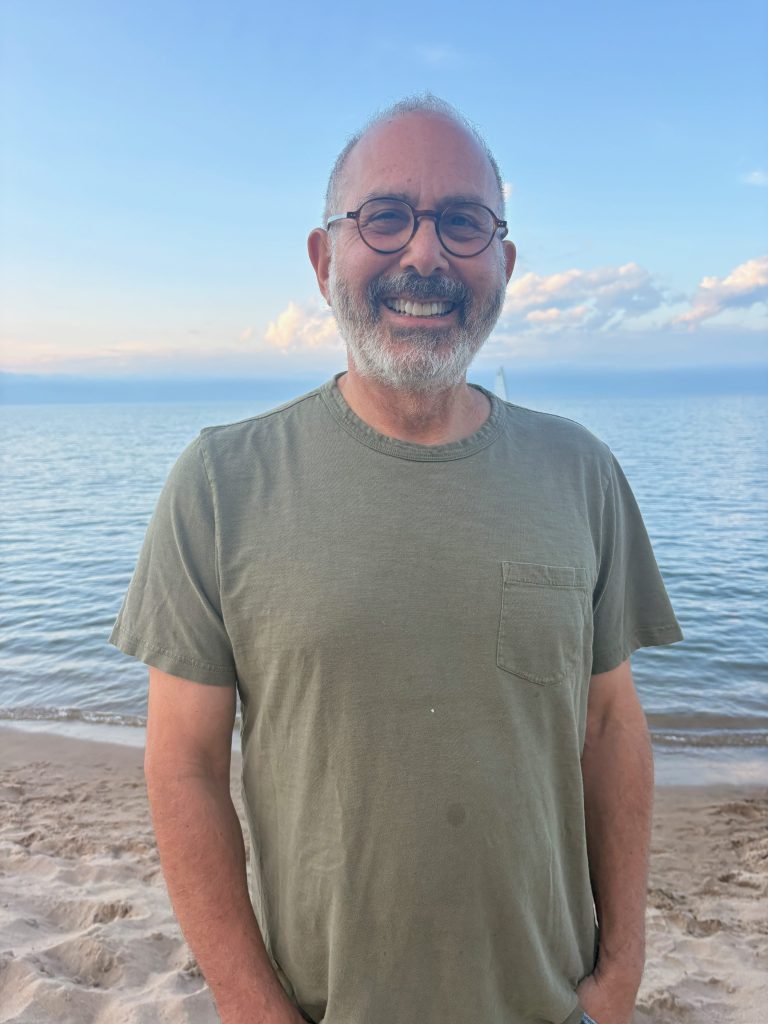
And when the recently retired UW-Milwaukee professor walked the route last year, the Village of Shorewood issued him a $313 trespassing ticket for doing so. Now, he’s one face of a growing trend: America’s public waterfronts are increasingly … less so.
Florsheim’s legal fight is winding its way through the Milwaukee County Circuit Court, on his way, he hopes, to the Wisconsin Supreme Court. Florsheim thinks the stakes are considerably larger than one man’s morning walk. He sees the same dynamic at work in the Texas Supreme Court’s June 19 ruling that handed Elon Musk’s SpaceX effective control over Boca Chica Beach—known locally as “poor man’s beach”—and in the wave of data center projects now competing for access to Great Lakes freshwater.
“If we don’t stand up for what is ours, sort of collectively ours, we’re going to regret it down the road,” he told Fortune.” People don’t want to give up what belongs to them, just as members of the citizenry. And I do think that’s what’s resonating right now.”
Exclusivity in the public realm
Florsheim’s case began when his neighbor—a dentist who built a boathouse on the beach and monitored foot traffic from it—began calling cops on walkers. When Shorewood issued him the ticket, Florsheim’s first instinct was to fight it. When the village lawyer called before the Dec. 2024 trial and encouraged him to settle, warning of mounting court fees, Florsheim declined. When the trial began, it drew a packed courtroom, and the NPR member station story previewing it became the most-read piece in the station’s history, per Florsheim.
He’s well aware about what makes his case unusual. “A water policy professor at UW told me, ‘I’ve been waiting for a case like this my whole life.’ And I said, ‘What do you mean? This must happen all the time.’ She said, ‘No, it doesn’t. People probably get tickets with some regularity for walking on the private part of the beach, but nobody fights them.'” The retired professor, the grandson of the founder of Florsheim Shoes, paused: he had the resources to lead the charge. “The average person would not be doing what I’m doing. I’m retired, so I have the time. Would I be doing this if I was hiring a lawyer? The honest answer is probably no.”
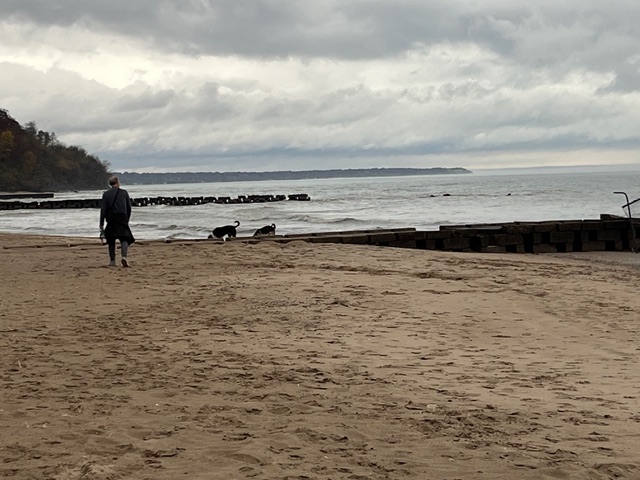
Wisconsin, like most states, recognizes the “Ordinary High Water Mark”—the line where exposed shoreline ends and open water begins—as the boundary of public ownership. But where many states allow the public to cross private beachfront in transit to reach those publicly held waters (also known as “riparian” access) Wisconsin grants landowners exclusive control over that strip of shoreline. You can boat, fish, or swim freely if you’re in the water, but you just can’t set foot on the sand to get there.
The charge rests on Doemel v. Jantz, a 1923 Wisconsin Supreme Court ruling that Florsheim has spent months researching. He said he contacted the archivist at the University of Wisconsin-Oshkosh, which sits on Lake Winnebago where the original dispute originated, finding that it involved a dairy farmer’s right to walk his cattle through the privately owned property to get to the publicly owned water. If his cattle remained in the public water, he was golden; if they crossed that barrier onto sand, not so.
The municipal judge who ruled against him in January wrote a 16-page opinion—extraordinary for a small municipal court—holding that she was bound by Doemel, but that it “probably should be revisited and perhaps overturned.” On June 22, Florsheim’s attorneys filed their response brief with the circuit court, arguing the land he walked is owned by the state of Wisconsin, not his neighbor. “It is decidedly not his land; it is the public’s land,” the brief states. The access to that land, Florsheim argues, doesn’t require a public vote to be protected. “The access to the beach is part of the public trust doctrine, which is baked into the state’s constitution,” he said. “So even though there hasn’t been a vote, there really doesn’t need to be, because it is established.” A hearing is set for August 13.
He is also clear about where his fight sits in the broader picture. His “bitter feud,” he says, is not with the dentist. “My bitter feud is much more with the village, because they should be protecting the rights of the general citizenry rather than the property owners on the beach.”
The ‘poor man’s beach’ in Texas ceded to SpaceX
A similar phenomenon playing out some 1,400 miles south. On June 19, the Texas Supreme Court unanimously ruled that SaveRGV, the Sierra Club, and the Carrizo/Comecrudo Nation of Texas had no legal standing to challenge SpaceX’s closure of Boca Chica Beach during rocket launches. The state’s attorney general had intervened to defend SpaceX throughout, never reaching the constitutional question of whether a 2009 amendment, backed by 77% of Texas voters protecting public beach access, outweighed a 2013 law written specifically for SpaceX. The court dismissed on standing. “The affected public has no remedy to enforce their constitutional right to access their own beach,” Marisa Perales, the attorney for the groups, told Fortune. That same week, Musk became the world’s first trillionaire following SpaceX’s record-breaking $75 billion IPO.
Boca Chica Beach is a free, undeveloped eight-mile stretch of Gulf shoreline near Brownsville—the southernmost city in Texas—where Highway 4 dead-ends at the water and SpaceX’s Starbase launch towers loom to the north. The stretch of Gulf shoreline, known locally as “poor man’s beach,” is the last wild, free, publicly accessible beach on the southernmost tip of Texas.
The Boca Chica takeover had been proceeding on the ground regardless of the litigation. SpaceX employees voted to incorporate the area as the city of Starbase in 2025; just as the county handed the new municipality authority to close the beach during launches. In Feb., Starbase officials voted to annex 7,133 additional acres near the beach, much of it within the Boca Chica Wildlife Refuge. The court ruling removed the last legal obstacle. “Starbase is clearly Elon Musk’s company town,” South Texas Environmental Justice Network co-founder Bekah Hinojosa told The Texas Tribune. Neither the Village of Shorewood, the Texas General Land Office, a lawyer representing the environmental groups, nor SpaceX responded to Fortune’s requests for comment.
Data centers in the Midwest and afar
Closer to Florsheim in the Midwest, over 220 data centers are planned across the Great Lakes region, drawn by the basin’s freshwater—21% of the world’s surface supply—for server cooling. Microsoft is investing $20 billion in data centers at Mount Pleasant, Wisconsin, a community that straddles the Great Lakes basin line and can divert lake water. Midwest Environmental Advocates—the same nonprofit representing Florsheim—sued after Racine, Wis. withheld public records on a data center’s water consumption for seven months. Fewer than one-third of data centers currently track water usage, and in Great Lakes states the reporting obligation falls on public water systems, not the corporate users drawing from them.
“A lot of these data centers want to be near the Great Lakes,” Florsheim said. “The question of what is in the public domain, and should we allow that to become privatized — that’s what’s ringing. It’s not just the beach. It’s the water. It’s who owns the resources that belong to all of us. And I think people are standing up.”
The problem goes beyond the Great Lakes region as well, and well beyond the country’s shorelines. In July 2025, President Donald Trump signed an executive order directing federal agencies to use “federally owned land and resources for the expeditious and orderly development of data centers,” fast-tracking construction on Department of Energy sites and opening military bases to proposals.
The order’s reach has extended to places once considered untouchable: in Northern Virginia, data center construction has pushed directly against Manassas National Battlefield Park, a Civil War site that saw 541,000 visitors in 2024, bounded on three sides by federal land, as part of a broader buildout that has made Virginia home to 663 operating data centers with another 595 planned, facilities that collectively handle roughly 70% of the world’s internet traffic. The pattern is consistent: public land, identified as available, converted to private use.
Florsheim still walks the beach and plans to keep walking it as he awaits the August 13 hearing.
“It’s become much bigger than my little spat on the beach,” he said. “I do feel confident that we will eventually prevail.”
This story was originally featured on Fortune.com
You May Also Like

Thordata Expands Residential Proxy Network to Over 100 Million IPs, Targeting AI Data Access

Base Fixes Critical Bug After Blockchain Outage, Major Network Testing Begins

Germany vs Paraguay Prediction: Odds, Lineups, Key Players and Score Forecast for World Cup 2026