A threat actor stole eight Hypurr NFTs worth approximately $400,000 within hours of the collection’s launch by compromising wallets that received the airdropped tokens on Hyperliquid’s HyperEVM layer. Blockchain investigator ZachXBT first reported the sophisticated theft targeting early Genesis Event participants who had opted to receive the free digital collectibles.Source: ZachXTB The Hyper Foundation distributed 4,600 unique cat-themed NFTs on September 28 to reward early supporters from the November 2024 Genesis Event. The collection immediately achieved a floor price of $68,900, with total trading volume reaching $45 million within 24 hours on OpenSea. At the time of writing, the floor price has surpassed $70K. The most expensive sale involved Hypurr #21, which featured rare “Knight Ghost Armor” traits, selling for 9,999 HYPE tokens, worth approximately $470,000. Some NFTs had traded over-the-counter for $88,000 before the official launch through DripTrade’s collateralized pre-sale system. The theft compounds security concerns plaguing Hyperliquid’s ecosystem following the $773,000 HyperDrive exploit and $3.6 million HyperVault rug pull within the same week. The rapid succession of attacks has intensified scrutiny of security practices across projects building on the decentralized exchange platform. Digital Cats Command Six-Figure Prices Despite Global Economic Pressures The Hypurr collection features generative art depicting cartoon cats with various traits, including sunglasses, wizard robes, and armor elements. Distribution allocated 4,313 NFTs to Genesis Event participants, 144 to the Hyper Foundation, and 143 to core contributors, including developers and artists. According to OpenSea data, over 1.3 million HYPE tokens were traded in the past 24 hours, equivalent to $61 million at current prices. The collection maintained 92.8% of supply held by 4,270 unique owners. Community reactions varied widely, with some celebrating life-changing windfalls while others criticized the wealth disparity. Creative director Alex Obymuralex praised the Hypurr design language as “timeless” rather than trend-driven, noting the collection’s simple forms and saturated colors lower intimidation barriers for mainstream adoption. He argued that recognizable silhouettes and joyful palettes create lasting brand equity beyond speculation cycles. Early adopters who participated in November’s Genesis Event received the NFTs at no cost beyond their initial platform engagement. The event centered on the launch of Hyperliquid’s native HYPE token and HyperEVM programmability layer. Notably, DripTrade’s over-the-counter system enabled pre-launch trading through collateralized agreements requiring sellers to fulfill transactions within seven days of receiving NFTs or forfeit deposited security. This mechanism allowed price discovery even before official distribution. Security Breaches Threaten Ecosystem Credibility The Hypurr NFT theft follows three major security incidents targeting Hyperliquid projects within one week. HyperDrive DeFi lost $773,000 through router contract vulnerabilities that enabled arbitrary function calls, while HyperVault developers executed a $3.6 million exit scam after ignoring community warnings about fabricated audit claims. Previous exploits include the March JELLY token manipulation, which cost $13.5 million, and the “ETH 50x Big Guy” trader, who netted a $1.8 million profit while causing $4 million in vault losses. This incident prompted a reduction in maximum leverage limits from 40x to 25x for major cryptocurrencies. Competition intensifies as ASTER DEX processes over $13 billion in daily perpetual futures volume, compared to Hyperliquid’s reduced activity. ASTER’s Trust Wallet integration provides 100 million users with direct access to perpetual contracts, challenging Hyperliquid’s market dominance. Arthur Hayes exited his entire HYPE position with a $823,000 profit, citing the massive token unlocks worth $11.9 billion that were set to start on November 29. He recently polled followers about re-entering after HYPE dropped 23% weekly to $35.50. However, community members have proposed blacklisting Hayes from purchasing HYPE, with some labeling his trades as the “ultimate sell signal.” Despite security challenges, Hyperliquid launched its USDH stablecoin, generating $2.2 million in early volume, while Native Markets secured the issuance mandate through a competitive governance voting process. The platform also activated HYPE/USDH spot trading following Native Markets’ commitment to stake 200,000 tokens for a period of three years. HYPE traded up 4.65% following the Hypurr launch, reaching $47.14 as community enthusiasm temporarily overshadowed ongoing security concerns and competition threats across the broader ecosystemA threat actor stole eight Hypurr NFTs worth approximately $400,000 within hours of the collection’s launch by compromising wallets that received the airdropped tokens on Hyperliquid’s HyperEVM layer. Blockchain investigator ZachXBT first reported the sophisticated theft targeting early Genesis Event participants who had opted to receive the free digital collectibles.Source: ZachXTB The Hyper Foundation distributed 4,600 unique cat-themed NFTs on September 28 to reward early supporters from the November 2024 Genesis Event. The collection immediately achieved a floor price of $68,900, with total trading volume reaching $45 million within 24 hours on OpenSea. At the time of writing, the floor price has surpassed $70K. The most expensive sale involved Hypurr #21, which featured rare “Knight Ghost Armor” traits, selling for 9,999 HYPE tokens, worth approximately $470,000. Some NFTs had traded over-the-counter for $88,000 before the official launch through DripTrade’s collateralized pre-sale system. The theft compounds security concerns plaguing Hyperliquid’s ecosystem following the $773,000 HyperDrive exploit and $3.6 million HyperVault rug pull within the same week. The rapid succession of attacks has intensified scrutiny of security practices across projects building on the decentralized exchange platform. Digital Cats Command Six-Figure Prices Despite Global Economic Pressures The Hypurr collection features generative art depicting cartoon cats with various traits, including sunglasses, wizard robes, and armor elements. Distribution allocated 4,313 NFTs to Genesis Event participants, 144 to the Hyper Foundation, and 143 to core contributors, including developers and artists. According to OpenSea data, over 1.3 million HYPE tokens were traded in the past 24 hours, equivalent to $61 million at current prices. The collection maintained 92.8% of supply held by 4,270 unique owners. Community reactions varied widely, with some celebrating life-changing windfalls while others criticized the wealth disparity. Creative director Alex Obymuralex praised the Hypurr design language as “timeless” rather than trend-driven, noting the collection’s simple forms and saturated colors lower intimidation barriers for mainstream adoption. He argued that recognizable silhouettes and joyful palettes create lasting brand equity beyond speculation cycles. Early adopters who participated in November’s Genesis Event received the NFTs at no cost beyond their initial platform engagement. The event centered on the launch of Hyperliquid’s native HYPE token and HyperEVM programmability layer. Notably, DripTrade’s over-the-counter system enabled pre-launch trading through collateralized agreements requiring sellers to fulfill transactions within seven days of receiving NFTs or forfeit deposited security. This mechanism allowed price discovery even before official distribution. Security Breaches Threaten Ecosystem Credibility The Hypurr NFT theft follows three major security incidents targeting Hyperliquid projects within one week. HyperDrive DeFi lost $773,000 through router contract vulnerabilities that enabled arbitrary function calls, while HyperVault developers executed a $3.6 million exit scam after ignoring community warnings about fabricated audit claims. Previous exploits include the March JELLY token manipulation, which cost $13.5 million, and the “ETH 50x Big Guy” trader, who netted a $1.8 million profit while causing $4 million in vault losses. This incident prompted a reduction in maximum leverage limits from 40x to 25x for major cryptocurrencies. Competition intensifies as ASTER DEX processes over $13 billion in daily perpetual futures volume, compared to Hyperliquid’s reduced activity. ASTER’s Trust Wallet integration provides 100 million users with direct access to perpetual contracts, challenging Hyperliquid’s market dominance. Arthur Hayes exited his entire HYPE position with a $823,000 profit, citing the massive token unlocks worth $11.9 billion that were set to start on November 29. He recently polled followers about re-entering after HYPE dropped 23% weekly to $35.50. However, community members have proposed blacklisting Hayes from purchasing HYPE, with some labeling his trades as the “ultimate sell signal.” Despite security challenges, Hyperliquid launched its USDH stablecoin, generating $2.2 million in early volume, while Native Markets secured the issuance mandate through a competitive governance voting process. The platform also activated HYPE/USDH spot trading following Native Markets’ commitment to stake 200,000 tokens for a period of three years. HYPE traded up 4.65% following the Hypurr launch, reaching $47.14 as community enthusiasm temporarily overshadowed ongoing security concerns and competition threats across the broader ecosystem

Hyperliquid’s Hypurr NFTs Hit $76K Floor Price, But Hacker Steals 8 for $400K Profit

A threat actor stole eight Hypurr NFTs worth approximately $400,000 within hours of the collection’s launch by compromising wallets that received the airdropped tokens on Hyperliquid’s HyperEVM layer.

Blockchain investigator ZachXBT first reported the sophisticated theft targeting early Genesis Event participants who had opted to receive the free digital collectibles.
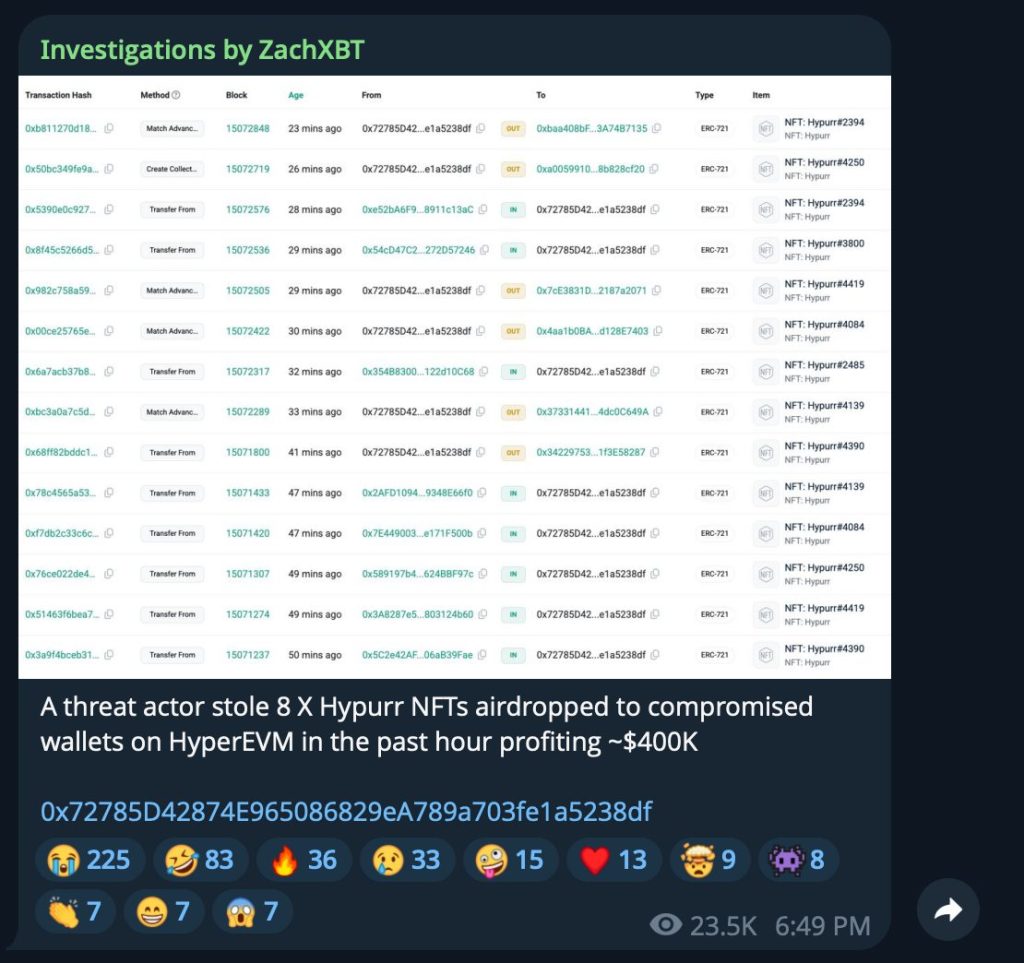
Hyperliquid's Hypurr NFTs Hit $76K Floor Price, But Hacker Steals 8 for $400K ProfitSource: ZachXTB

The Hyper Foundation distributed 4,600 unique cat-themed NFTs on September 28 to reward early supporters from the November 2024 Genesis Event.

The collection immediately achieved a floor price of $68,900, with total trading volume reaching $45 million within 24 hours on OpenSea. At the time of writing, the floor price has surpassed $70K.

The most expensive sale involved Hypurr #21, which featured rare “Knight Ghost Armor” traits, selling for 9,999 HYPE tokens, worth approximately $470,000.

Some NFTs had traded over-the-counter for $88,000 before the official launch through DripTrade’s collateralized pre-sale system.

The theft compounds security concerns plaguing Hyperliquid’s ecosystem following the $773,000 HyperDrive exploit and $3.6 million HyperVault rug pull within the same week.

The rapid succession of attacks has intensified scrutiny of security practices across projects building on the decentralized exchange platform.

Digital Cats Command Six-Figure Prices Despite Global Economic Pressures

The Hypurr collection features generative art depicting cartoon cats with various traits, including sunglasses, wizard robes, and armor elements.

Distribution allocated 4,313 NFTs to Genesis Event participants, 144 to the Hyper Foundation, and 143 to core contributors, including developers and artists.

According to OpenSea data, over 1.3 million HYPE tokens were traded in the past 24 hours, equivalent to $61 million at current prices.

The collection maintained 92.8% of supply held by 4,270 unique owners.

Community reactions varied widely, with some celebrating life-changing windfalls while others criticized the wealth disparity.

Creative director Alex Obymuralex praised the Hypurr design language as “timeless” rather than trend-driven, noting the collection’s simple forms and saturated colors lower intimidation barriers for mainstream adoption.

He argued that recognizable silhouettes and joyful palettes create lasting brand equity beyond speculation cycles.

Early adopters who participated in November’s Genesis Event received the NFTs at no cost beyond their initial platform engagement.

The event centered on the launch of Hyperliquid’s native HYPE token and HyperEVM programmability layer.

Notably, DripTrade’s over-the-counter system enabled pre-launch trading through collateralized agreements requiring sellers to fulfill transactions within seven days of receiving NFTs or forfeit deposited security.

This mechanism allowed price discovery even before official distribution.

Security Breaches Threaten Ecosystem Credibility

The Hypurr NFT theft follows three major security incidents targeting Hyperliquid projects within one week.

HyperDrive DeFi lost $773,000 through router contract vulnerabilities that enabled arbitrary function calls, while HyperVault developers executed a $3.6 million exit scam after ignoring community warnings about fabricated audit claims.

Previous exploits include the March JELLY token manipulation, which cost $13.5 million, and the “ETH 50x Big Guy” trader, who netted a $1.8 million profit while causing $4 million in vault losses.

This incident prompted a reduction in maximum leverage limits from 40x to 25x for major cryptocurrencies.

Competition intensifies as ASTER DEX processes over $13 billion in daily perpetual futures volume, compared to Hyperliquid’s reduced activity.

ASTER’s Trust Wallet integration provides 100 million users with direct access to perpetual contracts, challenging Hyperliquid’s market dominance.

Arthur Hayes exited his entire HYPE position with a $823,000 profit, citing the massive token unlocks worth $11.9 billion that were set to start on November 29.

He recently polled followers about re-entering after HYPE dropped 23% weekly to $35.50.

However, community members have proposed blacklisting Hayes from purchasing HYPE, with some labeling his trades as the “ultimate sell signal.”

Despite security challenges, Hyperliquid launched its USDH stablecoin, generating $2.2 million in early volume, while Native Markets secured the issuance mandate through a competitive governance voting process.

The platform also activated HYPE/USDH spot trading following Native Markets’ commitment to stake 200,000 tokens for a period of three years.

HYPE traded up 4.65% following the Hypurr launch, reaching $47.14 as community enthusiasm temporarily overshadowed ongoing security concerns and competition threats across the broader ecosystem.

Disclaimer: The articles reposted on this site are sourced from public platforms and are provided for informational purposes only. They do not necessarily reflect the views of MEXC. All rights remain with the original authors. If you believe any content infringes on third-party rights, please contact service@support.mexc.com for removal. MEXC makes no guarantees regarding the accuracy, completeness, or timeliness of the content and is not responsible for any actions taken based on the information provided. The content does not constitute financial, legal, or other professional advice, nor should it be considered a recommendation or endorsement by MEXC.

You May Also Like

The Channel Factories We’ve Been Waiting For

The Channel Factories We’ve Been Waiting For

The post The Channel Factories We’ve Been Waiting For appeared on BitcoinEthereumNews.com. Visions of future technology are often prescient about the broad strokes while flubbing the details. The tablets in “2001: A Space Odyssey” do indeed look like iPads, but you never see the astronauts paying for subscriptions or wasting hours on Candy Crush.  Channel factories are one vision that arose early in the history of the Lightning Network to address some challenges that Lightning has faced from the beginning. Despite having grown to become Bitcoin’s most successful layer-2 scaling solution, with instant and low-fee payments, Lightning’s scale is limited by its reliance on payment channels. Although Lightning shifts most transactions off-chain, each payment channel still requires an on-chain transaction to open and (usually) another to close. As adoption grows, pressure on the blockchain grows with it. The need for a more scalable approach to managing channels is clear. Channel factories were supposed to meet this need, but where are they? In 2025, subnetworks are emerging that revive the impetus of channel factories with some new details that vastly increase their potential. They are natively interoperable with Lightning and achieve greater scale by allowing a group of participants to open a shared multisig UTXO and create multiple bilateral channels, which reduces the number of on-chain transactions and improves capital efficiency. Achieving greater scale by reducing complexity, Ark and Spark perform the same function as traditional channel factories with new designs and additional capabilities based on shared UTXOs.  Channel Factories 101 Channel factories have been around since the inception of Lightning. A factory is a multiparty contract where multiple users (not just two, as in a Dryja-Poon channel) cooperatively lock funds in a single multisig UTXO. They can open, close and update channels off-chain without updating the blockchain for each operation. Only when participants leave or the factory dissolves is an on-chain transaction…
Share
BitcoinEthereumNews2025/09/18 00:09
XRP Escrow Amendment Gains Momentum, Set for February 2026 Activation

XRP Escrow Amendment Gains Momentum, Set for February 2026 Activation

TLDR The XRP Ledger’s Token Escrow amendment has gained 82.35% consensus and is set for activation on February 12, 2026. This amendment allows users to escrow a
Share
Coincentral2026/01/31 01:00
ZKP’s 300x Potential Takes Center Stage as XRP Price Shifts and Algorand News Turns Cautious

ZKP’s 300x Potential Takes Center Stage as XRP Price Shifts and Algorand News Turns Cautious

ZKP takes focus as XRP price tests a macro shift and Algorand news signals caution, reshaping views on structure and the best crypto to buy.
Share
Blockchainreporter2026/01/31 01:00