At the Japan Developer Conference, Ethereum founder Vitalik Buterin presented a detailed roadmap for the network’s evolution. The immediate focus is scaling and improving performance on Ethereum’s base layer, or L1. A central step is raising the gas limit, allowing the blockchain to process more transactions per block without undermining decentralization. The strategy involves several […]At the Japan Developer Conference, Ethereum founder Vitalik Buterin presented a detailed roadmap for the network’s evolution. The immediate focus is scaling and improving performance on Ethereum’s base layer, or L1. A central step is raising the gas limit, allowing the blockchain to process more transactions per block without undermining decentralization. The strategy involves several […]

Ethereum Future Plans: Vitalik Outlines Scaling, Privacy, and Simplified Quantum-Resistant Core

2025/09/18 15:00
3 min read
For feedback or concerns regarding this content, please contact us at crypto.news@mexc.com
ethereum
  • Vitalik Buterin outlined Ethereum’s roadmap at the Japan Developer Conference with short, mid, and long-term goals.
  • Near-term plans focus on scaling Ethereum L1 and enhancing user privacy.
  • The long-term vision includes quantum resistance, formal verification, and a simplified Ethereum core.

At the Japan Developer Conference, Ethereum founder Vitalik Buterin presented a detailed roadmap for the network’s evolution.

The immediate focus is scaling and improving performance on Ethereum’s base layer, or L1. A central step is raising the gas limit, allowing the blockchain to process more transactions per block without undermining decentralization.

Source: X

The strategy involves several technical upgrades. Tools like block-level access lists, slot optimization, ZK-EVMs, and gas repricing are expected to enhance performance. Together, these measures aim to strike a balance between expansion and Ethereum’s decentralized foundation.

Alongside scaling, the network’s short-term priorities also include privacy. It focuses on increasing privacy for write operations such as payments, voting, DeFi usage, and account recovery.

Zero-knowledge proofs, anonymous funding pools, mixnets, and encrypted vote schemes are being considered to protect users’ on-chain activity.

Also Read: PayPal Expands Peer-to-Peer Payments With Bitcoin, Ethereum, and Stablecoin PYUSD

Cross-L2 Interoperability as a Core Medium-Term Goal

These medium-term goals aim to ensure smooth and secure interoperations across the network’s growing Layer 2 ecosystem. Cross-L2 interoperability will be imperative as different scaling solutions increase.

Future roadmaps entail trustless cross-chain asset transfers, faster settlements on L2, and proof aggregation for efficiency improvements.

Source: X

Another mid-term goal is to achieve faster finality and responsiveness. Vitalik’s roadmap cited some solutions like 3SF for quick finality, together with network enhancements like erasure coding.

These upgrades will decrease block confirmation time dramatically, boost fault tolerance, and make the network more user-friendly.

It paves the way for the network to scale but also to be a truly integrated ecosystem where different L2s can communicate with each other safely and effortlessly.

Community-Driven Development at Ethereum’s Core

Looking further into the future, Ethereum’s future roadmap calls for a much easier but highly secure blockchain.

In the long term, the network is to be made quantum-resistant, a move necessary as quantum computing comes into its own. Code is also to be formally verified such that the protocol is mathematically proven to be secure.

Other plans include switching to optimized crypto libraries for hashing, zero-knowledge proofs, and signatures.

Community involvement will be a core principle, with developers being asked to work together to contribute to building the network. To end-users, they represent a network that is constantly improving usability, scalability, and trust.

Also Read: Ethereum Price Prediction: ETH Eyes $4,750 After Wedge Breakout Signal

Market Opportunity
Moonveil Logo
Moonveil Price(MORE)
$0.0001441
$0.0001441$0.0001441
-1.16%
USD
Moonveil (MORE) Live Price Chart
Disclaimer: The articles reposted on this site are sourced from public platforms and are provided for informational purposes only. They do not necessarily reflect the views of MEXC. All rights remain with the original authors. If you believe any content infringes on third-party rights, please contact crypto.news@mexc.com for removal. MEXC makes no guarantees regarding the accuracy, completeness, or timeliness of the content and is not responsible for any actions taken based on the information provided. The content does not constitute financial, legal, or other professional advice, nor should it be considered a recommendation or endorsement by MEXC.

You May Also Like

Shocking OpenVPP Partnership Claim Draws Urgent Scrutiny

Shocking OpenVPP Partnership Claim Draws Urgent Scrutiny

The post Shocking OpenVPP Partnership Claim Draws Urgent Scrutiny appeared on BitcoinEthereumNews.com. The cryptocurrency world is buzzing with a recent controversy surrounding a bold OpenVPP partnership claim. This week, OpenVPP (OVPP) announced what it presented as a significant collaboration with the U.S. government in the innovative field of energy tokenization. However, this claim quickly drew the sharp eye of on-chain analyst ZachXBT, who highlighted a swift and official rebuttal that has sent ripples through the digital asset community. What Sparked the OpenVPP Partnership Claim Controversy? The core of the issue revolves around OpenVPP’s assertion of a U.S. government partnership. This kind of collaboration would typically be a monumental endorsement for any private cryptocurrency project, especially given the current regulatory climate. Such a partnership could signify a new era of mainstream adoption and legitimacy for energy tokenization initiatives. OpenVPP initially claimed cooperation with the U.S. government. This alleged partnership was said to be in the domain of energy tokenization. The announcement generated considerable interest and discussion online. ZachXBT, known for his diligent on-chain investigations, was quick to flag the development. He brought attention to the fact that U.S. Securities and Exchange Commission (SEC) Commissioner Hester Peirce had directly addressed the OpenVPP partnership claim. Her response, delivered within hours, was unequivocal and starkly contradicted OpenVPP’s narrative. How Did Regulatory Authorities Respond to the OpenVPP Partnership Claim? Commissioner Hester Peirce’s statement was a crucial turning point in this unfolding story. She clearly stated that the SEC, as an agency, does not engage in partnerships with private cryptocurrency projects. This response effectively dismantled the credibility of OpenVPP’s initial announcement regarding their supposed government collaboration. Peirce’s swift clarification underscores a fundamental principle of regulatory bodies: maintaining impartiality and avoiding endorsements of private entities. Her statement serves as a vital reminder to the crypto community about the official stance of government agencies concerning private ventures. Moreover, ZachXBT’s analysis…
Share
BitcoinEthereumNews2025/09/18 02:13
Solana Sees $10M Capital Rotation, Eyes $100 Breakout
Solana Sees $10M Capital Rotation, Eyes $100 Breakout

The post Solana Sees $10M Capital Rotation, Eyes $100 Breakout appeared on BitcoinEthereumNews.com. Capital rotation into Solana accelerated this week as traders
Share
BitcoinEthereumNews2026/03/18 00:18
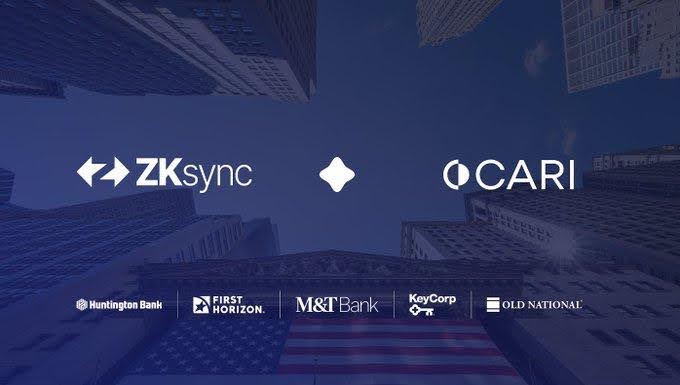
ZKsync Powers Tokenized Deposits in Major U.S. Bank Network

ZKsync Powers Tokenized Deposits in Major U.S. Bank Network

Key Takeaways: Five U.S. regional banks are building a tokenized deposit network on ZKsync. Deposits remain FDIC-insured bank liabilities, not stablecoins. The
Share
Crypto Ninjas2026/03/18 00:41
