Recently, the Robinhood Chain ecosystem has exploded, with memecoins posting strong growth. What makes this trend particularly interesting is that these memecoins are paired directly with specific tokenized stocks rather than stablecoins or ETH. Some projects have even started airdropping rewards to holders in the form of the tokenized stock itself.
In the history of the crypto market, few narratives have directly combined speculative Meme culture with traditional financial assets in the way Meme Stock is doing throughout the second half of 2026.
Key Takeaways
The narrative initially exploded with Marscoin/SPCXB in the BSC ecosystem.
AI/NVDA has pushed the narrative to a new level on Robinhood Chain.
As the trend accelerates, new emerging launchpads such as Flap.sh and Long.xyz are gaining traction.
Meme Stock is not simply a meme token built around a stock ticker. It combines AMMs, Stock Tokens, vaults, and on-chain financial mechanisms.
The potential is significant, but so are the risks involving liquidity, regulation, smart contracts, and the lifecycle of the narrative.
1. What Is a Meme Stock?
If memecoins turn Internet culture into speculative assets, while tokenized stocks bring traditional equities onto the blockchain, Meme Stock is where these two worlds begin to converge.
Simply put, Meme Stock is a narrative layer that combines memecoins + tokenized stocks + on-chain liquidity. Instead of a memecoin being traded only against USDT, ETH, or stablecoins, the token can be paired directly with a Stock Token representing value tied to a US stock, such as $AI/NVDA or
$MARSCOIN/SPCXB.
This creates a very important shift: tokenized stocks are no longer simply the "theme" or story behind a memecoin. They become the actual pricing and liquidity asset for the token.
One important point to keep in mind is that a Stock Token used in Meme Stock does not necessarily mean that users directly own the underlying stock. In practice, the token often represents a financial obligation backed by a commitment from the issuer, with its price designed to track the underlying stock through pricing mechanisms or an oracle.
As a result, holding the token does not automatically give users voting rights, shareholder rights, or direct ownership of the stock listed on the NYSE or Nasdaq.
The risks are therefore greater than those of holding a traditional stock. Investors must simultaneously deal with market risk, issuer risk, custody risk, smart contract risk, oracle risk, and on-chain liquidity risk.
2. How the Model Works?
Meme Stock can currently be divided into three main models.
Stock-Paired Meme: Memecoin Paired Directly With a Stock Token
This is the model that comes closest to the core concept of Meme Stock. The memecoin uses a Stock Token as the pricing asset in an AMM. Trading fees can then be used to buy back and burn the token, creating additional incentives for trading activity.
Stocks Vault: Turning Trading Fees Into Dividends
Instead of being directly paired, a portion of the memecoin's trading fees or transaction taxes is deposited into a vault to accumulate Stock Tokens. Holders who meet certain conditions can receive a share of these assets without needing to stake or lock their tokens.
This model creates a fairly attractive loop: meme generates volume → volume generates fees → fees buy Stock Tokens → Stock Tokens flow back to holders.
Leveraged Wrapper: Packaging Leveraged Stocks Into Tokens
This is the highest-risk version of the model. Leveraged stock positions are packaged into ERC-20 tokens so users can trade them on DEXs. Investors are therefore exposed not only to stock price volatility, but also to leverage risk, liquidity risk, and the extreme volatility of memecoins.
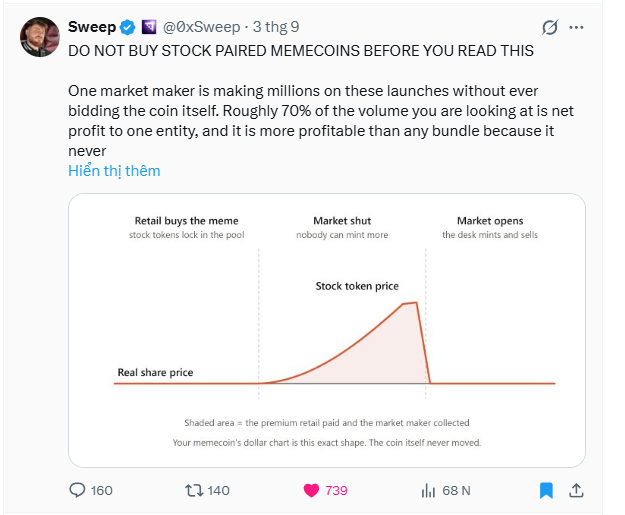
One notable phenomenon in Meme Stock is the on-chain "float squeeze." The supply of Stock Tokens can be limited because additional issuance depends on authorized parties. This becomes particularly interesting over the weekend, when US stock markets are closed but crypto continues trading 24/7. Demand for memecoins can simultaneously push demand for Stock Tokens sharply higher. When on-chain liquidity is thin, the price of a Stock Token on a DEX can trade significantly above the reference price of the underlying stock.
This is not a traditional short squeeze. Instead, it is the result of a supply-demand imbalance in a much smaller on-chain market. This mechanism is precisely what gives Meme Stock a different price behavior compared with ordinary memecoins.
3. Why Is Meme Stock Exploding?
Marscoin was one of the first projects to create a major breakthrough by combining the SpaceX and Elon Musk meme narrative with the tokenized stock SPCXB, while also distributing dividends to holders. Marscoin's subsequent listing as a perpetual contract on Binance added even more liquidity and leverage, transforming the narrative from a simple meme story into an asset that traders could actively speculate on.
After that, $AI (Artificial Inu) pushed the narrative even further by tying the token to NVDA's price movements. The appeal lies in the ability to gain exposure to tech stocks almost 24/7, while traditional stock markets remain limited by trading hours. This is one of the key factors that makes Meme Stock different from ordinary memecoins.
The explosion of the narrative has been driven by three factors: the market is lacking fresh narratives, tokenized stock infrastructure and adoption are rapidly expanding, and meme mechanisms create extremely strong FOMO. Once liquidity, dividends, leverage, and influencers all come into play, capital can begin reinforcing itself very quickly.
However, an explosion in popularity does not necessarily mean sustainability. The narrative remains heavily dependent on liquidity, influencers, and the market's ability to maintain attention. More importantly, projects still need to pass real-world tests involving regulation, liquidity, and how closely their tokens actually track the underlying stocks.
Therefore, Meme Stock may still have room to run in the short term, but for it to become a long-term asset class, it needs to prove that its value does not come solely from FOMO, but from a financial model that can genuinely survive over time.
4. Meme Stock Across Two of the Hottest Ecosystems: Robinhood and BNB Chain
Meme Stock initially exploded with MARSCOIN/SPCXB in the Binance Chain ecosystem, followed more recently by AI/NVDA. These two tokens quickly became some of the most prominent names in the narrative, while also drawing significant attention to the launchpads behind them.
4.1 BNB Chain: MARSCOIN and the Rise of Flap.sh
On BNB Chain,
MARSCOIN is one of the clearest examples of the Meme Stock model. The token is paired with SPCXB, the tokenized version of SpaceX stock, and uses the Stocks Vault mechanism developed by Flap.sh. With a 3% tax on each buy and sell transaction, the fees are transferred into a vault to accumulate SPCXB, which is then distributed to wallets holding at least 10,000 MARSCOIN.
The most notable aspect is that MARSCOIN has created a new loop: memecoin generates volume → volume generates fees → fees are converted into Stock Tokens → Stock Tokens become rewards for holders. After nearly falling to zero at the end of July 2026, MARSCOIN quickly recovered and reached a new high in early September, while the total value of SPCXB distributed to holders reached approximately $3.9 million.
The explosion of MARSCOIN also helped turn Flap.sh into one of the key hubs of the Meme Stock ecosystem on BNB Chain. Originally a memecoin launchpad, Flap.sh began expanding into a model that combines tokenized assets through its Stocks Vault. Meanwhile, Four.meme, which had previously led the memecoin launchpad sector on BNB Chain, declined sharply following the tax contract incident in April 2026 and its subsequent transition toward OpenFour, creating additional room for Flap.sh to gain market share.
4.2 Robinhood Chain: $AI/NVDA and Long.xyz
If MARSCOIN transforms trading fees into tokenized stock rewards, Robinhood Chain takes Meme Stock a step further by using Stock Tokens directly as the pricing assets within AMMs.
Robinhood Chain, launched on July 1, 2026, is built on Arbitrum and comes with hundreds of Stock Tokens such as NVDA, AAPL, TSLA, SPCX, GME, and MSTR. On July 14, Long.xyz launched as a launchpad focused on tokens paired with Stock Tokens.
The center of attention in the ecosystem quickly became $AI (Artificial Inu), a token directly paired with NVDA. From a market cap of only a few million dollars at the end of July, $AI climbed above $100 million by the end of August and surpassed $300 million in early September. This growth turned $AI into one of the clearest symbols of the Meme Stock narrative.
Following $AI, Long.xyz continued to see a wave of tokens built around corporate narratives, including $BONER/HIMS, $SPACEHOOD/SPCX, $MOO/MU, $AU/TSM, and $SAYLORMOON/MSTR. Each token is not only driven by a meme, but also anchored to a specific Stock Token, creating a hybrid of stock narratives, memecoin speculation, and on-chain liquidity.
As a result, the two ecosystems are developing along two fairly different paths. Flap.sh turns trading activity into a mechanism for accumulating and distributing Stock Tokens, while Long.xyz makes Stock Tokens a direct part of the Meme Stock market itself. Both approaches show that this narrative is no longer simply about "memecoins with stock tickers," but is beginning to experiment with entirely new on-chain financial mechanisms.
5. How to Evaluate Meme Stock, Its Potential, and Key Risks
When analyzing a Meme Stock token, the first step is to verify whether the underlying Stock Token is issued by a reputable organization such as Robinhood Markets or an audited platform, rather than simply being a self-proclaimed token. At the same time, it is important to check whether the "dividends" actually come from real revenue that is converted into authentic Stock Tokens, or simply from the issuance of new tokens.
Actual liquidity relative to market cap should also be examined, since a large sell order can make paper profits difficult to realize. Being linked to NVIDIA or SpaceX also only reflects the narrative and does not imply ownership or legal rights to the underlying stock.
The long-term potential of Meme Stock depends on whether platforms such as Robinhood Chain can expand their infrastructure to support compliant trading of stocks, funds, and commodities, alongside reliable custody and settlement services.
At the current stage, however, the market still shows clear signs of early-stage speculation: leading tokens are rising rapidly, launchpads are expanding, and KOLs are actively getting involved. None of this automatically proves that the model is being sustainably adopted. Some key indicators to monitor include whether the number of active addresses continues to grow after the gas-free program ends, whether Stock Token liquidity expands in line with trading volume, and whether platforms provide greater transparency around custody mechanisms and the legal relationship between Stock Tokens and the underlying assets.
In terms of
risks, particular attention should be paid to regulatory risks, thin liquidity, smart contract risks, concentration among KOLs and large wallets, and the short lifecycle of the narrative. In addition, for Robinhood Chain, the end of the gas-free program in late September 2026 could significantly change trading costs and user behavior.
Conclusion
Meme Stock is opening up a new direction for the crypto market by combining memecoins, tokenized financial assets, and DeFi within the same market.
From MARSCOIN/SPCXB and Flap.sh on BNB Chain to $AI/NVDA and Long.xyz on Robinhood Chain, projects are experimenting with different ways to turn stock narratives into on-chain liquidity, rewards, and pricing mechanisms.
However, this remains a very new narrative, with significant risks surrounding liquidity, regulation, smart contracts, and the sustainability of capital flows. For traders, the key is not simply to chase market cap gains, but to understand the value creation mechanism, actual liquidity, and the capital flows behind a token before getting involved.
Disclaimer: This content does not constitute investment, tax, legal, financial, or accounting advice. MEXC Blog provides this information for educational purposes only. Always do your own research, understand the risks, and invest responsibly.