Key Takeaways
StarkWare CEO Eli Ben-Sasson said at Token2049 that Starknet is seriously considering a transition from an Ethereum Layer 2 to an independent Layer 1, framing the case around post-quantum agility and stating that the network has everything a future-proof chain needs except L1 status. His central argument is a timeline gap: Starknet estimates it could reach full quantum resistance by 2027 if it controls its own upgrade schedule, against the Ethereum Foundation's target of end-2029. The urgency draws on ECDSA.Fail, an open challenge run by Eigen Labs in which more than 100 participants working with AI agents cut the estimated quantum resources needed to break secp256k1 signatures by 86%, from a baseline score of 10.75 billion to 1.496 billion, in a paper co-authored by researchers from StarkWare, Trail of Bits, Eigen Labs and the Ethereum Foundation. The transition is exploratory and unconfirmed, requiring governance approval, technical design and a validator set Starknet does not have. L2BEAT currently classifies Starknet as a Stage 1 rollup running five permissioned sequencers controlled by StarkWare under a Tendermint-style 3-of-5 consensus, which means the network already operates consensus machinery. STRK trades near $0.1053, up 77.7% over seven days and 260.3% over thirty, for a market capitalisation of $781.6 million against DeFi TVL near $168 million and network fees that reached $13,685 on October 8, a seven-day high. The token sits 97.6% below its all-time high of $4.41.
Overview
STRK has gained 260% in a month on an announcement; The network underneath that move holds $168 million in DeFi deposits and earned $13,685 in fees on its best day of the month. Ben-Sasson's case at Token2049 rests on cryptography and timing instead of economics. STARK proofs are built on hash functions, which resist quantum attack in a way the elliptic curve signatures underneath Bitcoin and Ethereum do not, so Starknet's proving system is already post-quantum. What Starknet does not control is when it can finish the rest of the migration, because a Layer 2 settles to a chain whose own post-quantum timeline targets the end of 2029 and cannot move faster than the layer securing it. This article covers what Ben-Sasson actually proposed and its status, the quantum argument and the two-year timeline gap at its centre, the ECDSA.Fail results that supply the urgency, the consensus machinery Starknet already operates, what leaving Ethereum would cost in security terms, the rally measured against the network's economics, the 2018 paper Starknet invoked and what it establishes, and the conditions that would settle the question.
1. What Ben-Sasson Actually Proposed
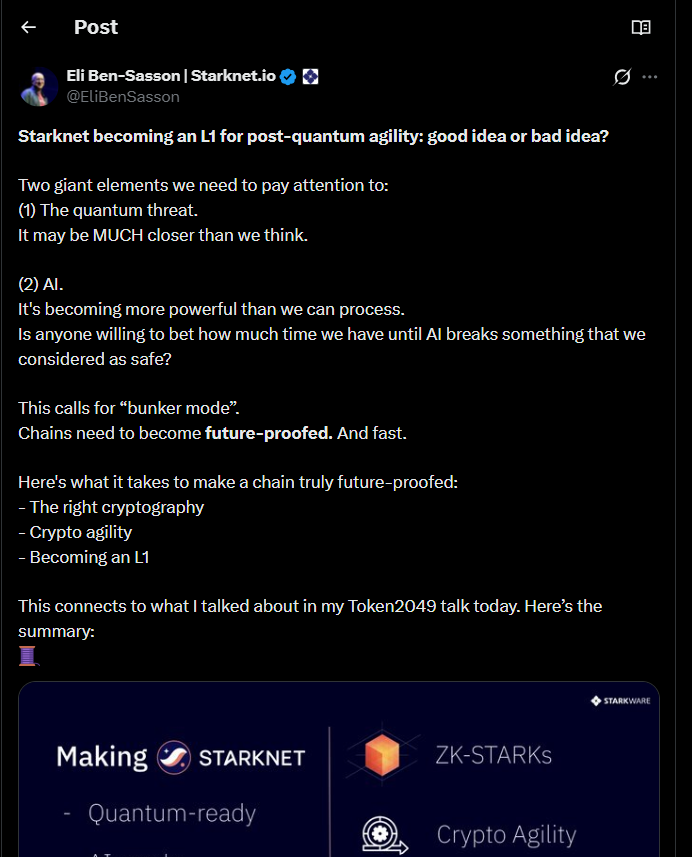
Ben-Sasson opened a thread on X with a question: "Starknet becoming an L1 for post-quantum agility: good idea or bad idea?" The post has since drawn more than 237,000 views, and it connects to the talk he gave at Token2049 in Singapore the same day. The two pressures he named are quantum computing and AI. On the first he wrote that the threat "may be MUCH closer than we think," and on the second that AI "is becoming more powerful than we can process," before asking whether anyone is willing to bet how much time remains until AI breaks something previously considered safe. His conclusion was that this calls for what he termed bunker mode, and that chains need to become future-proofed, and fast. Three things make a chain future-proofed in his account: the right cryptography, crypto agility, and becoming an L1. Starknet holds the first two, and the third is unavailable to a Layer 2, because a rollup inherits the security of the chain it settles to and inherits that chain's constraints on when and how its cryptography can change. He placed the argument inside a longer story about money, tracing an evolution from gold to digital gold in Bitcoin, then to private digital gold in Zcash, and asking which quality the next phase should aim for. He co-authored the original STARK paper and co-founded Zcash, so the lineage he is describing is partly his own. Nothing has been decided. Any transition would need governance approval, substantial technical design work, and a validator set that does not currently exist in the form an independent chain requires. There is no confirmed launch timeline, and Starknet continues to settle on Ethereum.
2. The Quantum Argument and the Two-Year Gap
The substance of the case is a date comparison. Ben-Sasson estimates Starknet could achieve full quantum resilience by 2027 if it controls its own upgrade path. The Ethereum Foundation's target for Ethereum is the end of 2029. The gap between those two dates is roughly two years, and as a Layer 2 Starknet cannot capture it, because the security of an L2 ultimately rests on the signature scheme protecting the chain it settles to. A rollup can run post-quantum cryptography internally and still be exposed through the layer beneath it. STARK proofs rely on hash functions and collision resistance, which degrade only modestly under Grover's algorithm and can be restored by increasing output size. ECDSA, which secures Bitcoin and Ethereum accounts, rests on the discrete logarithm problem, which Shor's algorithm breaks outright given a sufficiently capable machine. These are different categories of exposure, and Starknet's proof system genuinely sits on the safer side of the line.
His stated reasoning for urgency extends past quantum hardware to the software accelerating it. He has said that AI is speeding up the timeline toward breaking Bitcoin and Ethereum signatures with quantum computers, that the quantum threat may be much closer than people think, and he put the question to his audience as whether anyone is willing to bet how much time remains until AI breaks something previously considered safe. Starknet has also shipped against this. StarkWare researcher Avihu Levy spent a Bitcoin output on mainnet in August using a quantum-safe method, and the cost of that demonstration fell from roughly $320 to about $50. StarkWare's own caveat is that the test does not make Bitcoin quantum-resistant and that a real fix needs a Bitcoin software upgrade, which historically takes years.
3. ECDSA.Fail and Where the Urgency Comes From
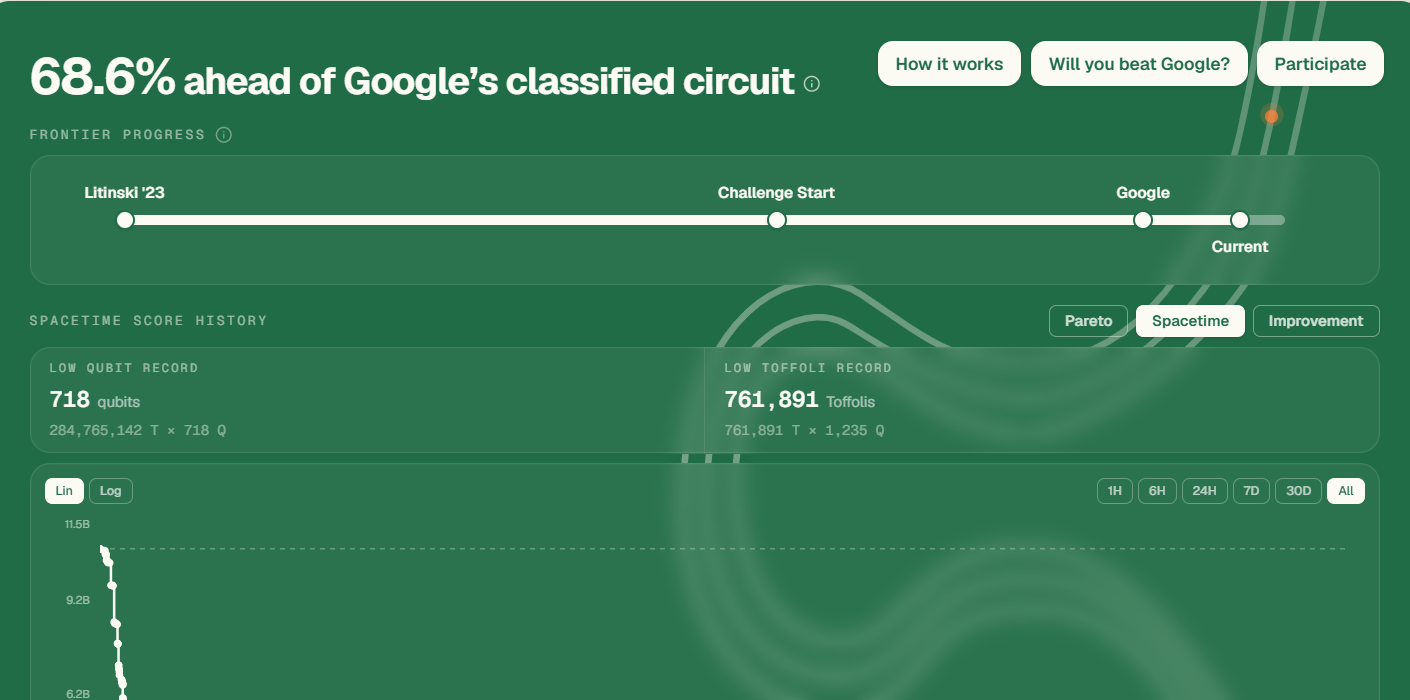
The empirical basis for the timeline argument is a competition.
Eigen Labs launched the ECDSA.Fail challenge in late May 2026, inviting participants to design quantum circuits attacking secp256k1, the elliptic curve securing Bitcoin and Ethereum signatures. Scoring multiplied logical qubits by Toffoli gates, so a lower score represents a cheaper attack. More than 100 participants worked the problem using AI agents, and the resulting paper, posted to arXiv in September 2026, carries authors from Theta Labs, MultiVM Labs, Eigen Labs, Trail of Bits, StarkWare and the Ethereum Foundation. The score fell 86%, from a baseline of 10.75 billion to 1.496 billion. The leading design used 1,151 logical qubits and roughly 1.3 million Toffoli gates, and a later submission brought the gate count below one million. That result lands at approximately half of Google Quantum AI's March benchmark, though differing methodologies make a direct comparison unreliable.
The challenge verified that the circuits compute correctly and did not crack a private key, and the scores exclude the hardware costs of mounting a real attack. The researchers' own conclusion was that the timing of Q-Day remains uncertain. What the exercise established is narrower and still significant: a hundred people with AI assistance cut a published resource estimate by 86% in roughly two months, which says the estimates themselves are softer than the field assumed.
The regulatory calendar runs in the same direction. NIST has published post-quantum standards and circulated a draft proposal to deprecate classical public-key algorithms at the 112-bit security level after 2030 and disallow them after 2035, which puts an institutional deadline on migration regardless of when a capable machine appears.
4. Starknet Already Runs Consensus
Starknet operates as a Stage 1 rollup with five permissioned sequencers controlled by StarkWare, running a Tendermint-style consensus that requires three of five votes, with proposers rotating in round-robin order. The network produces blocks through a working consensus protocol today. Converting to a Layer 1 means decentralising and expanding a validator set that exists in permissioned form, which is a different and smaller problem than designing consensus from scratch.
The same classification contains the reasons for caution; Those five sequencers are all controlled by one company. There is no real-time censorship resistance and no forced-inclusion function, so a user whose transactions are refused has no protocol-level remedy. Only two Starknet operators plus a Security Council minority can update canonical state through a permissioned pipeline. The 9-of-12 Security Council can execute instant upgrades in emergencies with no exit window, and L2BEAT notes the project fails the walkaway test, since users cannot exit under malicious operators if the Security Council disappears.
The operational record adds a further caveat. On January 5, 2026, an outage halted block production and reverted roughly eighteen minutes of history. A chain that reverts history while protected by Ethereum's settlement guarantees is in a materially different position from one that does so as a sovereign L1, where there is no underlying layer to anchor the canonical state. Starknet secures approximately $728.9 million in total value on L2BEAT's measure, with about 15.3% of that carrying additional trust assumptions. The proof system uses STARK validity proofs from the Stwo prover, verified on Ethereum through a SHARP verifier shared with other StarkEx and SN Stack chains.
5. What Leaving Ethereum Costs
A rollup borrows the economic security of Ethereum's validator set, which is backed by tens of millions of staked ETH. An independent Layer 1 has to source that security itself, by recruiting validators and persuading them to stake a token with a $781.6 million market capitalisation. The cost of attacking Starknet would shift from the cost of attacking Ethereum to the cost of acquiring enough STRK to compromise a new validator set, and those are not comparable numbers.
Liquidity carries a similar exposure. Assets on Starknet today are bridged from Ethereum and ultimately redeemable against it. A sovereign chain has to hold capital on its own merits, and the DeFi protocols currently deployed would face a decision about whether to follow. The composability loss compounds both. Ethereum's L2 ecosystem is converging on shared standards and interoperability frameworks, and a chain outside that perimeter gives up whatever unified liquidity and cross-chain execution those efforts eventually deliver.
Starknet would be making this trade at a moment when the flow is running the other way. Gnosis Chain has voted to convert itself from an independent Layer 1 into a rollup, retiring roughly 100,000 validators and moving settlement security to Ethereum on the reasoning that treasury-funded staking subsidies are not a durable basis for token value. Starknet is contemplating the reverse journey and would be taking on exactly the costs Gnosis is shedding. Whether that is wrong depends entirely on how much the two-year cryptographic head start is worth, and nobody can price that without knowing when capable quantum hardware arrives.
6. The Rally Against the Economics
STRK trades near $0.09, after gaining 77.7% over seven days and 260.3% over thirty. Market capitalisation stands at $781.6 million on 7.422 billion circulating tokens out of a 10 billion total supply, giving a fully diluted valuation of $1.053 billion. The token sits 97.6% below its all-time high of $4.41, set in February 2024.
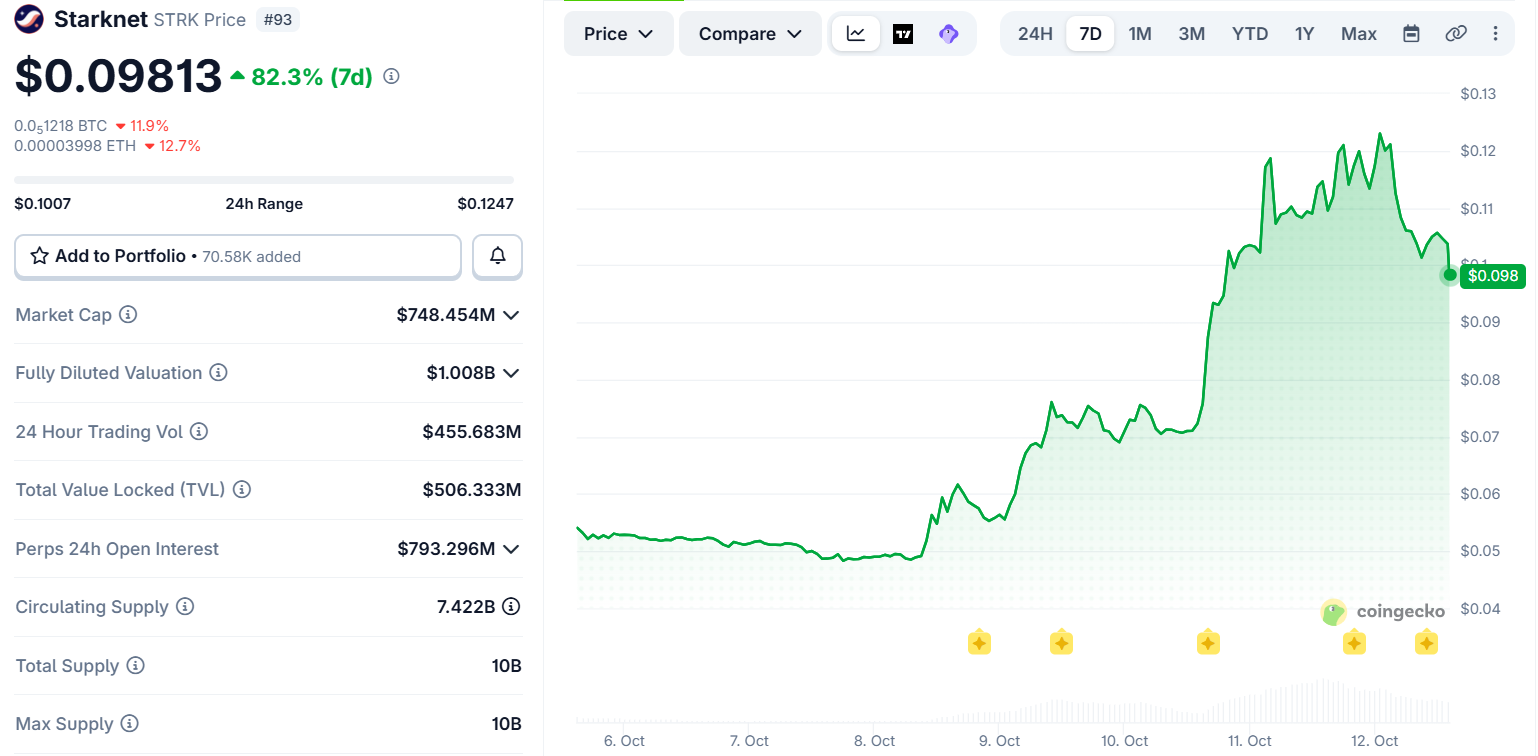
The network economics underneath that are modest. DeFi TVL is approximately $500 million, having risen over the period of the rally. Network fees reached $13,685 on October 8, a seven-day high representing a roughly 190% increase from the week's low, and daily DEX trading ran near $33.7 million. Futures open interest rose more than 50%. A market capitalisation of $748 million against DeFi TVL of $500 million puts the token at several multiples of the capital the network custodies, and fees in five figures on the chain's best day of the month cannot support a billion-dollar fully diluted valuation on any revenue basis. The 190% jump in fees is real activity responding to attention, and it still leaves daily fees in five figures.
The composition of the move points the same way. Open interest rising more than 50% means the rally was substantially levered, and leverage that arrives on an announcement departs on the absence of follow-through. None of this makes the technical argument wrong. It establishes that the market has priced a transition that has not been approved, designed or scheduled, on a network whose current usage would not support the valuation even if the transition completed tomorrow.
7. The 2018 Paper and What It Establishes
Starknet pointed to its founding research to argue that post-quantum security has been in the design since before launch.
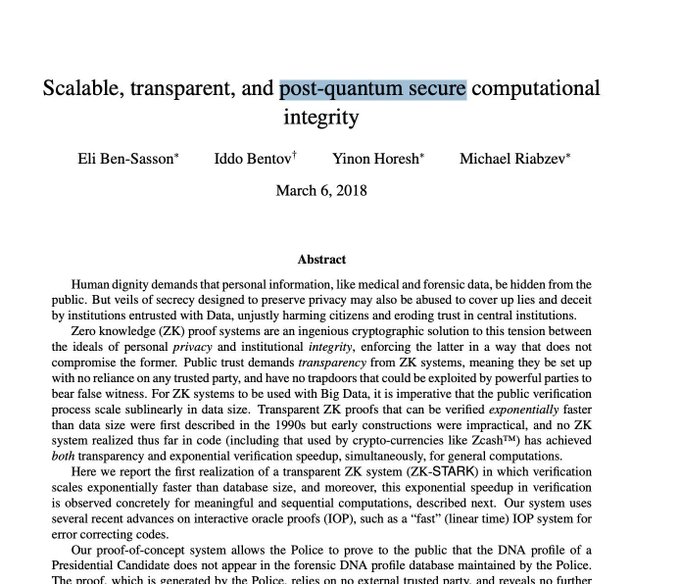
"Scalable, transparent, and post-quantum secure computational integrity," by Eli Ben-Sasson, Iddo Bentov, Yinon Horesh and Michael Riabzev, was received and published on the IACR Cryptology ePrint Archive on January 10, 2018, with its final revision, the fourth and a minor one, dated March 6, 2018. The paper introduced ZK-STARK as the first transparent zero-knowledge system requiring no trusted setup, with verification scaling exponentially faster than database size, demonstrated through a proof that a presidential candidate's DNA profile was absent from a forensic database without revealing either. What the paper establishes is that Starknet's proving system was designed on quantum-resistant foundations from the start. What it does not establish is anything about consensus, validator economics, or whether an independent Layer 1 is the right vehicle for deploying that advantage.
8. What Would Settle It
Four things will determine whether this becomes a transition or stays a talking point. A formal governance proposal with technical specifications comes first. Ben-Sasson described options under consideration, and a published design covering consensus, validator requirements, staking parameters and migration mechanics is a long way from a conference statement. Most proposals of this kind either become concrete at that stage or quietly lapse.
The validator economics are the second. An independent chain needs enough staked value to make attacks uneconomic, and the arithmetic connecting a $781.6 million market capitalisation to credible security on a chain securing hundreds of millions in assets has to be demonstrated, and so far it has only been asserted.
Whether usage follows the price is the third. TVL near $168 million and daily fees in five figures against a billion-dollar fully diluted valuation is the gap that defines the position, and the quantum argument changes nothing about it. A chain that reaches post-quantum security in 2027 with $168 million in TVL has solved a problem for a user base it has not yet attracted.
The quantum timeline itself is the fourth and the one nobody controls. ECDSA.Fail cut a resource estimate by 86% in two months and did not crack a key, and the researchers who produced it said Q-Day's timing remains uncertain. If capable hardware arrives closer to 2030 than to 2040, a two-year head start on migration is worth a great deal and Ben-Sasson's trade looks prescient. If it arrives later, Starknet will have given up Ethereum's security for an advantage that nobody needed yet.
Frequently Asked Questions
What did Starknet announce?
StarkWare CEO Eli Ben-Sasson said at Token2049 on October 8, 2026 that Starknet is seriously considering a transition from an Ethereum Layer 2 to an independent Layer 1, describing it as one of several options under consideration.
Why does Starknet want to leave Ethereum?
Ben-Sasson's argument is about control over cryptographic upgrade timing. He estimates Starknet could reach full quantum resistance by 2027 if it sets its own schedule, against the Ethereum Foundation's end-2029 target for Ethereum. As a Layer 2, Starknet inherits the security of the chain it settles to and cannot move faster than that chain's own migration.
Is Starknet's cryptography already quantum-resistant?
Its proof system is built on hash functions and collision resistance, which resist quantum attack far better than the elliptic curve cryptography securing Bitcoin and Ethereum accounts. Shor's algorithm breaks elliptic curve signatures outright given capable hardware, while hash-based constructions degrade more gradually and can be strengthened by increasing output size.
What is ECDSA.Fail?
An open challenge launched by Eigen Labs in late May 2026, in which more than 100 participants working with AI agents designed quantum circuits to attack secp256k1. The resource score fell 86%, from 10.75 billion to 1.496 billion, with the leading design using 1,151 logical qubits and about 1.3 million Toffoli gates.
Would Starknet have to build consensus from scratch?
No. L2BEAT classifies Starknet as a Stage 1 rollup running five permissioned sequencers controlled by StarkWare under a Tendermint-style consensus requiring three of five votes, with round-robin proposer rotation. The network already produces blocks through a working consensus protocol, so a transition means decentralising and expanding that set. The same classification notes no real-time censorship resistance, no forced-inclusion function, and that the project fails L2BEAT's walkaway test.
What would Starknet give up?
Ethereum's economic security, which is backed by tens of millions of staked ETH. An independent chain must source security from its own validator set staking STRK, against a $781.6 million market capitalisation. It would also give up liquidity that is bridged from and redeemable against Ethereum, and composability with the interoperability frameworks the L2 ecosystem is converging on.
How far has STRK rallied?
STRK trades near $0.09, up 77.7% over seven days and 260.3% over thirty days, down 2.6% on the day. Market capitalisation is $781.6 million on 7.422 billion circulating tokens of a 10 billion total supply, for a $1.053 billion fully diluted valuation. The token remains 97.6% below its all-time high of $4.41 from February 2024.
Do the fundamentals support the move in price?
DeFi TVL is approximately $168 million, up 5% to 7% over the rally, and network fees reached $13,685 on October 8, a seven-day high up roughly 190% from the week's low, with daily DEX volume near $33.7 million. A $781.6 million market capitalisation sits at several multiples of the capital the network custodies, and futures open interest rising more than 50% indicates the move was substantially levered.
Disclaimer: This article is for informational purposes only and does not constitute financial, investment, or trading advice. Digital assets are volatile and you may lose capital. Please evaluate carefully and assume full responsibility for your own decisions.