
MEXC Digest #45: Earned, Not Given


Crypto's strongest Q3 since 2017 ran without cheap money, new laws or token subsidies.


Bitcoin just posted its best third quarter since 2017, and it is still down on the year. Ether had its best third quarter on record. Both did it in a quarter when the 30-year Treasury yield climbed to its highest since 2002, the CLARITY Act died in the Senate, and Ethena switched off the token rewards that once helped its dollar grow to nearly $15 billion.


Rates, legislation and subsidies used to be the reasons crypto went up. This quarter, none of them were. So the question isn't how much the market made. It's who paid for it.


The Main Character: Who Paid for Q3's Rally?

The Quarter That Shouldn't Have Happened

Everything that normally fuels a crypto rally blew the wrong way this quarter. Rates went up: the Fed hiked on September 16, its first increase in three years. The bill crypto spent years lobbying for died in the Senate, 49 to 50. And the year's biggest exchange theft landed in the final week.


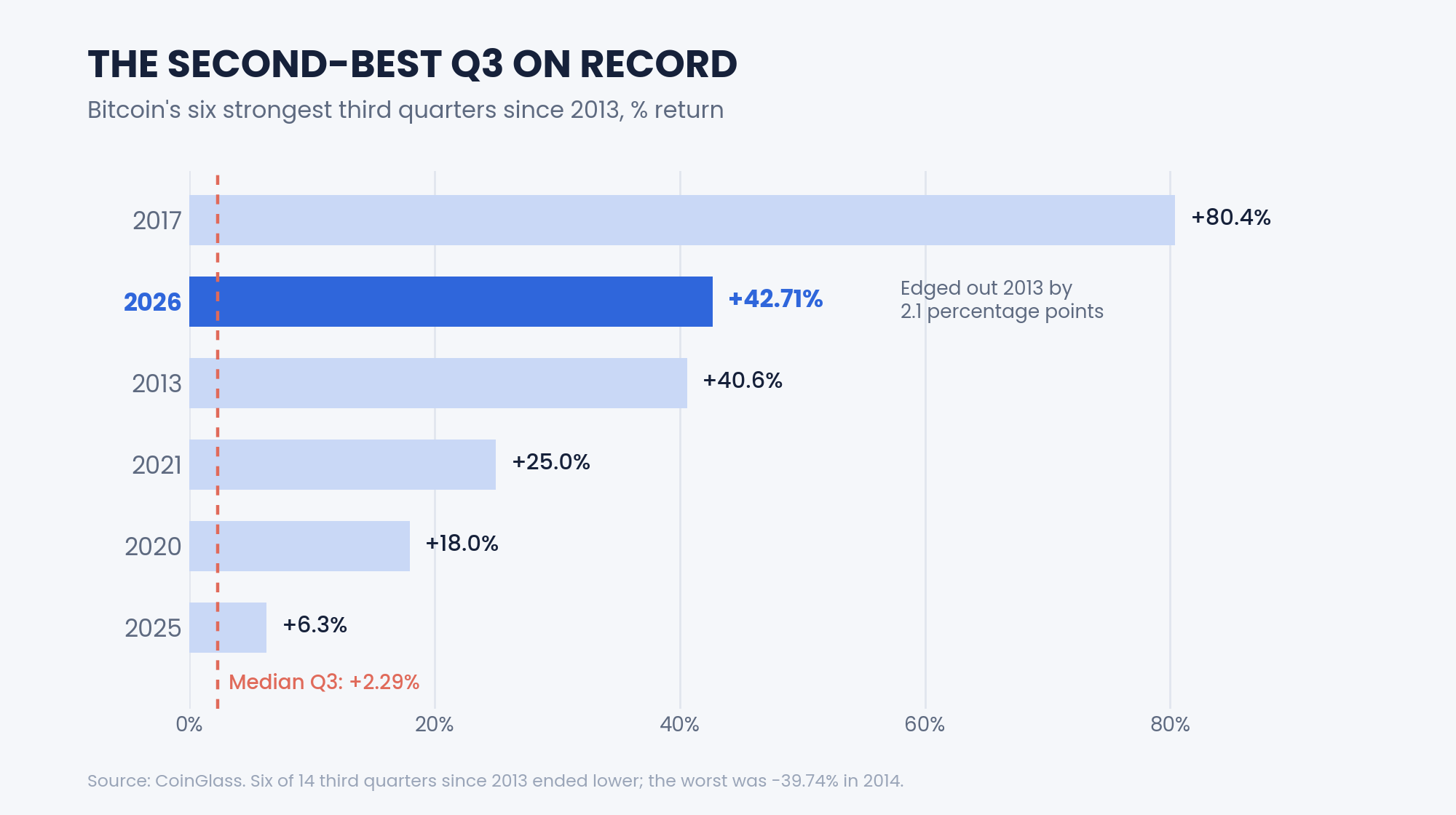
And yet Bitcoin closed Q3 up 42.7%, its strongest third quarter since 2017, according to CoinGlass data. Ether gained about 71%, its best Q3 on record. So if it wasn't cheap money, legislation or hype, what paid for it?


Follow the Money

The quarter wasn't a trend. It was a burst: Bitcoin rose 29.8% between August 19 and September 29, per The Kobeissi Letter. July and early August went nowhere.


As we noted in #40, futures open interest fell to a five-month low during the run while short covering and spot demand did the lifting.


It was real buyers. US spot Bitcoin ETFs took in $2.4 billion in the week to September 25, the biggest week of 2026, and roughly $6.4 billion across the quarter, per SoSoValue.


Even the standout altcoin moved on a real event. ZEC repriced after the SEC closed its review of Grayscale's Zcash trust without enforcement, and the fund converted into an ETF on August 25.


Meanwhile, subsidised demand did the opposite. USDe, Ethena's synthetic dollar, shrank from a $14.82 billion peak last October to about $4.9 billion as token rewards were cut and funding rates cooled. The rewards ended entirely on September 30. The market's verdict? ENA rose about 17% in a day on September 25, when Ethena said where the yield would come from instead. (Disclosure: MEXC Ventures is an investor in the Ethena ecosystem.)


The money that was paid to show up left. The money that wanted to be here arrived.


Good News and Bad News, Same Fact

The good news: unpaid demand is more durable than the rented kind. Nobody has to keep paying to keep it here.


The bad news, part one: it's not broad yet. One stretch of weeks, one ETF surge, and an Altcoin Season Index at 55 on September 30, still short of the 75 that marks a true rotation.


The bad news, part two: the bar just went up. On September 29 the 10-year Treasury hit 5.25% and the 30-year 5.57%, the highest in roughly two decades. When the safe option pays above 5%, anything that pays nothing has to earn its keep.


Then the arithmetic. Bitcoin fell 22.2% in Q1 and 14.1% in Q2, a 33.2% hole that takes nearly 50% to climb out of. Even the strongest third quarter in nine years falls short. And Uptober won't close the gap alone: CoinGlass's 77% average Q4 is carried by 2013 and 2017, while Q4 2018 lost 42% and last year's lost 23%.


What's Paying for Yours

Cheap money, legislative hope and token subsidies are off the table. What's left is demand that arrives without being paid to. Q4 gets graded on whether that grows.


So go through what you hold and ask why the money is there. A rate, a subsidy, a bill that might pass: those reasons expire. Someone genuinely wanting the thing doesn't. Measure your breakeven from where you bought, not from January 1. And know where your yield comes from: Treasury-backed moves with the Fed, basis trades with funding rates, emissions with someone's budget. Only one of those just got cancelled.


A great quarter didn't make the year whole, and cheap money didn't deliver it. The next one has to do it with the bar even higher.


Quick Hits

Security moved upstream. The year's largest exchange loss, roughly $350 million in late September, didn't involve a stolen private key. Attackers compromised the wallet backend, spoofed transaction data, and the signing process approved what it was shown. That's three major incidents in two months without broken cryptography, after Coldcard's firmware flaw and Liquid Network's $320 million drain, most of it later returned. "Not your keys, not your coins" is now incomplete. The question is who decides what the key signs.


Two forces, opposite ways. Soft jobs and confidence data trimmed October hike bets, while Brent ended September near $97, up about 7% on the month.


The rally comes in bursts. ZEC is up roughly 175% this year but fell about 14% in the past week. Private usage moved the same way: after its busiest stretch since 2022, the network averaged about 6,200 transactions involving shielded funds a day in the week to September 28, down from 11,700 the week before. Real demand, just not a straight line.


Q4 won't be graded on how far crypto rises, but on whether the buyers who came without being paid keep coming.


Translation

"Bitcoin Bears Ponder Long Hibernation as ETF Inflows Buoy Price." - Eric Balchunas, senior ETF analyst at Bloomberg Intelligence, September 30, 2026.


The bears had a strong case. The CLARITY Act failed, Treasury yields hit their highest in roughly two decades and sentiment stayed sour. None of it pushed Bitcoin down, because ETF buyers kept showing up anyway. That's the difference between demand that's paid to arrive and demand that isn't: the second kind doesn't wait for good news. Just remember that hibernation is seasonal. Bears always wake up.


New and Noteworthy

Autheo (THEO) opens for trading in the Innovation Zone on October 1 at 13:00 UTC. It pitches itself as a decentralized internet operating system: an EVM-compatible Layer 1 on a Cosmos-based Layer 0, built around quantum-resistant cryptography, with its own identity, cloud and storage layers. Total supply is 7 billion THEO, and withdrawals open October 2.


Ritual (RITUAL) has been live on MEXC Pre-Market since September 30, so you can trade it before it reaches Spot. It describes itself as a blockchain built for autonomous agents, where smart contracts can act on what they see and hear. Total supply is 10 billion RITUAL, and Pre-Market trading is currently fee-free.


[Get Early Access]{https://www.mexc.com/announcements/new-listings}


Before You Go

TOKEN2049 Singapore runs October 7 to 8 at Marina Bay Sands, with side events through October 11 and more than 25,000 attendees expected.


To mark the Autheo listing, the THEO Airdrop+ shares 60,000 USDT among users who deposit and trade, running until October 7 at 13:00 UTC.


And with Real Stocks, Real Friends, you can earn 15 USDT when a friend joins RealStocks, makes at least 100 USDT in net purchases, and holds for three days.


Coin Icon
Sign up now to receive 10,000 USDT in new user rewards

Subscribe to MEXC Digest

Weekly market moves, listings & insights, straight to your inbox.
By subscribing, you agree to receive MEXC newsletters and email updates, and to our Privacy Policy. The content provided is for informational purposes only and does not constitute investment advice.

Join MEXC on Telegram

Get the latest listings, events, and updates in real time, straight from our official Telegram channel.

MEXC Digest #45: Earned, Not Given


Crypto's strongest Q3 since 2017 ran without cheap money, new laws or token subsidies.


Bitcoin just posted its best third quarter since 2017, and it is still down on the year. Ether had its best third quarter on record. Both did it in a quarter when the 30-year Treasury yield climbed to its highest since 2002, the CLARITY Act died in the Senate, and Ethena switched off the token rewards that once helped its dollar grow to nearly $15 billion.


Rates, legislation and subsidies used to be the reasons crypto went up. This quarter, none of them were. So the question isn't how much the market made. It's who paid for it.


The Main Character: Who Paid for Q3's Rally?

The Quarter That Shouldn't Have Happened

Everything that normally fuels a crypto rally blew the wrong way this quarter. Rates went up: the Fed hiked on September 16, its first increase in three years. The bill crypto spent years lobbying for died in the Senate, 49 to 50. And the year's biggest exchange theft landed in the final week.


And yet Bitcoin closed Q3 up 42.7%, its strongest third quarter since 2017, according to CoinGlass data. Ether gained about 71%, its best Q3 on record. So if it wasn't cheap money, legislation or hype, what paid for it?


Follow the Money

The quarter wasn't a trend. It was a burst: Bitcoin rose 29.8% between August 19 and September 29, per The Kobeissi Letter. July and early August went nowhere.


As we noted in #40, futures open interest fell to a five-month low during the run while short covering and spot demand did the lifting.


It was real buyers. US spot Bitcoin ETFs took in $2.4 billion in the week to September 25, the biggest week of 2026, and roughly $6.4 billion across the quarter, per SoSoValue.


Even the standout altcoin moved on a real event. ZEC repriced after the SEC closed its review of Grayscale's Zcash trust without enforcement, and the fund converted into an ETF on August 25.


Meanwhile, subsidised demand did the opposite. USDe, Ethena's synthetic dollar, shrank from a $14.82 billion peak last October to about $4.9 billion as token rewards were cut and funding rates cooled. The rewards ended entirely on September 30. The market's verdict? ENA rose about 17% in a day on September 25, when Ethena said where the yield would come from instead. (Disclosure: MEXC Ventures is an investor in the Ethena ecosystem.)


The money that was paid to show up left. The money that wanted to be here arrived.


Good News and Bad News, Same Fact

The good news: unpaid demand is more durable than the rented kind. Nobody has to keep paying to keep it here.


The bad news, part one: it's not broad yet. One stretch of weeks, one ETF surge, and an Altcoin Season Index at 55 on September 30, still short of the 75 that marks a true rotation.


The bad news, part two: the bar just went up. On September 29 the 10-year Treasury hit 5.25% and the 30-year 5.57%, the highest in roughly two decades. When the safe option pays above 5%, anything that pays nothing has to earn its keep.


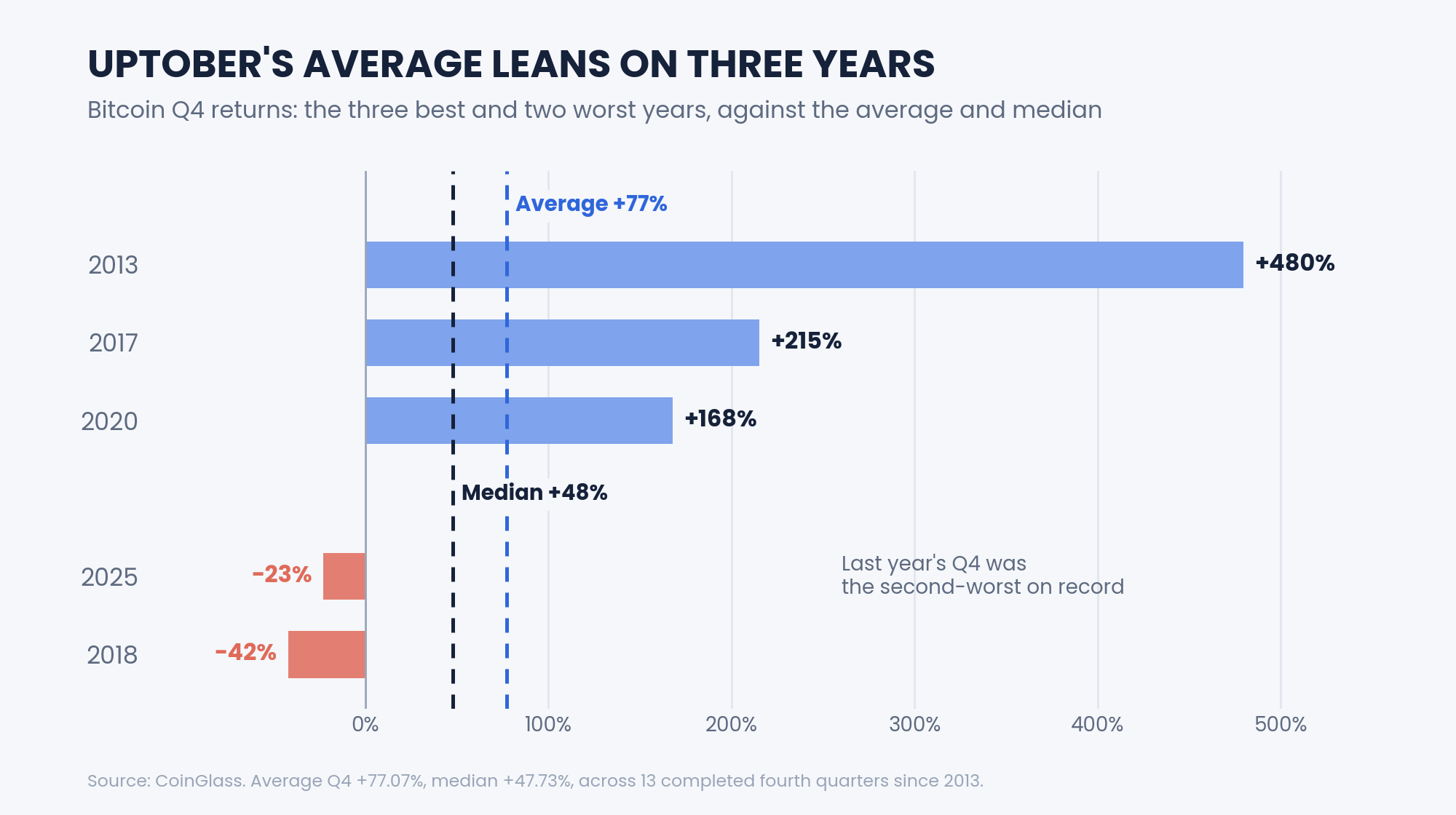
Then the arithmetic. Bitcoin fell 22.2% in Q1 and 14.1% in Q2, a 33.2% hole that takes nearly 50% to climb out of. Even the strongest third quarter in nine years falls short. And Uptober won't close the gap alone: CoinGlass's 77% average Q4 is carried by 2013 and 2017, while Q4 2018 lost 42% and last year's lost 23%.


What's Paying for Yours

Cheap money, legislative hope and token subsidies are off the table. What's left is demand that arrives without being paid to. Q4 gets graded on whether that grows.


So go through what you hold and ask why the money is there. A rate, a subsidy, a bill that might pass: those reasons expire. Someone genuinely wanting the thing doesn't. Measure your breakeven from where you bought, not from January 1. And know where your yield comes from: Treasury-backed moves with the Fed, basis trades with funding rates, emissions with someone's budget. Only one of those just got cancelled.


A great quarter didn't make the year whole, and cheap money didn't deliver it. The next one has to do it with the bar even higher.


Quick Hits

Security moved upstream. The year's largest exchange loss, roughly $350 million in late September, didn't involve a stolen private key. Attackers compromised the wallet backend, spoofed transaction data, and the signing process approved what it was shown. That's three major incidents in two months without broken cryptography, after Coldcard's firmware flaw and Liquid Network's $320 million drain, most of it later returned. "Not your keys, not your coins" is now incomplete. The question is who decides what the key signs.


Two forces, opposite ways. Soft jobs and confidence data trimmed October hike bets, while Brent ended September near $97, up about 7% on the month.


The rally comes in bursts. ZEC is up roughly 175% this year but fell about 14% in the past week. Private usage moved the same way: after its busiest stretch since 2022, the network averaged about 6,200 transactions involving shielded funds a day in the week to September 28, down from 11,700 the week before. Real demand, just not a straight line.


Q4 won't be graded on how far crypto rises, but on whether the buyers who came without being paid keep coming.


Translation

"Bitcoin Bears Ponder Long Hibernation as ETF Inflows Buoy Price." - Eric Balchunas, senior ETF analyst at Bloomberg Intelligence, September 30, 2026.


The bears had a strong case. The CLARITY Act failed, Treasury yields hit their highest in roughly two decades and sentiment stayed sour. None of it pushed Bitcoin down, because ETF buyers kept showing up anyway. That's the difference between demand that's paid to arrive and demand that isn't: the second kind doesn't wait for good news. Just remember that hibernation is seasonal. Bears always wake up.


New and Noteworthy

Autheo (THEO) opens for trading in the Innovation Zone on October 1 at 13:00 UTC. It pitches itself as a decentralized internet operating system: an EVM-compatible Layer 1 on a Cosmos-based Layer 0, built around quantum-resistant cryptography, with its own identity, cloud and storage layers. Total supply is 7 billion THEO, and withdrawals open October 2.


Ritual (RITUAL) has been live on MEXC Pre-Market since September 30, so you can trade it before it reaches Spot. It describes itself as a blockchain built for autonomous agents, where smart contracts can act on what they see and hear. Total supply is 10 billion RITUAL, and Pre-Market trading is currently fee-free.


[Get Early Access]{https://www.mexc.com/announcements/new-listings}


Before You Go

TOKEN2049 Singapore runs October 7 to 8 at Marina Bay Sands, with side events through October 11 and more than 25,000 attendees expected.


To mark the Autheo listing, the THEO Airdrop+ shares 60,000 USDT among users who deposit and trade, running until October 7 at 13:00 UTC.


And with Real Stocks, Real Friends, you can earn 15 USDT when a friend joins RealStocks, makes at least 100 USDT in net purchases, and holds for three days.

Coin Icon
Sign up now to receive 10,000 USDT in new user rewards

Subscribe to MEXC Digest

Weekly market moves, listings & insights, straight to your inbox.
By subscribing, you agree to receive MEXC newsletters and email updates, and to our Privacy Policy. The content provided is for informational purposes only and does not constitute investment advice.

Join MEXC on Telegram

Get the latest listings, events, and updates in real time, straight from our official Telegram channel.
Stay up-to-date on the latest MEXC listings, delistings, trading events, and product updates. Discover new tokens, Launchpad projects, Earn opportunities, AI-powered tools, and futures trading enhancements on the MEXC platform.Stay up-to-date on the latest MEXC listings, delistings, trading events, and product updates. Discover new tokens, Launchpad projects, Earn opportunities, AI-powered tools, and futures trading enhancements on the MEXC platform.